Extended Learning
A. Introduction
Congratulations — you have completed the Game Design merit badge! You have analyzed existing games, tested rule changes, built a prototype, revised it through playtesting, and learned how real people teach and build games. That is real design work. If you enjoyed this badge, there are many ways to keep going, from tabletop design clubs to coding camps to museum exhibits about play and invention.
B. Deep Dive: Why Balance Is Harder Than It Looks
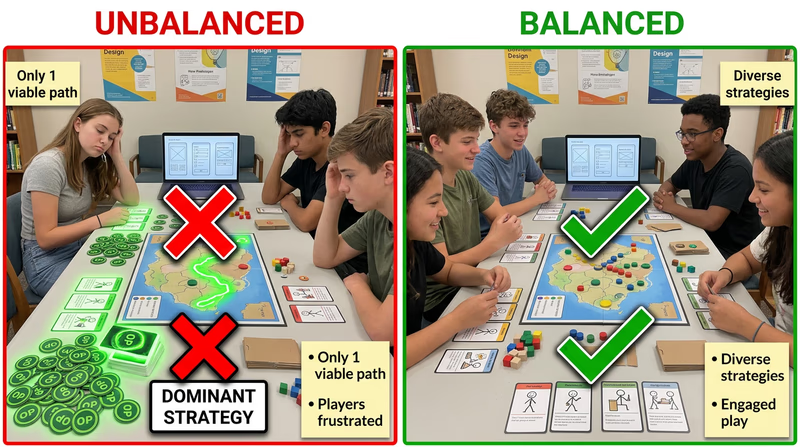
A game feels balanced when players believe their choices matter and no single strategy crushes everything else too easily. That sounds simple, but balance is one of the hardest jobs in design. Even small changes can ripple through the whole system. If one card costs too little, one path scores too quickly, or one player role has too many advantages, the game may still function while feeling unfair.
Designers often learn that perfect balance is not always the goal. In some party games, a little chaos adds humor. In some story-driven games, uneven powers may fit the theme. The real question is whether the game creates the experience it promises. If the game says it is competitive and strategic, players should not feel that luck decides everything. If it says it is cooperative, one dominant player should not end up making every important decision.
A useful balance habit is to test edge cases. Ask what happens if a player repeats the strongest-looking strategy every round. Ask what happens if someone falls behind early. Ask whether beginners and experienced players both have a way to stay engaged. These questions reveal weak spots before players turn them into frustrations.
C. Deep Dive: How Digital and Tabletop Design Borrow From Each Other
People sometimes divide games into “digital” and “non-digital” as if they have nothing in common. In reality, designers in both areas borrow ideas constantly. Tabletop games use progression systems, unlocks, and branching stories that feel video-game inspired. Digital games use card mechanics, drafting, deckbuilding, and turn structures that grew from physical games.
That overlap is useful for you as a learner. Even if you do not know how to code yet, you can still practice the heart of design through paper prototypes. You can explore pacing, objectives, balance, and replay value with simple materials. Later, if you move into digital design, those lessons still matter. The platform changes, but player psychology does not.
This is one reason many professional digital designers still prototype on paper. It is faster to test a system with cards and notes than to spend weeks building a feature in software that turns out not to be fun.
D. Deep Dive: Games That Teach, Train, and Solve Problems
Games are not only for entertainment. They can also teach history, model science systems, build teamwork, and help people practice difficult decisions in safer environments. Teachers use games to make abstract ideas more concrete. Emergency responders use simulations to practice procedures. Scientists and planners use game-like models to explore possible outcomes.
The challenge is that educational games still need real play value. If the game only repeats facts without meaningful decisions, players stop seeing it as a game. The strongest learning games let players test ideas, see results, and try again. That active loop makes the lesson stick.
If you want to keep exploring after this badge, designing a small educational game can be a great next project. Pick a subject you care about and ask what decisions would make that topic come alive for players.
E. Real-World Experiences
Board Game Cafes and Local Game Stores
Game Design Camps and Workshops
Museum Exhibits About Play and Design
Local Game Jams or Student Showcases
F. Organizations
A professional community for people across many game development roles, with chapters, resources, and career information.
Supports games that teach, inspire, and address real-world issues, with student programs and design challenges.
A museum devoted to play, games, toys, and the history of interactive entertainment.
Provides information about the video game industry, the people who work in it, and the impact of games in culture and learning.