Req 1a — Comparing Games
A fast phone game, a sport on a field, a card game at a table, and a story-heavy video game may feel completely different, but they all answer the same basic design questions. Who is playing? What are they trying to do? What rules guide them? What tools or materials do they need?
This requirement asks you to become a game detective. Instead of saying, “I liked it” or “It was boring,” you will learn to explain why a game feels the way it does. That is one of the most important skills a designer can build.
Start with Four Different Media
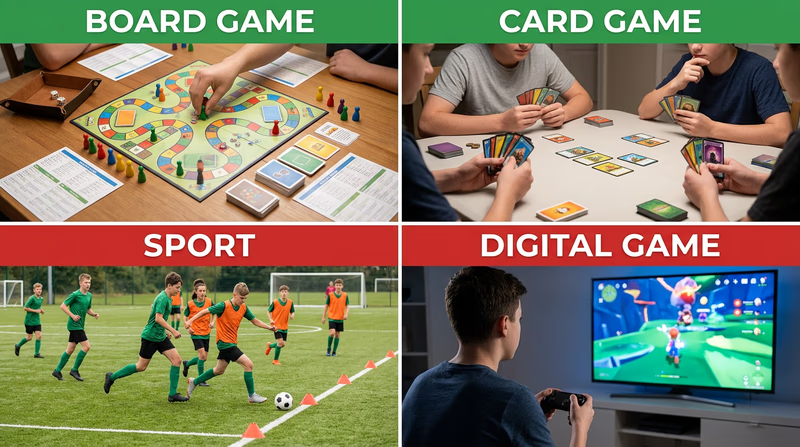
Pick four games that come from clearly different media. For example, you might choose a board game, a card game, a sport or playground game, and a digital game. You could also include a role-playing game, party game, escape-room style game, or trivia game. The goal is variety.
When the media are different, the design tradeoffs become easier to see. A digital game can hide complex calculations from the player. A board game needs physical pieces and printed rules. A sport depends on real bodies moving through real space. A role-playing game may rely more on imagination than equipment.
What to record for each game
Use the same categories every time so your chart is easy to compare
- Medium: Board, card, digital, sports, role-playing, party, or another format.
- Player format: Solo, head-to-head, teams, cooperative group, or large multiplayer.
- Objective: How do players win, score, survive, escape, or finish?
- Rules: What actions are allowed, limited, or required?
- Resources: What pieces, space, devices, cards, tokens, or time does the game need?
- Theme: What setting, story, or mood wraps around the mechanics?
- Play experience: How does it feel while playing — tense, funny, strategic, chaotic, calm?
Medium Changes Everything
The medium shapes what a game can do well. A card game is portable and easy to set up, but it cannot create sound effects or hidden computer logic. A digital game can react instantly and track hundreds of values, but it may require a device, battery life, and interface design that players must learn.
A physical sport has almost no loading time and creates strong face-to-face energy, but it depends on weather, space, and safety rules. A tabletop strategy game may create deep planning with simple materials, but it can also slow down if turns take too long.
When you compare your four games, notice how the medium affects pacing, complexity, and social interaction.
Look Beyond the Surface
Two games can share a theme and still feel very different. For example, two fantasy games may both have dragons and treasure, but one might be mostly about quick reflexes while the other is about long-term planning. That is why you should separate theme from mechanics.
Theme is the story wrapper. Mechanics are the actions and rules that drive play. A racing game might use a space theme, a car theme, or an animal theme, but if players are still choosing when to speed up, block, or conserve resources, the underlying design may be similar.
What You Enjoy — and What You Don’t
This part matters just as much as the chart. Designers need to understand player reactions, including their own. Ask yourself questions like these:
- Do you enjoy having lots of choices, or do you prefer simple rules?
- Do you like games that feel fair and balanced, or games that are wild and unpredictable?
- Do you enjoy direct competition, teamwork, or solo problem-solving?
- Do you like games that tell a story, or games that stay abstract?
- Do you lose interest when a game takes too long, repeats itself, or leaves players waiting?
There is no single correct answer. The point is to connect your feelings to design choices. “I got bored because turns were too slow” is useful. “I liked it because every round forced me to make a tough tradeoff” is even more useful.
Build a Comparison Chart
Your counselor wants to see that you can compare and contrast, not just list facts one game at a time. Make a chart with one row for each game and one column for each category. Once you fill it out, look across the rows.
Which games had the clearest objectives? Which required the most resources? Which one created the strongest emotions? Which one was easiest to teach? Which one had the most replay value?
That last step turns a worksheet into analysis.
Smithsonian Lemelson Center — The Art of Video Game Design A museum resource about the design choices that shape how games work and what players experience.In the next requirement, you will go deeper into a big question every designer asks: why do people play at all?