Req 1b — Why People Play
Some games are exciting because they test skill. Others are fun because they tell a story, make people laugh, or let friends spend time together. Designers call these different kinds of enjoyment play value. If you understand what kind of value a game offers, you are much better at explaining why players come back.
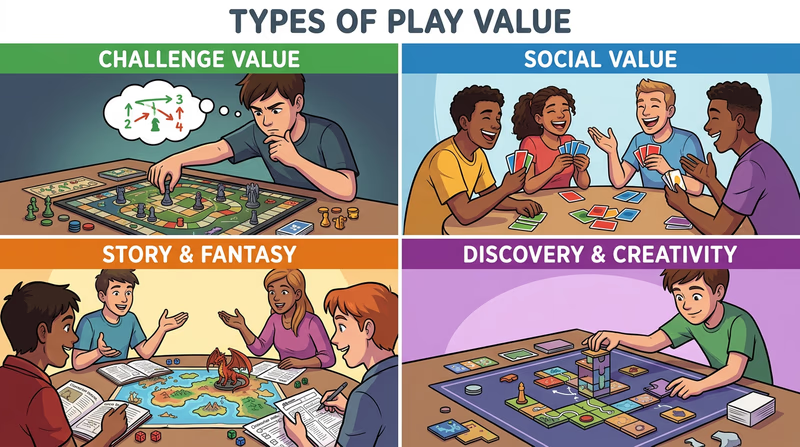
There is no single official list of play values, so the important thing is to describe real categories clearly and connect them to real games. Here are four strong types you can discuss with your counselor.
1. Challenge Value
Challenge value comes from trying to overcome difficulty. Players enjoy the feeling of improvement, mastery, and earned success. Puzzle games, strategy games, platformers, sports, and many action games depend heavily on challenge.
A game built around challenge value usually has clear goals, obstacles, and feedback. If it is too easy, players get bored. If it is too hard, players may quit. Good challenge feels possible but not automatic.
Example: Chess is built heavily around challenge value. The fun comes from planning ahead, reading your opponent, and making better decisions over time.
2. Social Value
Social value comes from interacting with other people. The game may create teamwork, competition, negotiation, bluffing, or shared laughter. In these games, the people at the table are part of the fun.
Party games, cooperative games, sports, and many online multiplayer games rely on social value. Even a simple game can become memorable if it creates strong group moments.
Example: A game like Uno has social value because the table talk, surprise reversals, and reactions from other players are a big part of the experience.
3. Story or Fantasy Value
Some games give players a chance to enter a different world. They might take on a role, explore a setting, or feel like the hero of an adventure. The fun comes from immersion, imagination, and emotional connection.
Role-playing games, adventure games, and many digital games use story or fantasy value. Theme matters a lot here, but it still needs mechanics that support the story instead of getting in the way.
Example: A tabletop role-playing game built around quests and characters offers story value because players are not just solving problems — they are living inside the game world.
4. Discovery or Creativity Value
Some games are fun because players get to experiment, build, explore, or invent. The game rewards curiosity more than victory. This can include sandbox games, world-building games, open-ended design games, or even games where players create their own content.
Example: A sandbox building game offers creativity value because players enjoy making structures, trying ideas, and seeing what is possible, even without a strict win condition.
Other Reasons People Play
Your counselor will probably want more than four labels. Think about the many real-life reasons people choose games:
- to relax after a stressful day
- to spend time with friends or family
- to compete and prove skill
- to explore a world they find interesting
- to laugh and be silly
- to feel progress and achievement
- to practice teamwork
- to learn something new
- to solve problems
- to enjoy surprise and unpredictability
Different players may want different things from the same game. One person may love a game because it is strategic. Another may love it because it creates funny group moments. Great designers know their audience and decide which reasons matter most.
Use Specific Examples
When you explain a play value, do not stop at a game title. Say what part of the design creates that value. For example, if you choose social value, explain whether the game creates it through teamwork, bluffing, communication, or chaos. If you choose challenge value, explain whether the challenge comes from reflexes, planning, memory, or risk.
That level of detail will help later when you design your own game in Req 5a and Req 5b. You will need to decide what kind of fun your own design is trying to create.
Questions to ask about play value
Use these when choosing your examples
- What feeling keeps players engaged? Tension, curiosity, laughter, pride, immersion?
- What mechanic creates that feeling? Turns, teamwork, speed, hidden information, story choices?
- Would the game still be fun if that element disappeared? If not, you probably found its core play value.
- Who is this value for? Competitive players, casual players, creative players, younger kids, families?
In Req 1a, you compared whole games. Next you will zoom in on the language designers use to describe how those games are built.