Req 2 — Core Design Terms
This requirement covers many terms, but they all help answer one question: what kind of experience is this game trying to create?
Because the requirement says to discuss five terms, you do not need to master all 17 at once. Still, it helps to understand the whole list so you can choose strong examples. Below is a quick guide to every term, along with ideas for how to talk about them.
Story, Setting, and Characters
These three terms shape the world around the player.
- Story is what happens. Does the game follow a plot, a mission, or a series of events?
- Setting is where and when the game takes place.
- Characters are the people, creatures, or roles involved.
A fantasy quest game may have a strong story and memorable characters. A pure logic puzzle may have almost none. That does not make one better than the other — it just means the design focus is different.
Play Sequence and Level Design
Play sequence means the order of actions in the game. Who goes first? What happens on a turn? What repeats each round? In a digital game, it can also describe the order of menus, missions, and player actions.
Level design matters most in games with spaces to move through. A level should teach, challenge, and reward the player. The layout itself can create tension, surprise, or learning.
Interface Design
Interface design is how players understand and control the game. In a board game, the interface may be the layout of the board, the player aids, and the symbols on the cards. In a video game, it includes menus, buttons, icons, health bars, maps, and tutorials.
A bad interface can make a good game feel confusing. A clear interface helps players focus on choices instead of wrestling with the controls.
Difficulty, Balance, and Depth
These three terms are often mixed up, so separate them carefully.
- Difficulty is how hard the game is to succeed at.
- Balance is whether options, players, or strategies feel fair compared with one another.
- Depth is how many meaningful decisions the game creates over time.
A game can be easy but deep. It can be hard but unbalanced. It can be balanced but shallow. When you give examples, explain which of those is true and why.
Pace and Replay Value
Pace is the speed and rhythm of the experience. Does the game move quickly with constant action, or does it encourage careful thinking between turns? Pace is not just about time. It is about how the game feels minute to minute.
Replay value is how much players want to come back after one session. Random setups, multiple strategies, changing player groups, unlockable content, and strong social interaction can all increase replay value.
Age Appropriateness
A game should match the age and maturity of its intended players. Younger players may need simpler rules, shorter play time, and gentler themes. Older players may enjoy more complexity or more intense competition.
Age appropriateness is not just about content. It also includes reading level, fine motor skills, frustration level, and how much patience the game expects.
Comparing Player Structures
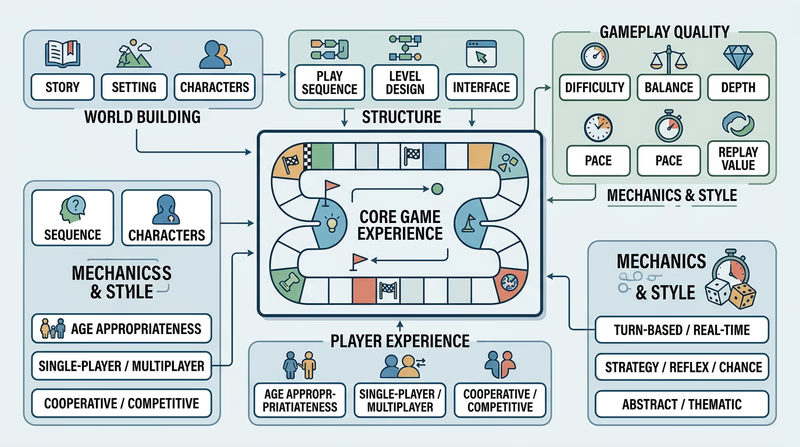
Several terms on this list ask you to compare two design directions:
- Single-player vs. multiplayer: Is the experience built for one person or several?
- Cooperative vs. competitive: Do players work together or against one another?
- Turn-based vs. real-time: Do players act in order, or all at once?
- Strategy vs. reflex vs. chance: Does success come mostly from planning, speed, luck, or a mix?
- Abstract vs. thematic: Does the game focus mostly on pure mechanics, or does it wrap them in a clear story or setting?
These pairs are useful because they show how design choices change behavior. A cooperative game encourages communication. A competitive game may create tension and bluffing. Real-time play creates urgency. Turn-based play often allows deeper planning.
How to Choose Your Five Terms
Pick terms that fit games you know well. It is easier to discuss balance in a game you have played many times than in a game you barely remember. Choose terms that let you say something specific.
For example:
- Use interface design for a game with menus, icons, or player aids.
- Use pace for a game that feels either thrilling or painfully slow.
- Use replay value for a game your group keeps revisiting.
- Use abstract vs. thematic for a game where the theme is either extremely strong or barely there.
A strong counselor discussion answer
What makes an explanation better than a definition
- Name the term clearly.
- Define it in your own words.
- Connect it to a specific game.
- Describe how that term changes the player experience.
- Give an opinion backed by evidence. For example: “I think the pace works because downtime stays short.”
Once you can talk about mechanics and player experience, you are ready for a different side of design: who owns creative work, and how that work is protected.