Req 4c — Observe New Reactions
Now you test your ideas in the real world. This is not about whether your changes are “good” or “bad.” It is about what actually happened when players met the new rules.
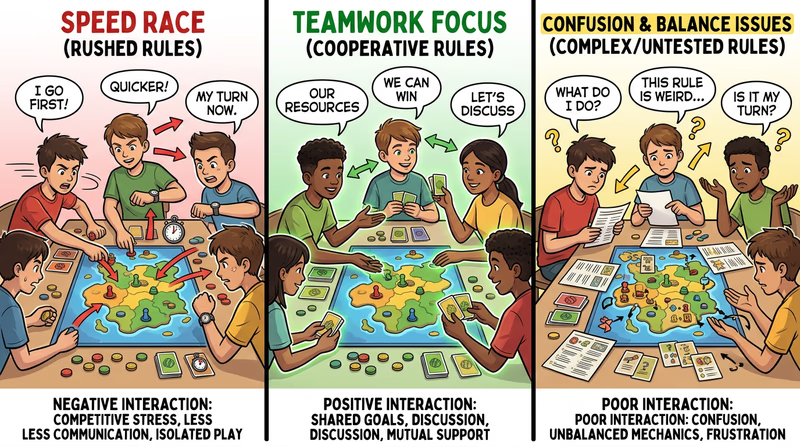
A rule change can affect three things at once: what players do, what they feel, and what kind of game experience the session becomes. Your job is to notice those shifts clearly.
Observe, Don’t Just Participate
If possible, spend part of the session watching instead of playing full-out. Designers often learn the most by noticing hesitation, confusion, excitement, and repeated behavior patterns.
Look for signs like these:
- players using different strategies than before
- players ignoring actions they used to rely on
- faster or slower turns
- more laughter, more frustration, or more tension
- confusion about how the new rule works
- one player or team becoming much stronger or weaker
Repeat the Process Three Times
The requirement asks you to repeat the process with three different changes. That means you need separate notes for each test. Treat them like three mini-experiments, not one giant blur.
A simple format works well:
| Change tested | What players did | How they seemed to feel | Surprise result |
|---|---|---|---|
| New scoring rule | Took more risks | More excited, less patient | Rounds ended faster |
You do not need to guess private thoughts, but you can observe visible reactions: cheering, slowing down, arguing, asking questions, or getting quiet.
What to watch during each test
Focus on evidence, not just opinions
- Actions: Did player decisions change?
- Pace: Did the game speed up or slow down?
- Clarity: Did the change make the rules easier or harder to understand?
- Balance: Did one strategy or player gain too much advantage?
- Emotion: Did players seem more engaged, more stressed, more bored, or more confident?
Player Emotion Is Part of the System
Designers sometimes focus only on mechanics, but emotional experience matters just as much. A rule that creates suspense can be exciting. A rule that creates confusion can feel unfair. A rule that gives struggling players a chance to recover may feel encouraging.
That is why the requirement specifically mentions emotional experiences. The goal of game design is not just to move pieces around. It is to create an experience people remember.
Expect Surprises
Even smart predictions can be wrong. Players are inventive. They may exploit loopholes, ignore the intended strategy, or turn your “fair improvement” into a confusing mess. That is normal. In fact, it is valuable.
Surprises are where design learning happens. If players keep finding a shortcut you did not expect, that may reveal a balance problem. If they smile more under one change even though the score stays close, that may reveal a better emotional tone.
Keep Your Notes Usable
Later, in Req 4d, you will explain how accurate your predictions were. That is hard to do if your notes are vague. Write down specifics like “players stopped passing and took more direct shots” or “the new objective made teammates talk constantly.”
Those details are more convincing than “it was fun.”
International Game Developers Association Resource Library Professional resources and articles about design practice, iteration, and game development workflows.Next, you will step back and compare your predictions with the real results.