Req 4d — Analyze the Results
This requirement turns testing into learning. You are not done when the games are over. A designer has to look back and ask: what actually changed, and what does that teach me about rules?
The best discussion compares three things side by side:
- the original version of the game
- what you predicted for each rule change
- what really happened
That comparison is where design insight lives.
Separate Outcome from Opinion
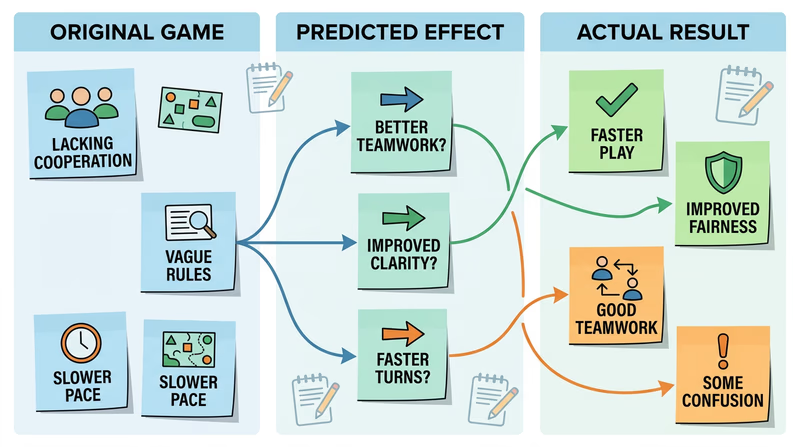
Start with facts. Did the game speed up? Did players cooperate more? Did one team gain a large advantage? Did confusion increase? Once you describe those outcomes, then explain whether that was good, bad, or just interesting.
This matters because a change can “work” in one sense and fail in another. Maybe it made the game faster, just like you predicted, but it also made it less fair. Both observations belong in your analysis.
Were Your Predictions Accurate?
You do not need perfect predictions to succeed here. In fact, a wrong prediction can lead to a great conversation if you explain why it turned out differently.
Maybe you thought a scoring change would encourage creativity, but it actually encouraged safe play. Maybe you expected more teamwork, but players became more competitive. Those surprises show that you are taking the design process seriously.
A strong analysis for each change
Use this structure when talking with your counselor
- Prediction: What did you think would happen?
- Observed action change: What did players actually do differently?
- Observed experience change: How did the game feel different?
- Accuracy: Were you fully right, partly right, or mostly wrong?
- Lesson: What did this teach you about game design?
Look for Patterns Across All Three Tests
Do not treat each rule change as a separate island. Compare them. Did every change that sped up pace also reduce strategy? Did players respond more strongly to objective changes than to scoring changes? Did simple rule changes have bigger effects than expected?
Those patterns can help you later when you build and revise your own game in Req 6bc. In fact, this whole requirement is practice for prototyping.
Why This Matters for Your Own Game
When you design your own game, you will have favorite ideas. Every designer does. But testing teaches humility. Players do not always react the way you expect. That is why strong designers do not fall in love with their first version. They look for evidence.
In Req 5b, you will describe why someone would want to play your game. In Req 6bc, you will have to test whether your design really creates that experience. The habit you build here will help a lot.
Be Honest About What Failed
If one of your changes made the game worse, say so clearly. That does not hurt your work. It strengthens it. Game design is full of ideas that sound smart until real players meet them. Honest notes are more valuable than pretending every change was an improvement.
ESA — How Video Games Are Made Industry resources from the Entertainment Software Association about how game development works, including iteration and collaboration.You have now practiced analyzing and testing existing systems. Next, you will start designing one of your own from scratch.