Req 5a — Vision, Theme, and Players
This is the moment where your own game stops being a vague idea and starts becoming a real design. A good vision statement is short, clear, and focused. It tells you what kind of experience you want to create before you get lost in details.
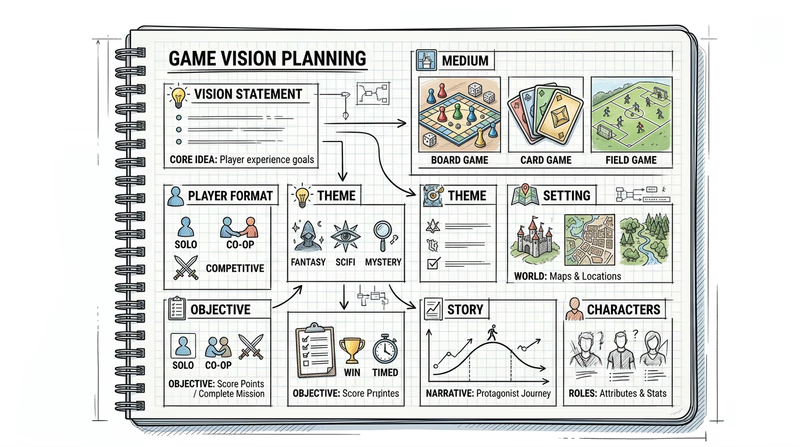
Since the parent requirement says, “Design a new game. Any game medium or combination of mediums is acceptable. Record your work in a game design notebook,” this page covers the first major design decisions you need to make:
- Vision statement — the core idea and experience you want to create
- Medium — where and how the game will be played
- Player format — who plays together, alone, or in teams
- Objective — what players are trying to achieve
- Theme — the mood, world, or concept wrapped around the mechanics
What a Vision Statement Does
A vision statement is not a full rulebook. It is more like a compass. It keeps your project pointed in the right direction.
A useful vision statement usually answers questions like these:
- What kind of game is this?
- Who is it for?
- What should players feel while playing?
- What makes it different from other games?
For example, a strong statement might say that your game is a fast cooperative card game for middle-school players where teammates race to solve a mystery before time runs out. That gives you direction right away.
Choose a Medium You Can Actually Build
You are going to prototype this game later. That means your best idea is not always the biggest idea. A paper card game, simple board game, or playground game may be much easier to prototype and test than a huge open-world video game concept.
Pick a medium that matches your time, tools, and players.
Questions before choosing your medium
Stay ambitious, but stay buildable
- Can I make a playable prototype with what I have now?
- Can I test it with real players soon?
- Does this medium support the feeling I want?
- Can I explain and revise the rules without needing a huge team?
Define the Player Format and Objective
Your player format affects almost every later decision. A solo puzzle game needs different systems than a team sport. A competitive card game needs different balance than a cooperative scavenger hunt.
Your objective should be clear enough that players know what success looks like. Are they trying to score points, escape, survive, build something, reach a location, or solve a mystery? If the objective stays fuzzy, the whole design will wobble.
Theme, Setting, Story, and Characters
Theme answers the question, “What is this game about?” It could be space exploration, wildlife rescue, castle defense, neighborhood racing, camp cooking, or something completely original.
If your game benefits from a setting, story, or characters, add them now in simple form. You do not need a novel. A few strong sentences can do a lot. What matters is that these story elements support the play instead of distracting from it.
Keep the Scope Reasonable
A common beginner mistake is trying to build three games at once: one story game, one strategy game, and one collectible system all packed together. Simpler is better. If players cannot understand the goal quickly, testing will be much harder in Req 6a.
Game Design Notebook Planner MIT Education Arcade — Game Design Thinking An educational project that explores how games are designed for learning, systems thinking, and player engagement.Next, you will answer a critical question: why would someone want to play your game in the first place?