Req 5c — Rules and Resources
A game idea becomes playable when players know what they can do, what they are trying to do, and what tools they need. That is what rules and resources are for.
Since the parent requirement says, “Design a new game. Any game medium or combination of mediums is acceptable. Record your work in a game design notebook,” this page focuses on the structure that turns your concept into something testable:
- rules — the actions, limits, turn order, and win conditions
- resources — the materials, components, space, or information needed to play
Write Rules for Humans
Your rules should be clear enough that another person could try the game without needing to read your mind. Do not worry about making them perfect yet. The requirement says preliminary list, which means this version is allowed to change later.
Still, your early rules should answer the basics:
- How does the game begin?
- What can a player do on a turn or during play?
- What is not allowed?
- How does scoring or progress work?
- How does the game end?
- How do players win?
Define the Core Loop
The core loop is the repeating pattern of play. In many games, that loop is where the fun lives. If the loop is confusing or dull, no amount of cool theme will save the design.
For example, a loop might be:
- draw a card
- choose one action
- resolve the result
- score or update the board
- pass play to the next player
A sports game might use a movement-and-possession loop. A digital puzzle game might use a try-fail-learn-repeat loop. Write your loop in simple order.
Rules that should appear early in your notebook
You can refine the wording later
- Setup: What players need and how to arrange it.
- Turn structure: What happens in what order.
- Actions: What each player is allowed to do.
- Limits: Movement caps, hand limits, time limits, or restrictions.
- Objectives: What counts as success.
- End condition: What makes the game stop.
Define Resources Carefully
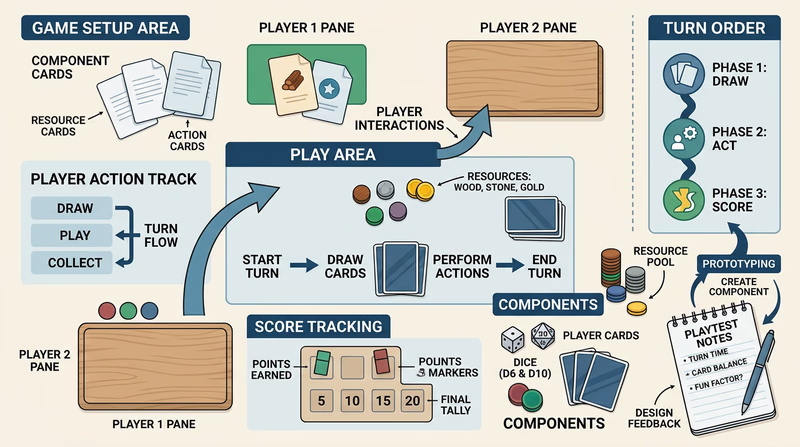
Resources are not just physical pieces. A resource can also be time, space, player attention, hidden information, stamina, or a shared pool of points.
In a board or card game, resources may include cards, dice, tokens, a board, markers, and a score sheet. In a playground game, they may include cones, field boundaries, safety gear, and team assignments. In a digital concept, they might include on-screen energy, inventory, or limited actions.
If a resource is important to decision-making, define it.
Keep It Prototype-Friendly
Since you will build a prototype in Req 6a, avoid writing rules that require materials you cannot produce. Fancy parts are optional. Clear systems matter more.
A strong prototype often begins with index cards, paper tokens, sticky notes, pencil sketches, or simple household objects. Designers use rough materials on purpose because they are easy to change.
Leave Room for Testing
Do not treat your preliminary rule list like a sacred document. It is a starting point. In Req 6bc, you are required to fix unclear rules, close loopholes, and change at least one rule, mechanic, or objective. That means change is not failure. It is part of the assignment.
Game Design Notebook Planner The Strong National Museum of Play — Game Design A major play and game museum with resources and examples that show how rules, components, and player interaction shape games.Once the rules exist on paper, the next step is making the components visible through sketches and drawings.