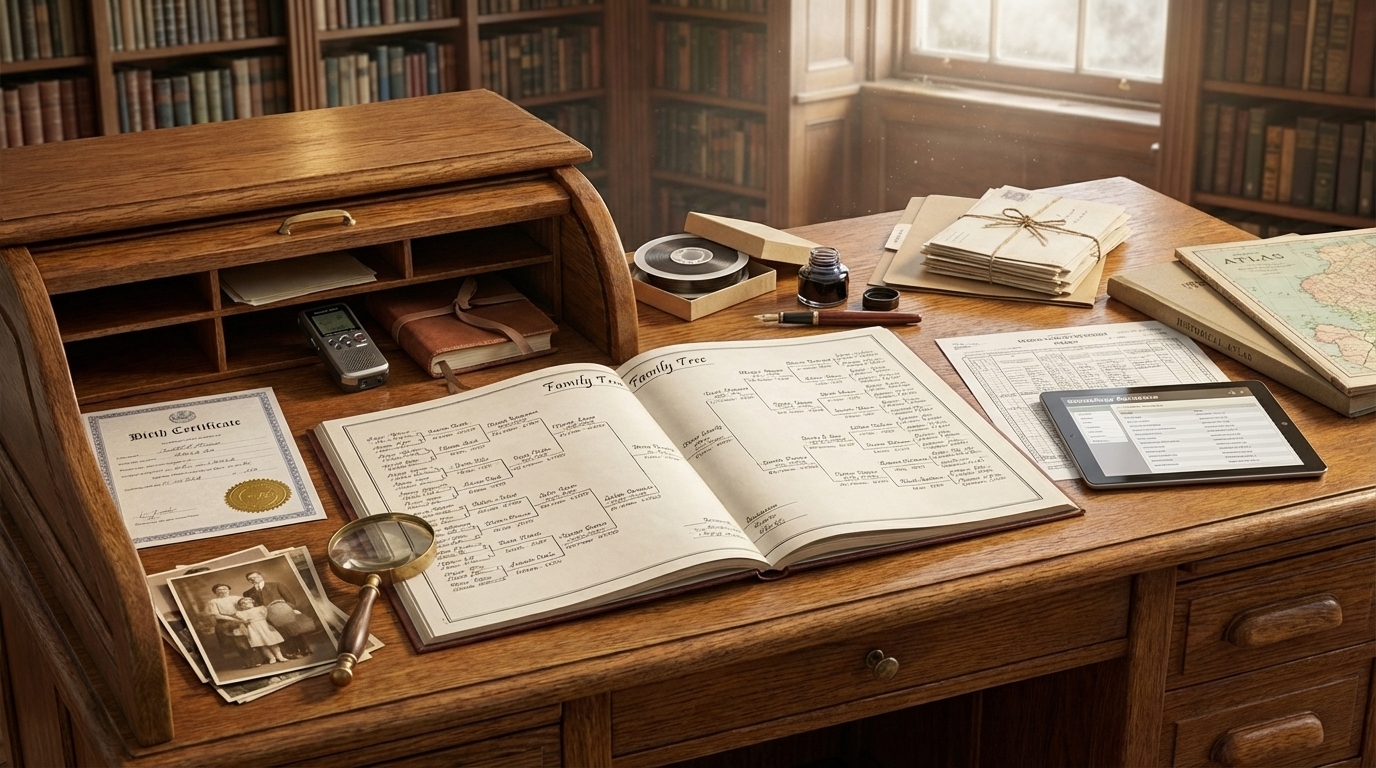
 Getting Started
Introduction & Overview
A name on an old photograph can be the start of a mystery. Who was this person? Where did they live? What choices did they make that helped shape your family today? Genealogy is the study of family history, and it turns small clues like dates, records, stories, and letters into a bigger picture of where you come from.
The Genealogy merit badge helps you become a careful researcher and a good listener. You will learn how to organize information, ask smart questions, and treat family stories with respect. Along the way, you may discover surprising connections, forgotten details, and a deeper understanding of your own place in history.
Then and Now
Then — Family Memory at the Kitchen Table
For most of history, families kept their history by talking about it. Grandparents told stories. Names were written inside Bibles. Important dates were copied into notebooks, letters, or church records. If a family moved, went to war, or lost papers in a fire or flood, some of that history could disappear.
Early genealogists spent long hours visiting courthouses, churches, cemeteries, and libraries. They copied records by hand and mailed letters to relatives they had never met. Building a family tree often took years because every clue had to be found in person.
- Main tools: Family Bibles, letters, courthouse books, cemetery visits
- Main challenge: Information was scattered and slow to collect
- Main skill: Patience and careful note-taking
Now — Digital Clues and Global Connections
Today, genealogy still depends on careful research, but the tools are very different. Millions of records have been scanned and indexed online. Libraries, archives, and family history groups share collections on websites. Video calls, email, and online family tree software make it easier to connect with relatives and compare research.
Modern genealogy is faster, but it still requires the same good habits as old-school research. You need to compare sources, check dates, protect private information, and make sure one exciting clue really belongs to your family before you add it to your chart.
- Main tools: Online databases, scanned records, digital photos, genealogy software
- Main opportunity: You can search across many places from home
- Main skill: Evaluating sources instead of trusting the first result you find
Get Ready! You do not need to be an expert to start tracing your family history. You just need curiosity, respect for the people you are researching, and a willingness to follow clues one step at a time.
Kinds of Genealogy
Genealogy is broader than just drawing a family tree. Here are several parts of the subject you will explore in this badge.
Oral History
Oral history means learning from people’s memories. A grandparent’s story about moving to a new town, a cousin’s memory of a family reunion, or a neighbor’s recollection of serving in the military can point you toward names, dates, and events you would never find on your own. Oral history is often the best place to start because it gives context to the records you search for later.
Documentary Research
This is the part many people picture first. Documentary research uses records such as birth certificates, marriage licenses, census forms, obituaries, school yearbooks, land records, and church registers. These records can confirm dates, relationships, and places. In this badge, you will learn how to use both physical and digital versions of these sources.
Family Tree Building
A family tree, sometimes called a pedigree chart, is the visual map of how people in your family connect across generations. It helps you spot missing information, keep names organized, and see patterns such as where relatives lived or how families moved over time. A chart is not the whole story, but it is the framework that holds your research together.
Record Organization
Genealogy creates a lot of information quickly. You may gather interviews, photographs, forms, dates, and copies of records from several branches of a family. Good organization matters just as much as finding information. That is why genealogists use tools like family group records, research logs, labeled folders, and source notes.
Genetic Genealogy
Some genealogists also use DNA testing to study family connections. This badge does not require DNA analysis, but it is part of the modern genealogy world. DNA can suggest biological relationships and migration patterns, but it should be handled carefully because it raises privacy questions and can reveal unexpected information.
Now you have a sense of what genealogy is and why it matters. The next page introduces the basic language and tools that every family historian needs.