Req 1 — Genealogy Basics
This requirement introduces three basic ideas that every genealogist uses:
- Genealogy, ancestor, and descendant — the key vocabulary of family history
- Family trees — the charts that show how relatives connect across generations
- Family group records — the forms that organize details about one family unit
If you can explain these three ideas clearly, you will be ready for almost every other page in this guide.
Requirement 1a: Core Vocabulary
Genealogy is the study of family history and family relationships. A genealogist gathers information about people, checks whether that information is reliable, and organizes it so others can understand it. In simple terms, genealogy is detective work about your family.
An ancestor is a person you come from in an earlier generation. Your parents are your ancestors. Your grandparents, great-grandparents, and earlier family members are your ancestors too.
A descendant is the opposite. A descendant is a person who comes after someone in the family line. You are a descendant of your grandparents and great-grandparents. Your children and grandchildren, if you have them someday, would be your descendants.
A good way to remember the difference is this: ancestors are the people above you on a family tree, and descendants are the people below.
When you explain these words to your counselor, do not just memorize dictionary definitions. Try using real examples from your own family. For example, you might say that one of your great-grandparents is an ancestor, and you are that person’s descendant. Showing that you can apply the words matters more than repeating them perfectly.
Requirement 1b: What a Family Tree Shows
A family tree is a chart that shows how people in a family are related. It usually begins with one person and then connects parents, grandparents, and earlier generations through lines or boxes. Some trees are small and simple. Others spread across many pages and include many branches.
The main job of a family tree is to show relationships clearly. It helps you answer questions like these: Who were this person’s parents? Which grandparents belong to this branch? How are two cousins connected? A chart can also help you notice missing information, like a birth date you still need or a place you have not confirmed yet.
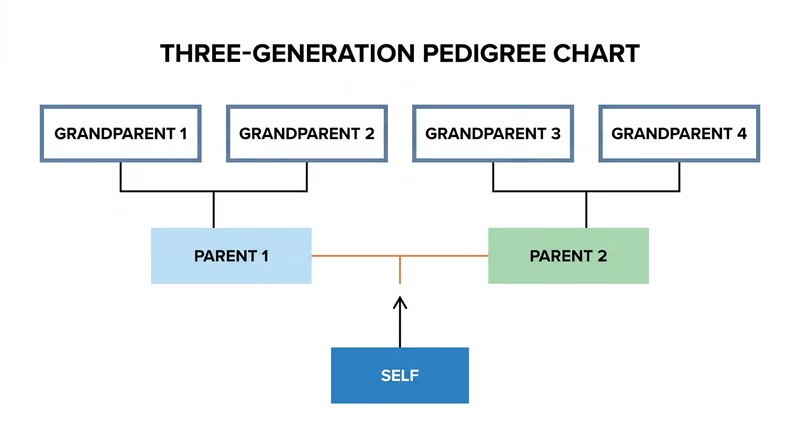
A family tree often includes:
- Full names
- Birth dates and birthplaces
- Marriage dates and places
- Death dates and burial places
- Connections between parents and children
Some family trees also include occupations, immigration information, military service, photographs, or short notes. That extra information can make the chart more meaningful, but the most important part is still the relationship structure.
When you build a tree, accuracy matters. Two people can have the same name but be completely different individuals. Dates and locations help you tell them apart. That is why genealogists do not rely on one clue alone.
Requirement 1c: What a Family Group Record Does
A family group record, sometimes called a family group sheet, is more detailed than a family tree. Instead of showing many generations at once, it focuses on one family unit: usually the parents and their children. Think of it as a close-up view instead of a wide map.
A family group record often includes:
- Parents’ full names
- Their birth, marriage, and death information
- The names of their children
- Birth, marriage, and death information for each child
- Places connected to those events
- Notes about records or sources
This form is useful because it gathers related facts in one place. If a family had six children who lived in different states as adults, the family group record helps you keep them connected. It also helps you see gaps. Maybe you know where the parents married, but you do not know where one child was born. That missing spot shows you where to research next.
In Req 6, you will build a pedigree chart, and in Req 7, you will make family group records. Understanding the difference now will make those pages much easier.
Be Ready to Explain These Basics
Use this as a quick review before meeting with your counselor
- Genealogy: The study of family history and relationships.
- Ancestor: A person from an earlier generation that you come from.
- Descendant: A person in a later generation who comes from an earlier ancestor.
- Family tree: A chart that shows relationships across generations.
- Family group record: A detailed form for one family unit, usually parents and children.
You now know the basic language and tools of genealogy. Next, you will choose one way to start preserving a personal story from your own life or the life of a relative.