Req 7 — Family Group Records
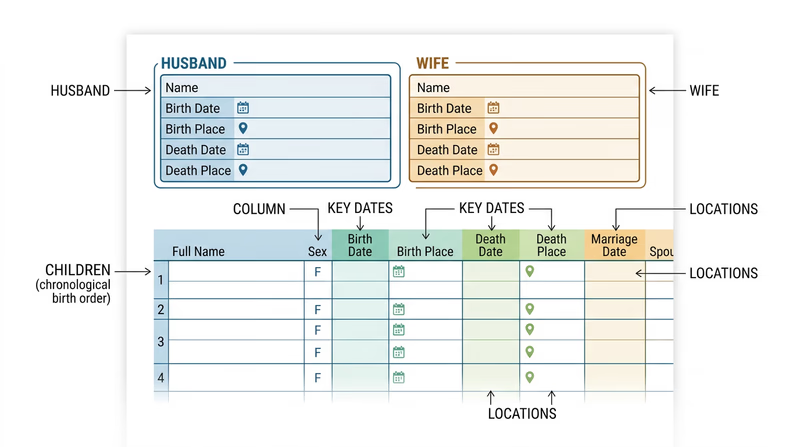
A pedigree chart gives you the big picture. A family group record zooms in. Instead of showing many generations at once, it focuses on one household or family unit and captures more detail about parents and children.
For this requirement, you will complete two family group records:
- One with you and your siblings listed as the children
- One with one of your parents and that parent’s siblings listed as the children
This requirement helps you organize families sideways as well as upward. That matters because siblings, not just direct ancestors, often provide the clues that break through research problems.
Why Family Group Records Matter
Suppose two men named James Carter live in the same county. A pedigree chart alone may not tell you which one belongs to your family line. But a family group record that includes spouse, children, dates, and places can help you separate them.
That is why genealogists use both charts and family group records. The chart shows the framework. The group record captures the details inside one branch.
What Goes on a Family Group Record?
A family group record usually includes:
- Full names of the parents
- Birth, marriage, and death information for the parents
- Names of the children
- Birth and death information for each child
- Places connected to those events
- Notes or source information
For this requirement, focus on making the relationships and core facts clear. If you do not know every date, write in what you can support and leave room to add more later.
Why Siblings Matter in Genealogy
Beginning genealogists sometimes pay attention only to direct ancestors. But siblings are often the key to understanding a family. One child’s obituary may name parents more clearly. One sibling may have stayed in the hometown while another moved away. One brother’s military paper may confirm the family address.
By creating a group record for siblings, you begin to see family history as a network instead of a straight line.
Strong Family Group Records
Use these habits while you fill out each form
- Keep the family unit clear: One set of parents and their children on each form.
- List siblings carefully: Birth order can matter.
- Include places as well as dates: Location often helps prove identity.
- Track missing facts: Empty spaces show where you need more research.
- Use evidence, not assumptions: Confirm names and relationships whenever possible.
Learn from the Comparison
The most useful part of this requirement may be comparing the two forms. Your own generation may be easy to fill out because you know the people directly. Your parent’s generation may reveal gaps, new relatives, or questions you had not thought about.
That is normal. In genealogy, every finished form also becomes a map of what to research next.
In Req 6, you built a pedigree chart. Together, these two requirements form the core record-keeping tools of the badge.
FamilySearch — Genealogy Forms Examples of common genealogy forms and explanations of how family group records help organize research.You now know how family group records capture the detail that broad family trees cannot. Next, you will explore how technology has reshaped genealogy itself.