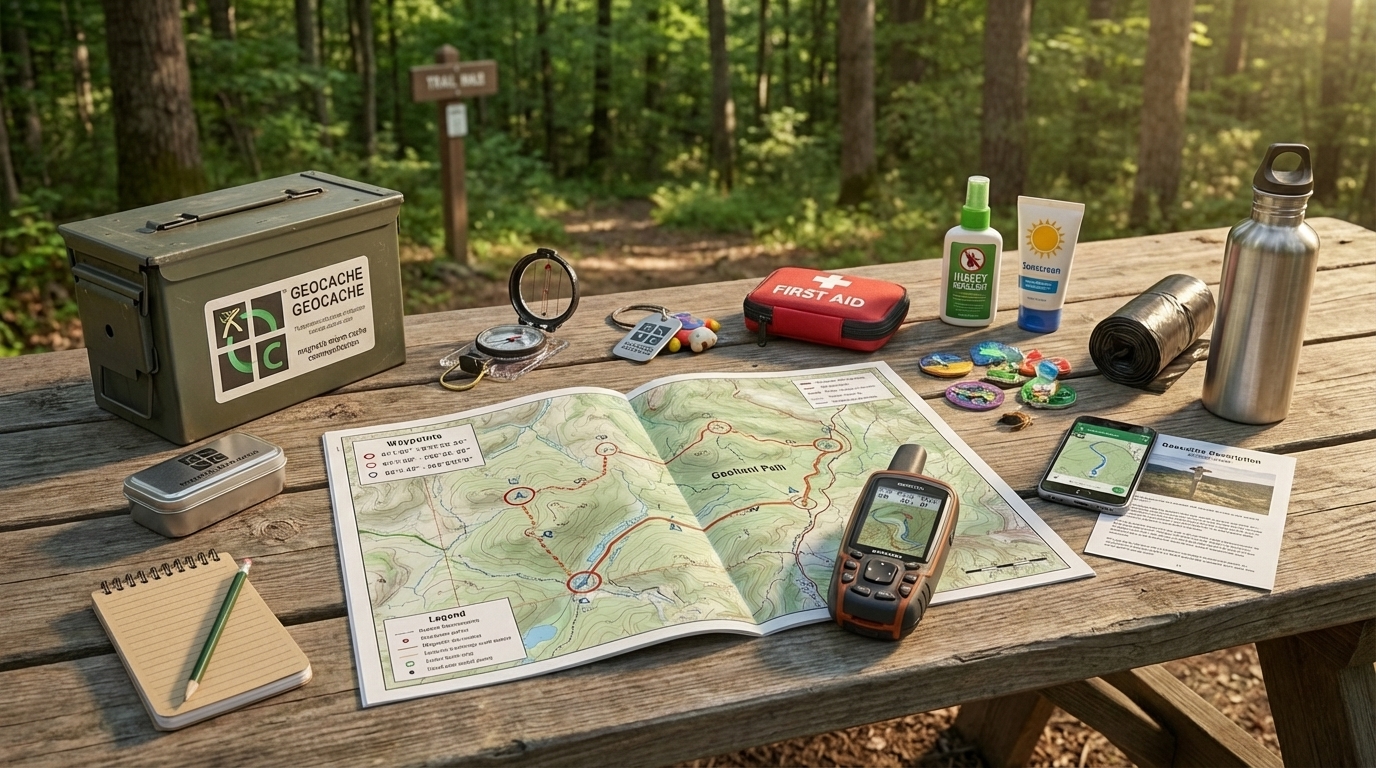
 Getting Started
Introduction & Overview
A waterproof box tucked under a park bench does not look like much until your GPS arrow points straight at it and you realize you just found something hidden by another adventurer. Geocaching turns hiking, map reading, and problem-solving into a real-world treasure hunt. It teaches you how to navigate, how to care for the outdoors, and how to be part of a worldwide community built on trust and discovery.
This badge matters because geocaching mixes outdoor skills with modern technology. You will use GPS, maps, and careful observation, but you will also learn good judgment. A great geocacher does not just find containers — they protect places, follow rules, and leave every site better than they found it.
Then and Now
Then — Navigation Before Satellites
Long before anyone hid a plastic box with a logbook inside, people still needed to find their way. Scouts learned to use maps, compasses, landmarks, and pace counting. Sailors crossed oceans by studying stars. Explorers followed rivers, ridgelines, and hand-drawn maps. The challenge was always the same: know where you are, know where you are going, and get there safely.
- Main tools: Paper maps, compasses, landmarks, and observation
- Main goal: Travel accurately without getting lost
- Main lesson: Good navigation depends on preparation, not luck
Now — A Global Treasure Hunt
Geocaching began in 2000, soon after the U.S. government improved civilian GPS accuracy. Almost immediately, people started hiding containers and posting their coordinates online so others could find them. What started as a fun experiment grew into a worldwide activity with millions of geocaches and a huge online community.
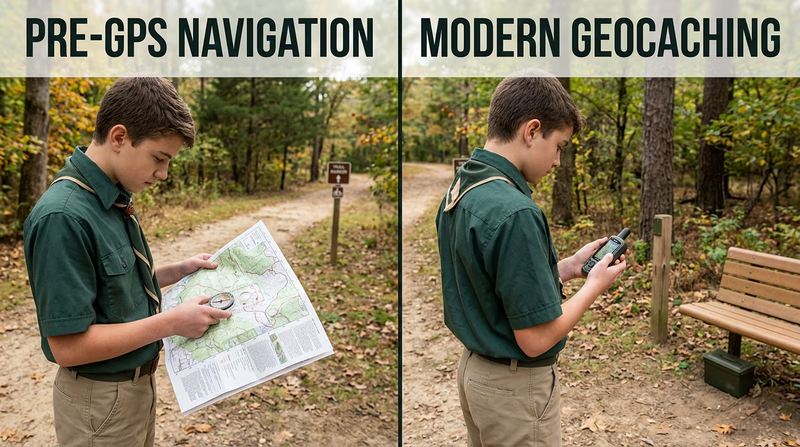
Today, geocachers use phones or GPS receivers to search for hidden caches in city parks, forests, trails, historic districts, and public spaces. The technology is newer, but the best habits are old-fashioned: pay attention, respect the land, and be honest in your logging and stewardship.
- Main tools: GPS receivers, smartphones, apps, and online cache listings
- Main goal: Combine navigation, exploration, and outdoor ethics
- Main lesson: Technology helps, but judgment still matters most
Get Ready! This badge will ask you to think like an explorer and act like a steward. Bring curiosity, patience, and a pencil — and be ready to look twice, because the cache is often hiding in plain sight.
Kinds of Geocaching
Geocaching is not just one kind of activity. Different cache types and different goals make each hunt feel a little different.
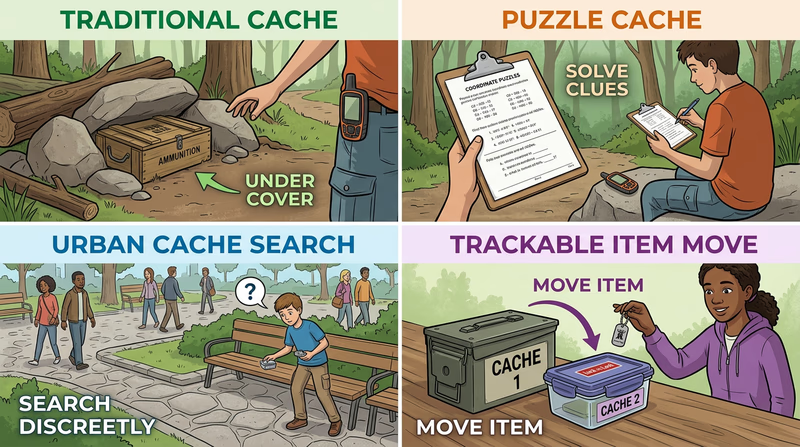
Traditional Geocaching
This is the classic version. You are given coordinates for a hidden container, then you travel to that spot and search carefully. Most Scouts start here because it teaches the basic rhythm of the hobby: navigate, observe, sign the log, and replace the cache exactly as you found it.
Puzzle and Multi-Stage Caches
Some caches require more than walking to one set of coordinates. A puzzle cache may ask you to solve a riddle or decode information before you can begin. A multi-cache sends you to one location first, where you gather a clue that leads to the next location. These caches reward patience and careful thinking as much as navigation skill.
Urban and Trail Caches
Some caches are hidden in busy public spaces where you have to search without drawing attention from people nearby. Geocachers call those bystanders muggles. Other caches are deep on trails where the bigger challenge is terrain, distance, or weather. Both kinds teach different skills.
Trackables and Mission-Based Caching
Some geocaching adventures are about more than one find. A trackable, such as a Travel Bug®, is meant to move from cache to cache while people log its journey online. Programs like Cache to Eagle® and CITO connect geocaching with service, conservation, and Scouting stories. These experiences turn geocaching into something bigger than a hunt — they make it a way to share values and help a community.
Now that you know what geocaching is and how wide the hobby can be, start with the most important part: how to stay safe, prepare well, and look after your team.