Req 5 — Maps, Compass, and Navigation Choices
This requirement covers two connected ideas:
- How to use a map and compass as real navigation tools
- How GPS and traditional navigation help in different ways
If your battery dies, your phone loses signal, or your receiver acts strangely under heavy tree cover, your geocaching trip should not fall apart. Strong geocachers are never trapped by depending on only one method.
Requirement 5a: Why Map and Compass Still Matter
A GPS can tell you where you are standing. A map and compass help you understand the bigger picture: ridges, streams, roads, trails, property boundaries, and safer routes. That wider view is one reason traditional navigation is still important.
What a map does
A map shows the layout of the land. It helps you see distance, terrain, trail connections, and nearby features. When you head toward a cache, a map may reveal that the shortest straight-line path is actually a bad idea because it crosses a creek, steep slope, or private property line.
What a compass does
A compass gives direction. It helps you orient the map, follow a bearing, and keep your sense of direction when everything in the woods starts to look the same. Even a simple compass can stop you from drifting the wrong way.
Why this matters in geocaching
Geocaching is not only about reaching a coordinate. It is about reaching it smartly. A map and compass help you choose the best route, avoid hazards, and get back out again.
Map and Compass Basics
What to be ready to show your counselor
- Orient the map: Turn it so the map matches the land around you.
- Identify key features: Trails, roads, streams, parking, hills, and boundaries.
- Use the compass for direction: Know which way you are traveling and how to stay on course.
- Compare the route: Decide whether the direct path is really the best path.
Requirement 5b: GPS Navigation vs. Map Reading
GPS and map reading are both navigation systems, but they do not think the same way.
Similarities
Both methods help you figure out where you are, where you want to go, and how to travel between those points. Both are more useful when you plan ahead. Both also work better when you understand the terrain instead of blindly following directions.
Differences
GPS is usually faster and more precise for reaching a coordinate. It can guide you directly toward a cache and show distance remaining in real time.
Map reading gives better context. It shows the shape of the land, nearby routes, and bigger patterns that a small device screen may hide. A paper map also does not run out of battery power.
Benefits of GPS
- Fast access to exact coordinates
- Helpful for marking and returning to waypoints
- Easy to track distance and direction changes
- Great for urban caches or direct navigation to a listed spot
Benefits of map and compass
- Gives a wider picture of the area
- Works without batteries or signal
- Helps with route planning and emergency backup
- Encourages strong observation and terrain awareness
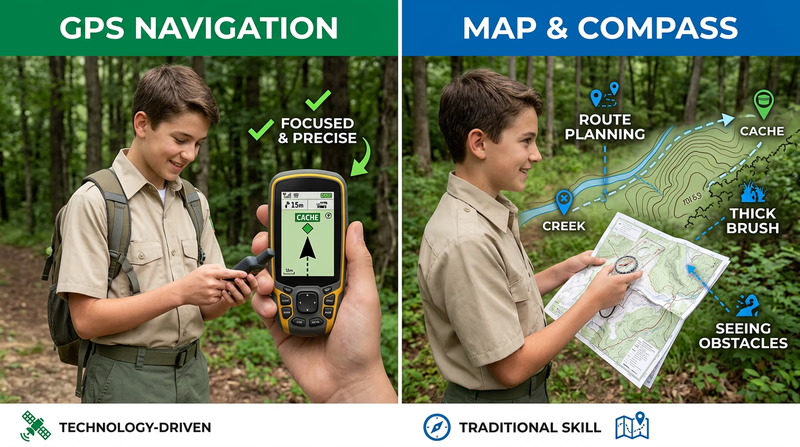
| Skill | GPS navigation | Map and compass |
|---|---|---|
| Best at | Reaching a specific coordinate | Understanding the whole area |
| Weakness | Depends on battery, settings, and signal quality | Slower and requires practice |
| Great use in geocaching | Final approach and saved waypoints | Route planning, backup, and safer travel |
By now you know how to prepare, how to behave ethically, how GPS works, and why map-and-compass skills still matter. That sets you up well for Req 6, where you will describe the basic process of finding your first cache and practice waypoint skills again.