 Getting Started
Introduction & Overview
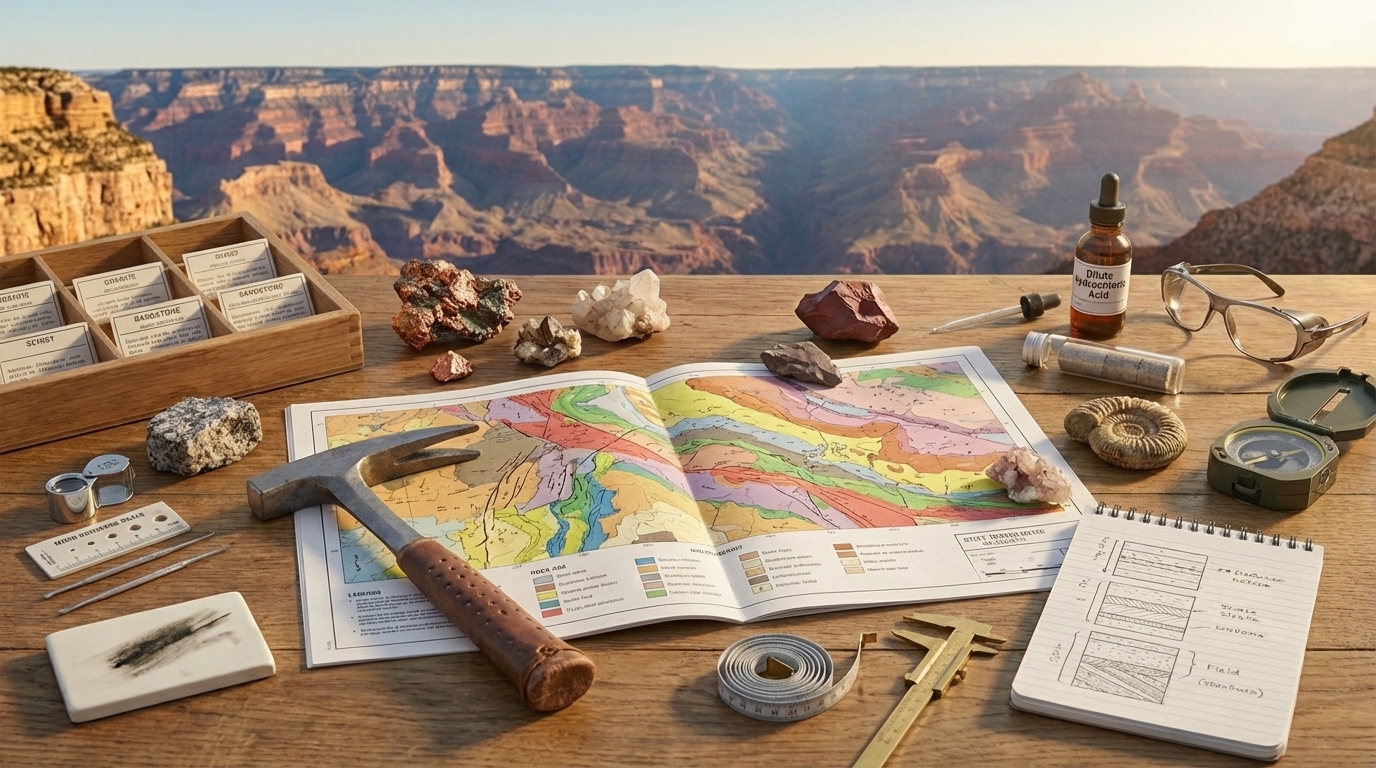
Geology is the story of Earth written in stone. Every canyon wall, road cut, beach, mountain, and fossil bed holds clues about volcanoes, rivers, ancient seas, buried forests, and continents that moved over millions of years. When you study geology, you learn how to read those clues and explain how the world around you formed.
This merit badge matters because geology is not just about rocks in a display case. Geologists help communities find clean water, build safer roads, understand earthquakes and landslides, locate resources, and protect important fossil and mineral sites. If you like solving mysteries outdoors, geology gives you a way to turn curiosity into real investigation.
Then and Now
Then — Reading the Land Without Modern Tools
People have been noticing rock layers and landforms for thousands of years. Miners learned where useful ores were likely to be found. Farmers noticed which soils grew better crops. Builders figured out which stones were strong enough for roads, walls, and foundations. Long before satellites or drilling rigs, observers used streambeds, cliffs, cave walls, and mountain slopes to guess what lay underground.
In the 1700s and 1800s, scientists began comparing rock layers from place to place and realized Earth must be far older than anyone had imagined. Geologists such as James Hutton and Charles Lyell argued that slow processes happening today — erosion, deposition, uplift, and volcanism — could also explain many features from the distant past.
Now — Earth Science with Maps, Labs, and Technology
Modern geologists still use field notebooks and careful observation, but now they also work with aerial photos, GPS, digital maps, microscopes, chemistry labs, seismic tools, and computer models. They can trace faults hidden underground, date ancient rocks, study fossils under magnification, and model how groundwater moves through layers of sand, clay, and bedrock.
The big idea has not changed: clues in the present help explain the past. What has changed is the number of tools available to test ideas and gather evidence. Today geology connects outdoor fieldwork with technology, engineering, climate science, and natural resource management.
Get Ready! You do not need to know every mineral name or memorize a giant chart to begin. Start by noticing patterns: layer on top of layer, rounded pebbles in a stream, a road cut exposing folded rock, or shells preserved in stone far from the ocean. Those patterns are where geology begins.
Kinds of Geology
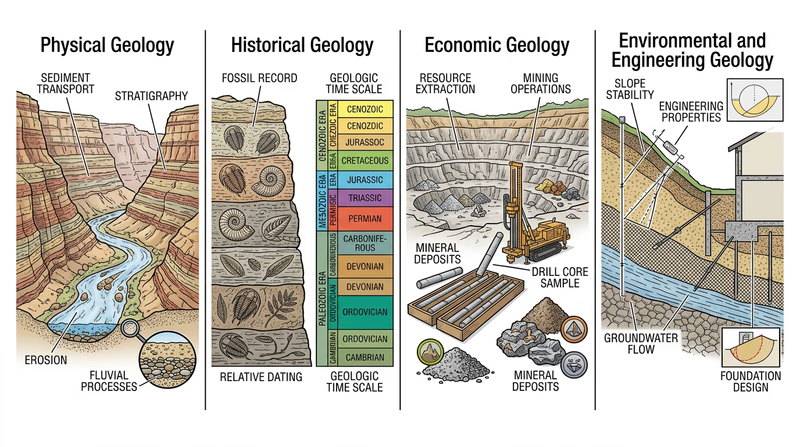
Geology includes several branches, and this badge lets you sample quite a few of them.
Physical Geology
Physical geology focuses on the materials and processes that shape Earth right now. It asks questions like: How do streams carry sediment? Why do mountains rise? What causes earthquakes? How do different kinds of rocks form? If you enjoy landforms, erosion, volcanoes, and plate tectonics, this is your lane.
Historical Geology
Historical geology looks backward through deep time. Geologists use fossils, rock layers, and geologic maps to reconstruct ancient environments. A limestone full of marine fossils might show that your area was once covered by a shallow sea. A layer of volcanic ash can mark a dramatic event in the past.
Economic Geology
Economic geology studies useful Earth materials such as metals, sand, gravel, coal, oil, natural gas, stone, and industrial minerals. This branch matters whenever people build roads, generate electricity, produce concrete, or manufacture products that depend on mined materials.
Environmental and Engineering Geology
Environmental geologists study hazards and resources that affect people directly, such as erosion, sinkholes, contaminated groundwater, and unstable slopes. Engineering geologists help decide whether the ground beneath a building, bridge, or highway is strong and safe enough for construction.
Paleontology and Fossil Studies
Paleontology overlaps with geology because fossils are preserved in rock. Fossils help geologists estimate ages of rock layers, identify ancient environments, and understand how life changed over time. If you like extinct animals, ancient plants, or the mystery of how organisms were preserved, you will see that branch in the Earth History option.
Now that you know what geology covers, you are ready to start with the biggest idea of all: what geology is, how geologists gather evidence, and why the present helps explain the past.