Req 1 — What Geology Explains
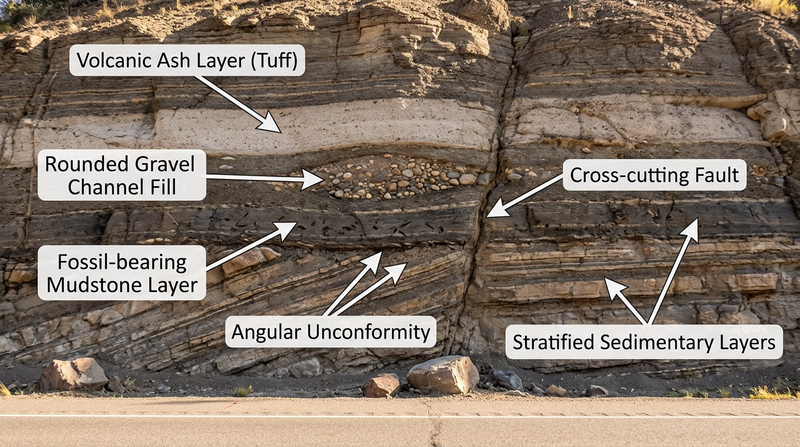
A cliff beside the highway can look like a stack of random colors, but to a geologist it is a timeline. One layer may be mud from an ancient sea. Another may be volcanic ash. Another may show a river channel that cut through older rock and filled with gravel. Geology is the science of Earth materials, Earth processes, and Earth’s history — and geologists learn to read those clues the way a detective reads evidence at a scene.
What Geology Means
At its simplest, geology is the study of the Earth. That includes:
- Materials such as rocks, minerals, sediments, fossils, soil, and groundwater
- Processes such as erosion, deposition, volcanism, mountain building, weathering, and plate movement
- History recorded in layers, structures, and fossils
- Resources and hazards that affect people, such as fuel, building stone, landslides, earthquakes, and erosion
Geology is not only about naming rocks. It is about asking how they formed, what happened to them later, and what they tell us about the place where you found them.
How Geologists Learn About Rock Formations
Geologists combine outdoor observation with lab work and mapping. They rarely trust a single clue by itself. Instead, they build explanations by comparing many kinds of evidence.
Field Observations
The first step is often simply going outside and looking carefully. Geologists examine the color, thickness, grain size, shape, and order of rock layers. They look for cracks, folds, faults, fossils, ripple marks, rounded pebbles, and mineral veins. They sketch what they see, take notes, mark locations, and photograph important details.
Mapping and Measuring
A geologic map shows where different rock units appear at the surface and how old they are thought to be. Geologists also measure the direction a layer tilts, trace faults, and compare one outcrop with another. A single hillside may not tell the whole story, but several outcrops across a larger area can reveal the shape of a buried fold or the path of an old lava flow.
Samples and Lab Work
Sometimes geologists bring back samples to study in more detail. In a lab, they may cut thin slices of rock to examine minerals under a microscope, test chemical composition, or compare fossils inside one rock layer with fossils in another. These clues help confirm how a rock formed and how old it may be.
Drilling and Geophysics
Not all geology is exposed at the surface. To learn what lies below, geologists may study drill cores, well logs, seismic data, or ground-penetrating methods. This matters when searching for groundwater, oil and gas, minerals, or stable ground for building.
What Geologists Look For
Clues that help explain a rock formation
- Layer order: Which beds lie above or below others?
- Rock type: Is the rock sedimentary, igneous, or metamorphic?
- Structures: Are the rocks flat, folded, broken by faults, or cut by an intrusion?
- Textures: Are grains coarse, fine, rounded, sharp, or sorted by size?
- Fossils or features: Do shells, plant remains, ripple marks, or mud cracks reveal the environment?
Why the Present Helps Explain the Past
One of the most important ideas in geology is often summed up as “the present is the key to the past.” Geologists study processes happening now because the same kinds of processes shaped Earth long ago.
If a modern river carries sand, forms point bars, and cuts into its banks, then similar patterns in ancient rock may show where a long-vanished river once flowed. If mud cracks form today when wet sediment dries out, mud cracks preserved in stone suggest an ancient surface that dried in the air. If volcanic ash settles today after an eruption, ash layers in old rock point to eruptions in the past.
This idea does not mean the past was identical to the present. Ancient climates, ocean levels, and life forms were often very different. It means the physical rules of nature stay consistent. Water still flows downhill. Sediment still settles out by size. Heat and pressure still alter rock. That consistency lets geologists test explanations instead of guessing.
A Simple Example
Imagine you find sandstone with ripple marks and mudstone full of dried cracks. A geologist might compare those features with a modern tidal flat, river edge, or shallow lake shore. That comparison does not prove every detail, but it gives a strong, evidence-based starting point. Add fossils, map data, and the position of nearby layers, and the story becomes clearer.
The official videos below give you two strong introductions before you move on. Watch for examples of observation, mapping, and present-day processes that help explain older rocks.
Official Resources
Now that you understand what geology is and how geologists think, you are ready to look at something very practical: the Earth materials people extract and use every day.