Req 2 — Resources From the Ground
Flip a light switch, drive on a highway, hold a phone, or drink from a glass bottle, and you are using geology. This requirement asks you to choose three Earth resources and tell the story of each one from discovery to processing. The best discussions do not try to cover everything on Earth. They follow three good examples in detail.
Good Resource Choices
Pick resources that are easy to explain and clearly important in daily life. Strong choices include:
- Sand and gravel for roads, concrete, and construction
- Iron ore for steel
- Copper for wiring and electronics
- Limestone for cement and crushed stone
- Coal, oil, or natural gas for energy and industry
- Lithium for batteries
- Clay for bricks, tile, and ceramics
Try choosing resources that come from different settings. For example, one metal ore, one construction material, and one fuel resource will give you more variety than picking three similar materials.
What “Discovered and Processed” Means
For each resource, be ready to explain four big steps:
- Where it forms — What geologic setting creates it?
- How it is found — What clues or tools lead geologists to it?
- How it is extracted — Is it mined, quarried, pumped, or dredged?
- How it is processed — What happens before people can use it?
Example 1: Limestone
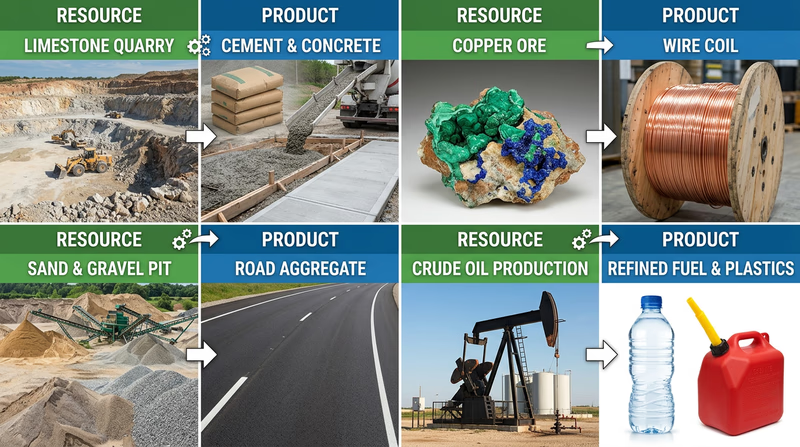
Limestone usually forms in warm, shallow seas where shells, mud, and chemical sediments build up over time. Geologists may find it at the surface in cliffs, quarries, and road cuts or identify it on maps and drill logs. It is often quarried rather than mined underground. Once extracted, it may be crushed for road stone or heated in giant kilns to help make cement.
Example 2: Copper
Copper ore commonly forms when hot fluids move through rock and leave minerals behind. Geologists look for certain rock types, mineral stains, geophysical signals, and drill-core evidence. A copper deposit may be mined in an open pit or underground. The ore is then crushed, concentrated, smelted, and refined until the copper is pure enough for wiring and electronics.
Example 3: Sand and Gravel
Sand and gravel often come from river deposits, glacial deposits, old floodplains, and pits dug into loose sediment. They are usually easy to recognize because the grains and pebbles are visible. Extraction often happens in pits or dredged areas. Processing may include washing, sorting by size, and removing clay or unwanted material before the aggregate is sold.
Build Your Resource Discussion
Questions to answer for each of your three choices
- How did this resource form? Tie it to a real geologic process.
- How do people locate it? Mention maps, surface clues, drilling, or geophysics.
- How is it removed from the ground? Name the extraction method.
- What processing makes it useful? Crushing, washing, refining, smelting, separating, or grading.
- How do people use it? Give everyday examples your counselor will recognize.
Discovery Is Part Geology, Part Problem Solving
Not every useful material is easy to spot. Some deposits are exposed right at the surface. Others are buried under soil, younger rock, or water. Geologists study maps, aerial images, stream sediments, rock chemistry, drill samples, and physical measurements from underground. They compare all of those clues before a company ever starts extraction.
Processing Changes a Raw Material Into a Product
A resource fresh out of the ground is rarely ready for immediate use. Gravel may need washing and sorting. Metal ore may need crushing, chemical separation, or melting. Oil and gas need drilling, separation, transport, and refining. That is why geology connects closely with mining, engineering, chemistry, transportation, and environmental planning.
The official video below is a good starting point because it shows that resource extraction is not one single process. Watch for how the geology of a deposit influences the way people recover it.
Official Resources
Next you will use a different geologist’s tool: the geologic map. It turns landforms, rock types, and structure into a picture you can interpret.