Req 4a1 — Sediment Settling
Shake a jar of muddy water and, for a few seconds, it can look like one uniform mixture. Wait a little longer and the materials start separating. Gravel drops first, then sand, then silt, while the finest clay may stay cloudy for a long time. That simple experiment reveals one of the most important ideas in sedimentary geology: moving water sorts material.
What This Experiment Demonstrates
Suspended sediment does not all settle at the same rate. Larger, denser grains usually fall faster because gravity overcomes water resistance more easily. Smaller grains settle more slowly, and some may remain suspended for a long time if the water is still slightly moving.
That matters because natural water systems sort sediment constantly. Streams, lakes, and deltas create different layers and grain sizes depending on water speed and how long sediment stays in suspension.
A Simple Approved Setup
Your counselor may suggest a jar test, clear cylinder, bottle, or beaker. A common version uses a clear container filled with water and mixed sediment such as gravel, sand, silt, and clay-rich soil.
- Add water and sediment to the container.
- Shake or stir until the sediment is suspended.
- Set the container down and watch what settles first.
- Record what you see after a few seconds, one minute, five minutes, and later if needed.
- Sketch the layers that form.
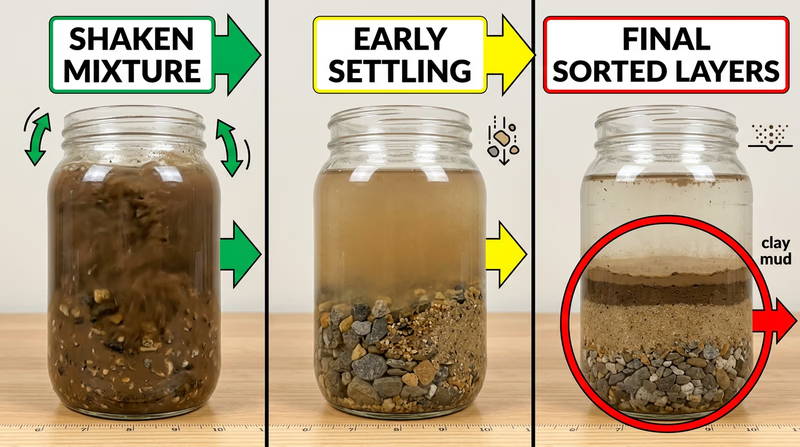
The point is not fancy equipment. The point is careful observation.
What to Record
Useful observations for your notebook
- What materials were in the mixture? Gravel, sand, silt, clay, organic bits?
- Which grains settled first? Note the order.
- How long did the water stay cloudy? That shows how long the smallest particles remained suspended.
- Did distinct layers form? Describe or sketch them.
- What does this suggest about natural water? Connect the jar to streams, ponds, or deltas.
Why It Is Important
This experiment helps explain how sedimentary layers form in nature. Fast-moving water can carry bigger particles. When water slows down, those particles settle out first. That is why a river channel may deposit sand and gravel while a quiet lake bottom collects much finer mud. Over time those deposits can harden into rock.
It also helps explain why geologists pay attention to grain size. A rock made of coarse rounded pebbles tells a different story from a thin layer of fine clay. One suggests stronger current energy. The other suggests calmer water.
Explaining the Results to Your Counselor
A strong explanation might sound like this: “The coarsest grains settled first, and the water stayed cloudy because the finest sediment remained suspended longer. This matters because streams and lakes sort sediment by energy level. The size of the grains in a layer can tell us about how fast the water was moving when that layer formed.”
The official videos below show the same idea in action from a few different angles.
Official Resources
Now that you have seen sediment sorting in a container, the next step is to scale up and compare how different kinds of streams move across real landscapes.