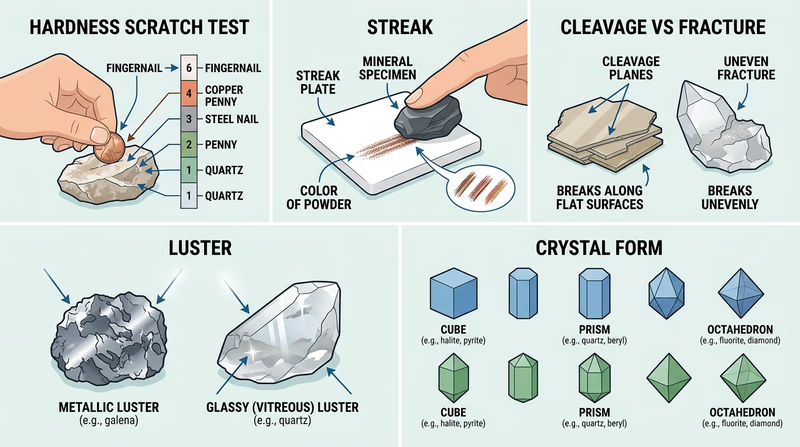
Define mineral. Discuss the origin of minerals and their chemical composition and identification properties, including hardness, specific gravity, color, streak, cleavage, luster, and crystal form.
A mineral is a naturally occurring, inorganic solid with a definite chemical composition and an ordered crystal structure. That sounds technical, but each part matters. Minerals form in nature, are not living, stay solid under ordinary conditions, have chemistry that fits within a specific range, and build their atoms in repeating patterns.
Where Minerals Come From
Minerals form in several ways:
Cooling magma or lava can grow crystals such as quartz, feldspar, and olivine.
Evaporating water can leave minerals such as halite and gypsum behind.
Hot fluids underground can deposit ore minerals in cracks and veins.
Metamorphism can create new minerals as heat and pressure change older rocks.
Mineral Identification Properties
Hardness
Hardness is a mineral’s resistance to scratching. Geologists compare hardness using the Mohs scale, where talc is very soft and diamond is hardest.
Specific Gravity
Specific gravity compares how heavy a mineral feels relative to an equal volume of water. Some minerals feel surprisingly heavy for their size.
Color
Color can be useful, but it is not always reliable because impurities may change it.
Streak
Streak is the color of the mineral’s powdered form when rubbed on an unglazed streak plate. It is often more reliable than surface color.
Cleavage
Cleavage describes the way a mineral breaks along flat planes related to its crystal structure.
Luster
Luster is how light reflects from a mineral surface — metallic, glassy, pearly, dull, and more.
Crystal Form
Crystal form describes the outward shape a mineral tends to grow when it has room. Quartz often forms six-sided prisms, while halite tends to form cubes.
Best Mineral-ID Habit
Do not rely on only one property
Start with luster and hardness.
Check streak if it is safe to test.
Look for cleavage or fracture.
Notice crystal form if visible.
Use several clues together before naming the mineral.
Official Resources
Rocks and Minerals (video)Identifying Rocks and Minerals - Using Physical Properties for Identification (video)
The next page gives you a choice: build a collection of ten specimens or identify fifteen with your counselor’s help.