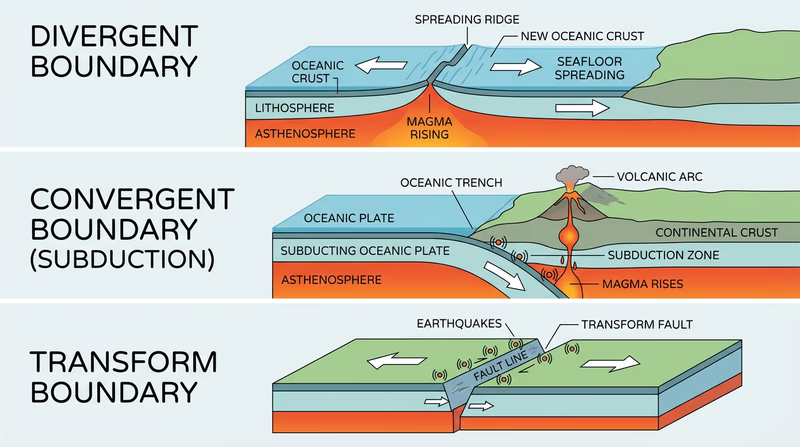
Explain the theory of plate tectonics. Make a chart explaining, or discuss with your counselor, how the processes of plate tectonics work. Discuss how plate tectonics determines the distribution of most of the Earth’s volcanoes, earthquakes, and mountain belts.
Earth’s crust is not one unbroken shell. It is divided into large plates that move slowly over the softer, deeper part of the mantle. That movement is small on a human time scale, but over millions of years it changes oceans, continents, mountain belts, and the locations of many major geologic hazards.
The Basic Idea
Plate tectonics explains that Earth’s outer rigid layer is broken into plates that move relative to one another. Their motion is driven by heat from inside Earth, which causes slow movement in the mantle and helps move the plates.
Plate Boundaries
Divergent Boundaries
At divergent boundaries, plates move apart. Magma rises, cools, and forms new crust. Mid-ocean ridges are the classic example.
Convergent Boundaries
At convergent boundaries, plates move toward each other. One plate may sink beneath another in a subduction zone, creating volcanoes and earthquakes. Or two continental plates may collide and build mountains.
Transform Boundaries
At transform boundaries, plates slide past each other. These boundaries are famous for earthquakes because stress builds and then releases suddenly.
Why Hazards Cluster Where They Do
Most volcanoes, earthquakes, and mountain belts are not scattered randomly. They cluster near plate boundaries because that is where the crust is being created, destroyed, deformed, or sheared.
Volcanoes are common where plates separate or where one plate subducts under another.
Earthquakes are common where plates collide, separate, or slide past.
Mountain belts often form where plates converge and crust is compressed.
How to Explain Plate Tectonics
A simple structure for your chart or counselor talk
What are plates? Rigid pieces of Earth’s outer shell.
Why do they move? Internal Earth heat drives motion.
What happens at each boundary type? Divergent, convergent, transform.
Why do hazards cluster? Plate interaction concentrates stress, melting, and deformation.
Official Resources
How Plate Tectonics Work (video)
The next page shifts from whole plates to individual organisms and asks how fossils get preserved in the first place.