Req 2b1 — Rules, Courtesy & Scoring
Disc golf feels relaxed compared with many organized sports, but it still depends on clear rules. The PDGA rulebook explains how to take throws, mark lies, count strokes, and share a course fairly with other players. Start here because every later disc golf requirement depends on knowing how the game is supposed to work.
The biggest themes on this page are:
- Courtesy: How players protect safety and respect one another.
- Scoring: How strokes are counted and how a hole score becomes a round score.
- Rule awareness: How to use the PDGA rulebook as a reference instead of trying to memorize every line.
Requirement 2b1a
Courtesy in disc golf is more than just being polite. It is a set of habits that keeps people safe, preserves concentration, and helps public courses stay welcome in parks. When your counselor asks about Courtesy under rule 812, be ready to explain it in everyday language, not just repeat rule numbers.
The six areas are easiest to understand like this:
- Do not distract another player: Stay quiet, still, and out of the thrower’s line of sight while they throw.
- Do not throw when people, animals, or park users could be hit: Safety comes before speed.
- Help maintain pace of play: Be ready for your turn, watch where discs land, and move efficiently.
- Take care of the course: Do not damage trees, signs, baskets, benches, or park property.
- Put trash in its place: Leave the course cleaner than you found it.
- Show respect to groups around you: That includes your card, other cards, and people who are not playing at all.
Unlike a private golf course, a disc golf course often shares space with walkers, children, cyclists, dogs, or picnic groups. That makes Courtesy especially important. A player who knows the rules but ignores other park users is still not playing the game the right way.
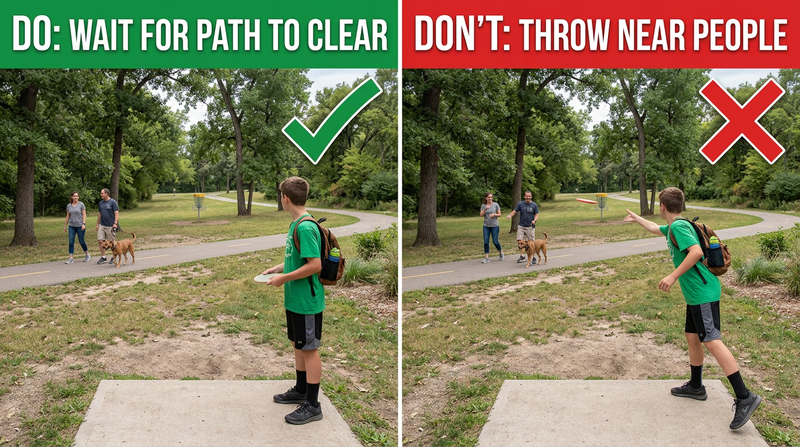
What Courtesy Looks Like
Habits a counselor will notice right away
- You wait until the landing area is clear: No throw is worth risking injury.
- You stay quiet during another player’s throw: Focus is part of fairness.
- You move with purpose: You are not rushing, but you are also not holding up the group.
- You protect the park: No breaking branches or stomping through plants just to reach a disc.
- You clean up after yourself: Water bottles, wrappers, and broken pencils all count as litter.
Requirement 2b1b
Scoring in disc golf sounds simple at first: count every throw until the disc comes to rest in the basket. The details matter because players still need a fair way to handle missed mandatories, penalty throws, out-of-bounds shots, unfinished holes, and score disputes.
A Scout-friendly way to describe the seven scoring areas is to explain the main ideas that section 808 covers:
- Each throw counts as one stroke.
- Penalty throws add to the score when the rules require them.
- The hole score is total throws plus penalties for that hole.
- The round score is the sum of all hole scores.
- A hole is finished when the disc is holed out correctly in the target.
- Players are responsible for checking and confirming scores before the card is submitted.
- Incorrect or incomplete scoring can lead to penalties or corrections.
The key idea is honesty. Disc golf usually relies on players in the group to keep and confirm one another’s scores. That means you should know your throws, admit penalties, and pay attention when the group reviews each hole.
Disc Golf Scoring Rules (website) Read the official PDGA scoring section to see exactly how throws, penalties, hole completion, and scorekeeping are defined.A few examples make the rules easier to picture:
- If you throw from the tee, then throw an approach, then hole out, your score is 3.
- If your drive goes out of bounds and the rule adds one penalty throw, your score includes that extra stroke.
- If a player holes out but marks the wrong score on the card and nobody catches it, that can create a rules problem after the hole is finished.
Good Scoring Habits
Simple ways to avoid mistakes during a round
- Know your lie and penalties: Do not guess after the hole is over.
- Listen during score review: Pay attention when each player says their number.
- Ask questions right away: It is easier to fix confusion before moving to the next tee.
- Keep the card neat and complete: Accurate recordkeeping is part of the game.
You do not need to become a tournament rules official for this badge. You do need to show that you know how disc golf stays fair: players follow the published rules, protect each other, and keep scores honestly. That same rule knowledge will matter even more when you play a full round in Req 2b6.