Extended Learning
A. Congratulations
You have just explored one of the biggest and most varied career fields in the world. That matters because health care is not only about medicine. It is about science, ethics, service, teamwork, technology, and trust.
You may now feel more interested in one specific career, or you may simply understand the health care system better than you did before. Either outcome is a win. The best next step is to keep noticing how many different ways people help patients heal, recover, and stay healthy.
B. Deep Dive: Team-Based Care
Many people picture health care as one expert walking into a room and solving a problem alone. Real health care is almost never like that. A patient with diabetes, a foot injury, hearing loss, and anxiety may need a primary care clinician, a podiatrist, an audiologist, a dietitian, a pharmacist, a psychologist, and a medical records system that helps all of them stay coordinated.
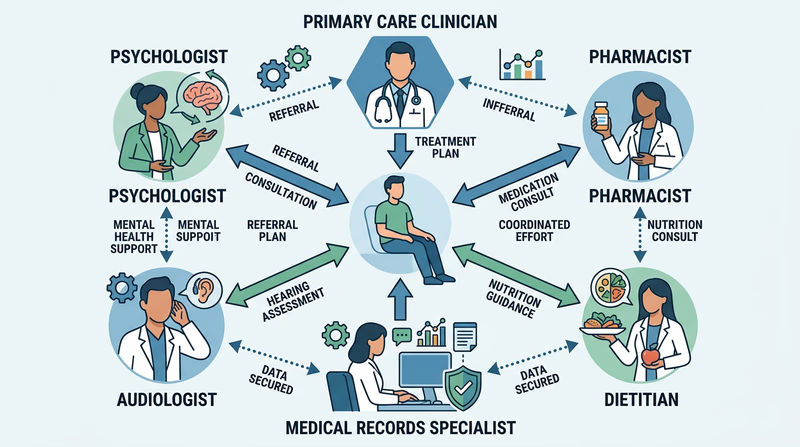
That is called team-based care. The goal is not just to bring many professionals into the same building. The goal is to make sure each professional contributes the right expertise at the right time. One person may diagnose. Another may teach. Another may monitor progress. Another may handle equipment or lab testing. Good care happens when those pieces connect.
Team-based care also reduces the chance that a patient falls through the cracks. If everyone communicates clearly, medicines are safer, follow-up is more likely, and the patient spends less time trying to repeat the same story over and over. This is one reason electronic health records, care coordinators, and standardized communication tools matter so much.
If you are interested in leadership, team-based care is worth watching closely. Health care leaders do not just need medical knowledge. They need the ability to organize people, solve workflow problems, and keep communication strong under stress.
C. Deep Dive: Public Health and Prevention
A lot of health care happens before anyone gets seriously sick. That is the work of public health and prevention. Vaccination campaigns, nutrition education, safer road design, clean water systems, disease tracking, school screenings, and smoking prevention programs all protect communities before a patient ends up in an exam room.
This is an important shift in thinking. Clinical medicine usually focuses on one person at a time. Public health asks bigger questions: Why are asthma rates higher in one neighborhood? Why are teens missing vaccines? How can a county respond faster to an outbreak? Those questions still involve health care, but at the community scale.
Scouts can understand this especially well because Scouting already teaches preparedness and service. A blood drive, a CPR class, a sunscreen station at a summer event, or a campaign to encourage helmets and seat belts are all examples of prevention in action. They may not feel as dramatic as surgery or emergency response, but they often help more people in the long run.
If you like science plus community problem-solving, public health can be a powerful direction. It includes epidemiology, health education, emergency management, environmental health, and policy work.
D. Deep Dive: Technology, Records, and Human Judgment
Modern health care uses more technology every year. Imaging systems produce detailed scans. Wearable devices track heart rhythms and glucose. AI tools may highlight patterns in records or scans. Remote monitoring lets clinicians watch some patients from home. All of this can improve care — but only if humans use it wisely.
Technology creates three big responsibilities. First, clinicians have to understand what a tool can and cannot do. Second, health systems have to protect privacy and data security. Third, professionals have to keep the patient at the center. A monitor reading is useful, but it does not replace listening to a frightened person or noticing something that a machine missed.
This matters for almost every career in the badge. A sonographer uses high-tech equipment, but still needs patient communication skills. A pharmacist may use software to catch interactions, but still has to explain the medicine clearly. A medical records specialist may protect the flow of information that allows an entire team to work safely. Technology does not remove the human side of health care. It makes the human side even more important.
E. Real-World Experiences
Try These Next
Real experiences that can deepen your understanding of health care
- Tour a training program: Ask a local community college or university whether it offers open houses for nursing, EMT, radiology, respiratory therapy, or medical laboratory programs.
- Visit a simulation lab: Some schools let visitors see mannequins, mock hospital rooms, or ambulance training spaces used to teach clinical skills.
- Attend a public health event: Health fairs, CPR classes, blood drives, and community wellness events show the prevention side of health care.
- Shadow a second profession: If you already visited one kind of professional for Req 5, compare it with a very different role, such as a pharmacist, sonographer, or physical therapist.
- Volunteer more than once: Returning to the same event type can help you notice systems, teamwork, and patient communication more clearly.