Req 3 — Recovery, Communication, and Movement
Select three of the professions from Group 3 listed below which interest you, then complete the following:
Group 3:
- Physical Therapist (DPT)
- Occupational Therapist (OT)
- Orthotist/Prosthetist
- Medical Appliance Technician
- Respiratory Therapist (RT)
- Medical Assistant
- Dietitian (RD)
- Speech-Language Pathologist (Speech Therapist) (SLP)
A patient may leave the emergency room alive but still need months of work to get back to normal life. That is where Group 3 careers stand out. These professionals help people move, breathe, eat, communicate, use adaptive equipment, and manage everyday tasks after illness, injury, or disability.
This page is about care that often happens step by step. Progress may be slow, but it can be life-changing.
Requirement 3a: Roles in Health Care
Learning to walk again after surgery, using a new prosthetic leg, speaking clearly after a stroke, or managing asthma treatments at home all require different kinds of help. Group 3 professionals often work with patients repeatedly over time, which means they build strong relationships and celebrate many small wins.
Movement and Function
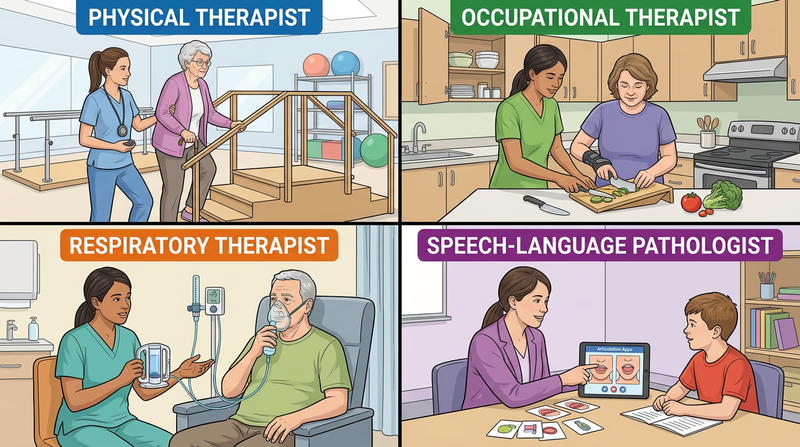
Physical therapists (DPTs) help patients improve strength, balance, flexibility, and movement. They guide exercises, measure progress, and design recovery plans after injuries, surgeries, or neurological conditions.
Occupational therapists (OTs) help patients do the activities of daily life. That can include getting dressed, writing, using kitchen tools, returning to school, or adapting a bedroom so a person can move more safely.
Orthotists/prosthetists design, fit, and adjust braces and artificial limbs. Their work combines anatomy, biomechanics, and careful listening because a device has to fit the person’s body and life.
Medical appliance technicians build, adjust, or repair certain devices and supports used in patient care. Depending on the setting, that may include orthotic or prosthetic parts, specialized equipment, or other custom medical aids.
Breathing, Nutrition, and Communication
Respiratory therapists (RTs) help patients breathe more effectively. They may manage oxygen therapy, breathing treatments, ventilators, and education for patients with asthma, pneumonia, premature birth complications, or chronic lung disease.
Dietitians (RDs) use food and nutrition science to help patients stay healthy or recover. They may work with people who have diabetes, food allergies, eating disorders, sports nutrition needs, or digestive conditions.
Speech-language pathologists (SLPs) help with speech, language, voice, swallowing, and communication challenges. Despite the name, their work goes far beyond pronunciation.
Clinic Support
Medical assistants support physicians and clinics by taking histories, checking vital signs, preparing rooms, managing records, and sometimes handling basic clinical tasks. They keep a practice organized and help patients move through visits smoothly.
What Makes Group 3 Different?
Look for these patterns as you compare careers
- Longer recovery relationships: Many patients see these professionals repeatedly over weeks or months.
- Practical goals: Success may mean climbing stairs, breathing easier, swallowing safely, or returning to school sports.
- Adaptation matters: Equipment, exercises, and environment changes are often part of the solution.
- Teamwork stays important: These professionals often coordinate with physicians, nurses, families, and schools.
Requirement 3b: Education and Licensing
Training in this group ranges from certificate-level programs to doctoral degrees. A good comparison should show not only how much school each career requires, but also how much patient evaluation, planning, and independence the job includes.
Typical Training Patterns
- DPT: bachelor’s preparation, doctoral physical therapy program, national licensure exam, and state licensure
- OT: graduate occupational therapy education, fieldwork, national certification exam, and state licensure
- Orthotist/prosthetist: college-level preparation plus specialized graduate or certificate training, supervised residency, certification, and often licensure depending on state
- Medical appliance technician: program or technical training depending on role and employer, plus hands-on skill development
- RT: associate or bachelor’s level respiratory therapy education, clinical training, certification exams, and state licensure where required
- Medical assistant: certificate or diploma program, sometimes associate degree, and optional or employer-preferred certification
- RD: college degree, supervised practice, national exam, and in many states licensure or certification
- SLP: bachelor’s degree plus graduate speech-language pathology program, supervised fellowship, national exam, and state licensure
Matching Training to Responsibility
If a job includes diagnosis, independent treatment planning, or complex decision-making, the training path is usually longer. That helps explain why a medical assistant may enter the field more quickly than an SLP, and why a DPT usually trains longer than a respiratory therapist.
Questions Worth Asking
If you meet someone from one of these careers, ask:
- What kind of patients do you see most often?
- What skills took the longest to learn?
- How do you measure patient progress?
- What kind of schooling surprised you the most?
Those questions move the conversation past job titles and into real understanding.
American Physical Therapy Association — Choose PT An overview of what physical therapists do and how they help patients recover movement and function. American Occupational Therapy Association — About Occupational Therapy A plain-language explanation of how occupational therapists help people participate in everyday life. American Speech-Language-Hearing Association — Speech-Language Pathologists A patient-friendly overview of speech-language pathology and the communication and swallowing challenges SLPs address.In Req 4, you will look at another side of health care: the professionals who test samples, capture images, manage records, and build the technology that supports diagnosis and treatment.