Req 5 — Making the Most of a Workplace Visit
This requirement turns health care from a list on a page into a real place with real people. A workplace visit helps you notice details you would never get from a career website alone: the pace, the sounds, the teamwork, the tools, and the way a professional talks to patients and coworkers.
Before you visit, make a plan. Know which career you are exploring, bring a notebook, dress appropriately, and ask your parent or guardian and counselor for approval. Your goal is not to impress anyone. Your goal is to listen carefully and come away with honest observations.
Requirement 5a: Why They Chose the Career
Career choices are often more personal than Scouts expect. One professional may have been inspired by a family member’s illness. Another may have loved biology, anatomy, or engineering. Someone else may have chosen a path because they wanted direct patient contact, predictable hours, or the chance to work in emergencies.
When you ask this question, listen for turning points. Did a volunteer experience matter? Did a mentor encourage them? Did they switch careers after discovering a better fit? The answer helps you see that careers are shaped by values and interests, not just pay or prestige.
Requirement 5b: What They Like Most
The answer to this question reveals what makes the work meaningful. Some professionals love solving difficult cases. Others love helping patients through scary moments. A therapist may enjoy watching progress over time. A lab or imaging professional may love accuracy, technology, and helping the team reach the right diagnosis.
Try to notice whether the person’s favorite part matches what you would enjoy. A career that sounds impressive may not fit your personality, while a less famous role may suit you perfectly.
Requirement 5c: Biggest Challenges
Every health care job comes with pressure. Challenges may include long hours, emotional situations, difficult paperwork, shift work, emergencies, or the responsibility of avoiding mistakes when patients are counting on you.
This question matters because it keeps career exploration honest. A strong answer shows both the rewards and the hard parts.
Requirement 5d: Tools and Instruments
Tools tell you a lot about a career. A pharmacist may rely on dispensing systems, medication databases, and barcode checks. A podiatrist may use imaging, exam tools, and casting materials. A sonographer depends on ultrasound equipment. An EMT uses airway tools, stretchers, and monitors.
Look for both physical tools and digital tools. In health care, computers, imaging systems, electronic records, and decision-support software are often just as important as stethoscopes or syringes.
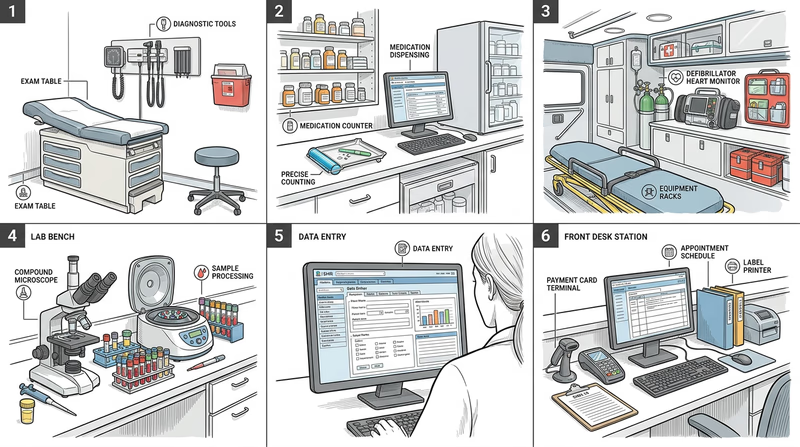
What to Observe During Your Visit
Watch for these details while you are there
- Work setting: hospital, clinic, ambulance, lab, pharmacy, school, or private office
- People interaction: how the professional talks to patients, families, and coworkers
- Tools and technology: machines, protective gear, records systems, or medical supplies
- Pace of the job: steady, rushed, appointment-based, or unpredictable
- Teamwork: who else works closely with this professional
Requirement 5e: Most Surprising Aspect
This answer often gives the most memorable insight. A professional may say the biggest surprise was how much of the job involves communication, paperwork, teaching, or teamwork instead of just science. Someone else may say the surprise was how emotionally intense the work can be.
A good surprise answer helps you move past stereotypes. For example, a pharmacist may spend more time counseling people than counting pills. A psychologist may spend a lot of time on careful assessment and documentation, not just conversation.
Requirement 5f: Continuing Education
Finishing school does not mean learning stops. Many health care professionals must complete continuing education to renew licenses or certifications. That may include formal classes, online courses, conferences, skills refreshers, or proof of ongoing clinical practice.
This requirement shows an important truth about health care: the science keeps changing. New medicines appear. Guidelines are updated. Technology improves. Ethical and legal rules shift. Good professionals keep up.
Turning the Visit Into a Strong Report
After your visit, organize your notes while the details are still fresh. You do not need a perfect essay, but you should be ready to tell your counselor:
- who you visited
- where they worked
- what you learned from each of the six discussion points
- whether the career seems more or less interesting to you now
In Req 1 through Req 4, you compared careers on paper. Here, you are adding real-world evidence.
ExploreHealthCareers.org Career profiles and planning ideas that can help you prepare better questions before your workplace visit. U.S. Bureau of Labor Statistics — Occupational Outlook Handbook A useful place to review day-to-day duties, work environments, and required training before you visit a professional.Next, you will shift from careers to ethics by exploring one of medicine’s oldest and most important ideas: the Physician’s Oath.