Req 4 — Your Hikes
This is it—the heart of the Hiking merit badge! After all your conditioning in Requirement 3, you are finally ready to “hit the trail” for the big miles. These five hikes are where your preparation meets the pavement (or the dirt, more likely).
A 10-mile hike is a significant undertaking, taking most hikers between four and six hours to complete. A 20-mile hike is a true “capstone” experience that will test your endurance and your gear. But don’t worry—if you’ve followed your conditioning plan and you prepare a solid hike plan, you’ll find that these miles are some of the most rewarding moments in Scouting.
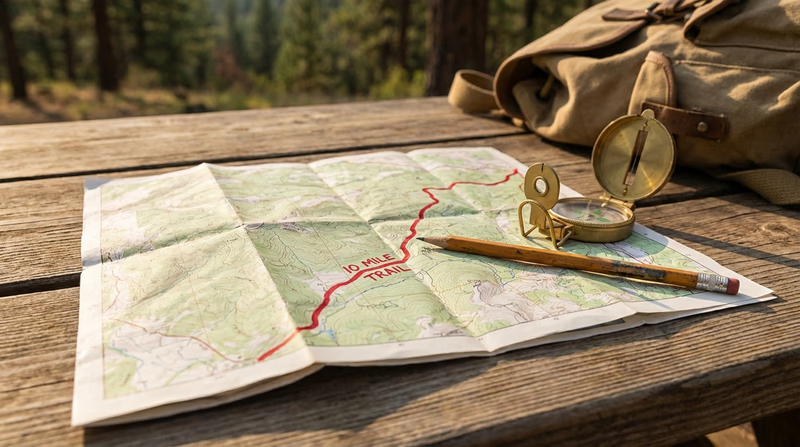
Planning Your 10-Mile Hikes
You can’t just lace up your boots and walk out the door for a 10-mile trek. For this requirement, every single hike must have a written hike plan that is approved by your counselor or an adult leader before you start.
Think back to Requirement 1a where we discussed the Five W’s of a Trip Plan:
- Who: Who is going with you? (Remember: Never hike alone!)
- What: What are you doing? (A 10-mile hike on a specific trail.)
- Where: Where exactly are you going? (The specific route.)
- When: When are you leaving and when do you expect to be back?
- Why: To fulfill Hiking Merit Badge Requirement 4!
By writing these down, you ensure that someone at home knows where you are and when to expect you back. It also forces you to think through the logistics of the day.
What Goes in a Hike Plan?
A good hike plan isn’t just a note on a napkin. For this requirement, your counselor will want to see three specific things in your written document:
1. Map Routes
Don’t just name the trail. You should have a physical or digital map that shows exactly which turns you are taking. 10 miles can involve several different trail intersections. Knowing the “elevation profile”—how many hills you’ll be climbing—is also vital. A flat 10-mile hike is very different from one that climbs 2,000 feet!
2. Clothing and Equipment List
This is your chance to double-check your Scout Essentials. Your list should change based on the weather. If there is a 30% chance of rain, your plan better include rain gear! If it’s going to be 90 degrees, you’ll need extra water and sun protection. Refer back to the gear we discussed in Requirement 1a to make sure you aren’t forgetting anything like a first aid kit, whistle, or extra socks.
3. Trail Lunch Items
Since these hikes are “continuous” (meaning you do them all at once), you will be on the trail during a mealtime. You need to list exactly what you are bringing to eat. We’ll dive deeper into trail lunch planning in the next section.
Pre-Hike Planning Worksheet Print this worksheet to plan each of your five hikes. Covers the Five W's, route details, gear checklist, and trail lunch.Trail Lunch Planning
When you are hiking 10 or 20 miles, your body is like a car driving at high speeds—it needs high-quality fuel. A soggy peanut butter sandwich might get you through a two-mile walk, but for a 20-miler, you need a mix of carbohydrates for quick energy and protein/fats for long-lasting endurance.
Good trail food should be:
- High Energy: Lots of calories to keep you moving.
- Lightweight: You have to carry it, so avoid heavy cans or glass jars.
- Non-Perishable: It needs to stay safe to eat even after sitting in a warm backpack for four hours.
- Easy to Eat: You don’t want to spend an hour “cooking” in the middle of a 20-mile hike.
Trail Lunch Essentials
Pack these for a high-energy day on the trail
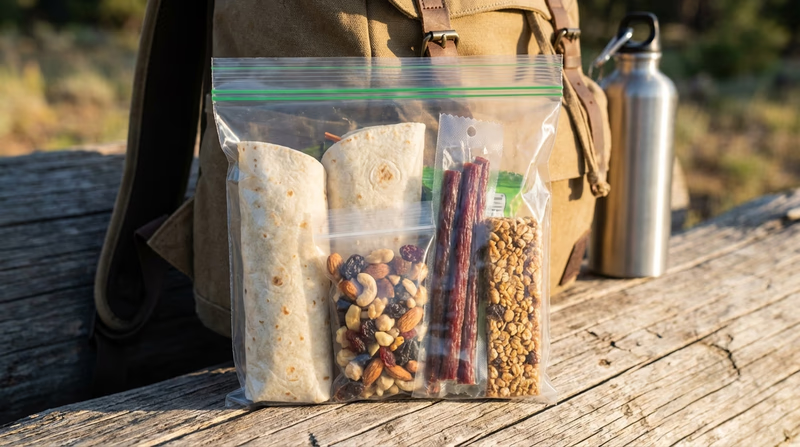
- Trail Mix (GORP): A classic mix of nuts, raisins, and chocolate. The nuts provide fat/protein, while the fruit and chocolate give you a quick sugar boost.
- Beef or Turkey Jerky: Excellent lightweight protein that won’t spoil in the heat.
- Peanut Butter Wraps: Use tortillas instead of bread—they don’t get squashed in your pack and provide plenty of energy.
- Dried Fruit: Apricots, mangoes, or apples give you vitamins and natural sugars without the weight of water in fresh fruit.
- Energy Bars: Look for bars with at least 10 grams of protein and complex carbs (like oats).
- Tuna or Chicken Pouches: These come in foil pouches (no can opener needed!) and are great for a protein-heavy “main course.”
- Hard Cheese: Blocks of cheddar or parmesan stay fresh longer than soft cheeses and provide necessary salt and fats.
- Electrolyte Powder: Adding this to one of your water bottles helps replace the salt you lose through sweat.
Choosing Your Routes
Variety is the spice of life—and the secret to enjoying this merit badge! While you could walk the same 10-mile loop four times, it’s much better to explore different areas.
Try to find:
- Different Terrains: A forest trail one day, a coastal path another, and maybe a hilly ridge for the third.
- Different Seasons: If your schedule allows, seeing a trail in the fall colors versus the spring bloom is a totally different experience.
- Different Challenges: One hike might be flat and fast, while another might be rocky and technical.
Remember: Each hike must be on a different day. You cannot do 5 miles in the morning, 5 in the afternoon, and count it as a 10-mile hike. It must be a single, continuous effort.
Rest Stops and Pacing
The requirement says the miles must be “continuous.” This means you can’t hike 5 miles, go home for a nap, and come back for the other 5. However, it does not mean you can’t stop!
You are encouraged to take:
- Short rest periods: 5–10 minutes every hour to catch your breath and hydrate.
- One meal stop: A longer break (usually 30 minutes) to eat your trail lunch.
The key is to avoid “extended periods” like staying overnight. Think of it as a “day hike” on steroids. Keep your muscles warm by not sitting still for too long. If you sit for an hour, your legs will stiffen up, making the next mile feel twice as hard.
The 20-Mile Hike: Your Capstone
The 20-mile hike is the “final boss” of the Hiking merit badge. It is a long day—usually 8 to 10 hours of walking. While it might sound scary, remember that you’ve already completed four 10-mile hikes and a conditioning program by the time you reach this step. You are ready!
Strategies for the 20-Miler:
- Start Early: Be on the trail at sunrise. This gives you plenty of daylight and prevents you from having to finish in the dark.
- Mental Segments: Don’t think of it as 20 miles. Think of it as four 5-mile hikes. Reward yourself with a special snack at each 5-mile mark.
- Foot Care: This is the hike where blisters are most likely. Change your socks halfway through. It feels amazing and helps keep your feet dry.
- Hydration: You will likely need 3–4 liters of water. If there isn’t a water source on the trail, you may need to “cache” water (hide it) along the route beforehand or carry it all.

Find Hiking Trails Near You
Not sure where to find a 10-mile loop? These resources are great for scouting out your next adventure:
Hiking Project Find maps, trail descriptions, and ideas for hikes near you. AllTrails Search for trails by location, difficulty, and length with reviews from other hikers. National Park Service — Find a Park Explore trails and hiking opportunities in America's national parks. USGS Topographic Maps Download free topographic maps from the U.S. Geological Survey to plan your route and study the terrain. U.S. Forest Service — Recreation Find trails, campgrounds, and recreation areas in America's national forests and grasslands. Rails-to-Trails Conservancy — TrailLink Search for converted rail-trails — flat, well-maintained paths that are perfect for long-distance hiking. Bureau of Land Management — Recreation Explore hiking opportunities on public lands managed by the BLM across the western United States.Once you finish each of these hikes, your job isn’t quite done. You need to document what happened!