Req 2 — Insect Anatomy and Orders
This requirement gives you the basic language of insect study. You will learn how to separate insects from other animals, compare them with spiders and millipedes, identify the main body parts, and notice the traits that sort insects into major orders.
Requirement 2a
If you can explain what makes an insect an insect, you are already thinking like an entomologist. Insects belong to a huge group of animals called arthropods, which are animals with jointed legs and an external skeleton called an exoskeleton. But not every arthropod is an insect.
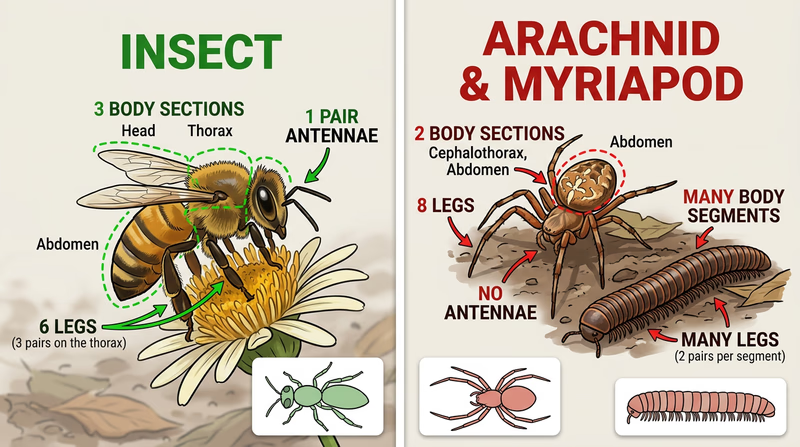
The classic insect body plan has three main body sections: head, thorax, and abdomen. Insects also have six legs, one pair of antennae, and usually one or two pairs of wings as adults. That combination is what sets them apart from vertebrates like birds and mammals, from worms and snails, and even from other arthropods.
Another big difference is growth. Insects do not grow the way mammals do. Their hard exoskeleton does not stretch, so they must molt, shedding the old outer covering so a larger one can form. Many insects also go through major life-stage changes, including metamorphosis.
You can explain this requirement by naming a few clear traits:
What makes an insect an insect?
Use these features in your counselor discussion
- Six legs: Three pairs attached to the thorax.
- Three body regions: Head, thorax, and abdomen.
- One pair of antennae: Important for touch, smell, and sensing the environment.
- Exoskeleton: A hard outside covering instead of an internal skeleton.
- Often wings: Many adult insects have wings, though not all do.
Requirement 2b
This part matters because beginners often call every small crawling creature a bug. In science, that is not accurate. Spiders are arachnids, millipedes belong to a different arthropod group, and neither one is an insect.
Spiders have eight legs, not six. They have two main body sections, not three, and they do not have antennae. Many spiders also have fangs and silk-producing spinnerets, which insects do not.
Millipedes look very different again. They have long bodies made of many repeating segments, and most body segments carry two pairs of legs. They also lack the three-part body plan of insects. A millipede is more like a walking train of segments, while an insect has a more clearly separated head, thorax, and abdomen.
A quick comparison can help:
| Group | Legs | Body Sections | Antennae | Other clues |
|---|---|---|---|---|
| Insects | 6 | 3 | Yes | Often wings as adults |
| Spiders | 8 | 2 | No | Spinnerets, no wings |
| Millipedes | Many | Many segments | Yes | Two pairs of legs on most segments |
Requirement 2c
For this requirement, you should be able to look at a picture, model, or real insect and identify the major parts. Start with the big three body sections.
- The head holds the eyes, antennae, and mouthparts.
- The thorax is the middle section and carries the legs and wings.
- The abdomen is the rear section, where many organs are located.
From there, learn a few more visible parts: compound eyes, simple eyes on some insects, antennae, mandibles or other mouthparts, wings, and legs. If you can point to those confidently, you are in good shape.
Requirement 2d
An order is a major category of insects. You do not need to memorize every insect order on Earth, but you should know that orders are sorted by traits such as wing structure, mouthparts, body shape, and how the young develop.
A few major orders show up often in basic insect study:
- Coleoptera — beetles. Front wings hardened into protective covers.
- Lepidoptera — butterflies and moths. Wings covered in tiny scales.
- Diptera — true flies. One pair of wings instead of two.
- Hymenoptera — ants, bees, and wasps. Narrow waists are common, and many are social.
- Orthoptera — grasshoppers and crickets. Strong hind legs for jumping.
- Odonata — dragonflies and damselflies. Long bodies, big eyes, strong flight.
You do not have to list every detail perfectly. What matters is that you can explain the kinds of clues a scientist uses to sort one order from another.
By now you have the body-plan knowledge you need for later requirements. When you start observing twenty live insects in Req 4, these anatomy clues are what will help you sort them into orders instead of just calling them “little brown bugs.”