Req 4 — Observe, Record, and Interpret
This requirement is where insect study becomes real fieldwork. You will apply outdoor ethics, observe live species in their habitats, organize those observations into a scrapbook, and then think about what those insects are doing in the ecosystem.
Requirement 4a
Insect study can be low-impact science, but only if you make good choices. The Leave No Trace Seven Principles and the Outdoor Code remind you that learning about nature does not give you permission to damage it.
For insect study, the most important ideas are simple: plan ahead, stay on durable surfaces when possible, leave what you find unless collection is necessary and approved, respect wildlife, and think about how your actions affect the habitat. Flipping every rock in a stream bank, trampling wildflowers to chase butterflies, or tearing apart rotten logs just to get a closer look is bad science because it damages the very system you are trying to understand.
The Outdoor Code matters too. Being clean in your outdoor manners means not wrecking a site for the next visitor. Being careful with fire and gear means not creating avoidable hazards. Being conservation-minded means protecting habitat, not just enjoying it.
Leave No Trace Basics ( video) Introduces the core Leave No Trace ideas you can apply directly to observation, handling, and habitat protection.Requirement 4b
This is a field-observation challenge, not a race. The goal is to notice living insects where they actually belong. You are more likely to succeed if you visit several micro-habitats instead of standing in one place and hoping for twenty species.
Try looking in these places:
- flowers for bees, flies, butterflies, and beetles
- grassy edges for grasshoppers and leafhoppers
- ponds and wet ground for dragonflies and water-associated insects
- bark, leaf litter, and rotting wood for beetles and ants
- porch lights at night for moths and other nocturnal species
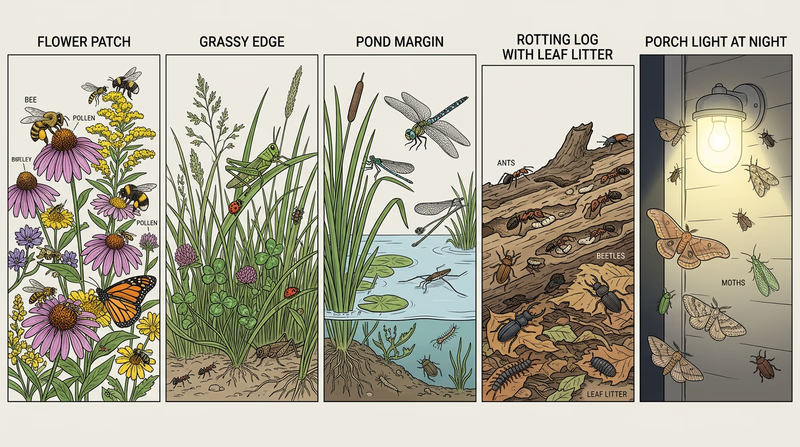
Pay attention to behavior, not just appearance. An insect perched on a stem, one carrying pollen, and one dragging prey all tell different stories. Those notes also help later when you identify ecosystem roles in 4d.
Requirement 4c
Your scrapbook is the evidence that your observations were organized and thoughtful. It does not need to look fancy, but it does need to be clear. A strong scrapbook page for one insect usually includes a photo or sketch, the date and place observed, the common name, the scientific name if you can determine it, the insect order, and one or two notes about behavior or habitat.
If you cannot identify every insect all the way to species, be honest about it. It is better to label one as “syrphid fly, family Syrphidae” than to guess wrong. Your counselor wants to see careful work, not fake certainty.
What to include for each scrapbook entry
Keep every page useful and easy to review
- Common name: The everyday name people use.
- Scientific name: Include it when you can identify it reliably.
- Order: Helps prove you covered four or more insect orders.
- Where observed: Meadow, garden, trail edge, pond, tree bark, and so on.
- Behavior note: Feeding, flying, pollinating, hiding, carrying food, or mating.
Requirement 4d
This is where you move from naming insects to understanding their jobs. Insects can be pollinators, decomposers, predators, prey, herbivores, scavengers, or parasites. Some do more than one job during different life stages.
For example, a bee may act as a pollinator. A lady beetle may be a predator that helps control aphids. A carrion beetle helps recycle dead material. A caterpillar is often an herbivore, while the adult butterfly may become a pollinator. Dragonflies are predators both as aquatic nymphs and flying adults.
The best way to answer this part is to connect each insect to something you actually observed or know about its biology. If you saw a bee moving from flower to flower with pollen on its legs, that supports its pollinator role. If you found an ant carrying a dead insect, that suggests scavenging or food transport within the colony.
Req 4 gives you a field notebook scientist’s mindset. You are no longer just spotting insects. You are recording evidence, organizing it, and asking what each organism is doing in its environment.