 Getting Started
Introduction & Overview
Inventing starts with a simple moment: something is frustrating, wasteful, uncomfortable, or slow, and you catch yourself thinking, There has to be a better way. The Inventing merit badge teaches you how to turn that thought into action by studying real inventors, protecting ideas, sketching solutions, and building a prototype you can test.
Inventing is not magic, and it is not just for famous adults in labs. It is a process of noticing problems, asking good questions, trying ideas, learning from mistakes, and improving what you made. That mindset can help you in Scouting, school, future jobs, and everyday life.
Then and Now
Then
Humans have always invented. Early people shaped stone tools, learned how to control fire, and built shelters that made survival easier. Over time, inventors created the wheel, paper, printing presses, clocks, steam engines, telegraphs, electric lights, airplanes, and thousands of other tools that changed daily life.
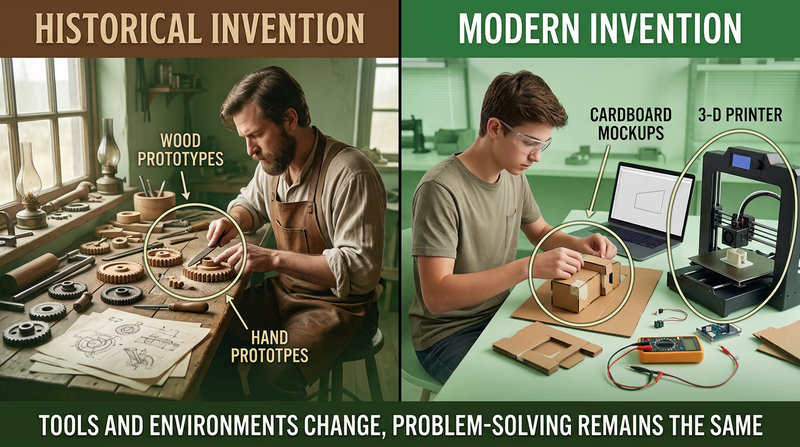
For a long time, inventing was closely tied to workshops, mills, farms, and factories. Many inventors were also mechanics, tinkerers, blacksmiths, or business owners. They worked with hand tools, trial and error, and lots of patience. Some inventions transformed the whole country by speeding up transportation, communication, manufacturing, and medicine.
- Then: inventors often solved physical problems with gears, metals, wood, and hand-built parts
- Big impact: inventions helped communities grow, businesses expand, and living standards rise
Now
Today, inventing still includes tools, machines, and materials, but it also includes software, medical devices, cleaner energy systems, safer outdoor gear, and better ways of sharing information. A modern inventor might use cardboard and tape for a first model, computer software for a design, and a 3-D printer for a quick prototype.
What has not changed is the heart of the work. Inventors still begin with a problem, learn what people need, build something, test it, and improve it. The best inventions are not just clever. They are useful.
- Now: inventors work in homes, schools, maker spaces, labs, and companies of every size
- Big impact: inventions can improve safety, save time, reduce waste, help people with disabilities, and make outdoor adventures better
Get Ready!
Pay attention during this badge. The next great idea probably will not arrive with dramatic music. It will show up when a tent stake bends, a camp gadget breaks, or a job takes twice as long as it should. Inventors notice those moments and decide to do something about them.
Kinds of Inventing
Inventing is a broad field. Here are some of the main ways people invent solutions.
Product Inventing
This is what many people picture first: a physical object you can hold, carry, wear, or use. A better flashlight, a safer stove handle, a more comfortable backpack strap, or a faster way to organize gear all fit here. Product inventors think about size, weight, durability, cost, and how easy something is to use.
Process Inventing
Not every invention is an object. Sometimes the invention is a better method. A new way to sort materials for recycling, pack troop gear, route deliveries, or organize medical records can save huge amounts of time and money. If it solves a problem in a repeatable way, it can still be an invention.
Assistive Inventing
Some of the most meaningful inventions help people do things that were once hard or impossible. Assistive inventions include tools that improve mobility, communication, grip, visibility, or access. These inventions begin with careful listening because the inventor must understand the real needs of the user.
Outdoor and Scouting Inventing
Scouts are surrounded by chances to improve gear and systems. Campsites, patrol boxes, meal cleanup, rain protection, gear storage, and trail comfort all create design problems worth solving. Requirement 5 and Requirement 6 will push you to think like an inventor in exactly those situations.
Digital and Electronic Inventing
Some inventions are built from code, sensors, or circuits instead of wood and metal. A reminder app, a sensor that tracks water use, or a simple robot that performs a task can all be inventions. Even if your own project is not electronic, it helps to see how wide the field really is.
Now you know what inventing is really about: solving real problems in useful ways. Next, you will look at how inventors and inventions shape everyday life and the economy.