Inventing Merit Badge — Complete Digital Resource Guide
https://merit-badge.university/merit-badges/inventing/guide/
Introduction & Overview
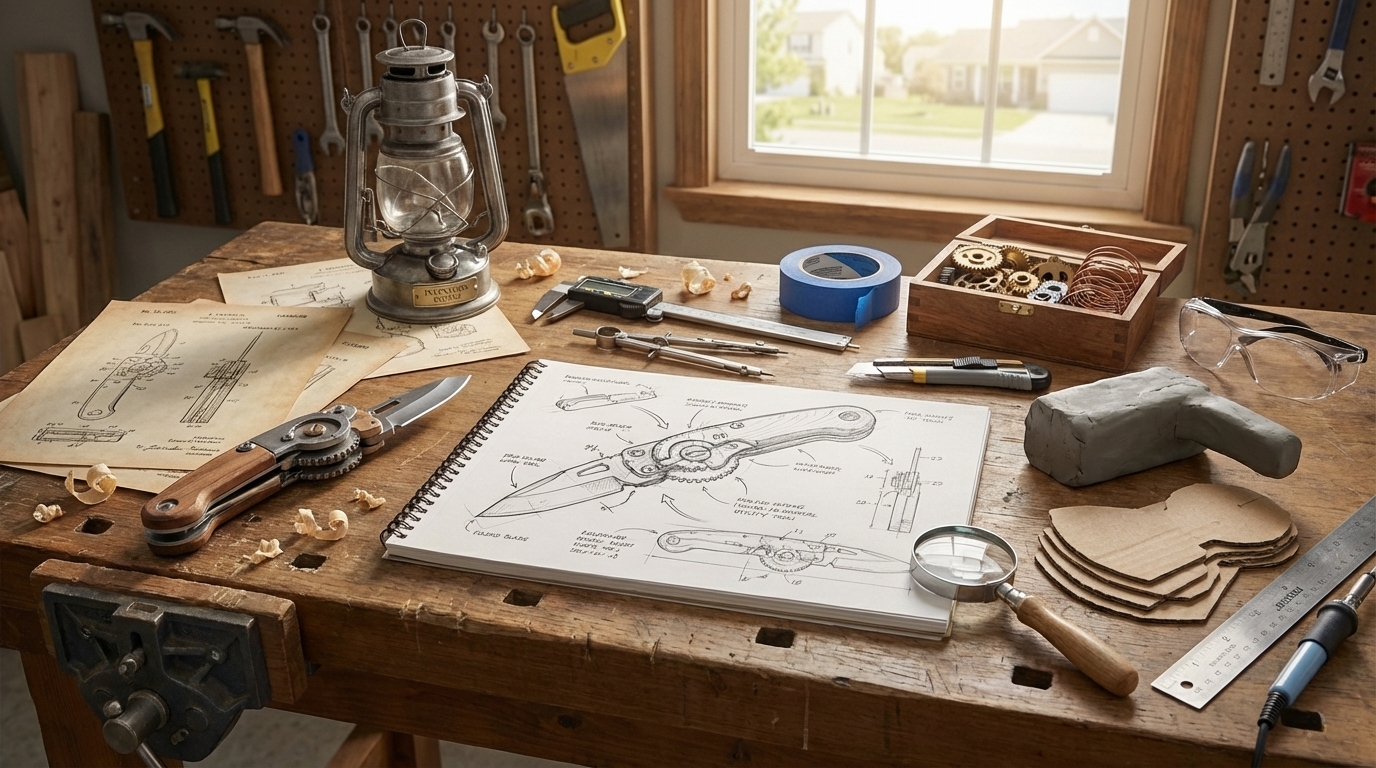
Inventing starts with a simple moment: something is frustrating, wasteful, uncomfortable, or slow, and you catch yourself thinking, There has to be a better way. The Inventing merit badge teaches you how to turn that thought into action by studying real inventors, protecting ideas, sketching solutions, and building a prototype you can test.
Inventing is not magic, and it is not just for famous adults in labs. It is a process of noticing problems, asking good questions, trying ideas, learning from mistakes, and improving what you made. That mindset can help you in Scouting, school, future jobs, and everyday life.
Then and Now
Then
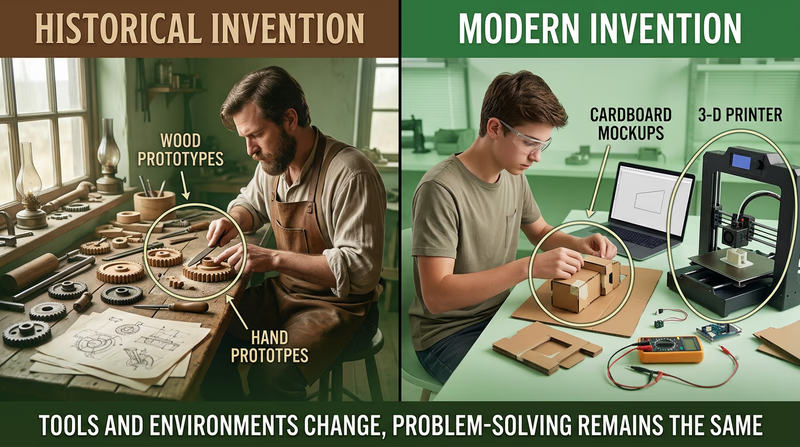
Humans have always invented. Early people shaped stone tools, learned how to control fire, and built shelters that made survival easier. Over time, inventors created the wheel, paper, printing presses, clocks, steam engines, telegraphs, electric lights, airplanes, and thousands of other tools that changed daily life.
For a long time, inventing was closely tied to workshops, mills, farms, and factories. Many inventors were also mechanics, tinkerers, blacksmiths, or business owners. They worked with hand tools, trial and error, and lots of patience. Some inventions transformed the whole country by speeding up transportation, communication, manufacturing, and medicine.
- Then: inventors often solved physical problems with gears, metals, wood, and hand-built parts
- Big impact: inventions helped communities grow, businesses expand, and living standards rise
Now
Today, inventing still includes tools, machines, and materials, but it also includes software, medical devices, cleaner energy systems, safer outdoor gear, and better ways of sharing information. A modern inventor might use cardboard and tape for a first model, computer software for a design, and a 3-D printer for a quick prototype.
What has not changed is the heart of the work. Inventors still begin with a problem, learn what people need, build something, test it, and improve it. The best inventions are not just clever. They are useful.
- Now: inventors work in homes, schools, maker spaces, labs, and companies of every size
- Big impact: inventions can improve safety, save time, reduce waste, help people with disabilities, and make outdoor adventures better
Get Ready!
Pay attention during this badge. The next great idea probably will not arrive with dramatic music. It will show up when a tent stake bends, a camp gadget breaks, or a job takes twice as long as it should. Inventors notice those moments and decide to do something about them.
Kinds of Inventing
Inventing is a broad field. Here are some of the main ways people invent solutions.
Product Inventing
This is what many people picture first: a physical object you can hold, carry, wear, or use. A better flashlight, a safer stove handle, a more comfortable backpack strap, or a faster way to organize gear all fit here. Product inventors think about size, weight, durability, cost, and how easy something is to use.
Process Inventing
Not every invention is an object. Sometimes the invention is a better method. A new way to sort materials for recycling, pack troop gear, route deliveries, or organize medical records can save huge amounts of time and money. If it solves a problem in a repeatable way, it can still be an invention.
Assistive Inventing
Some of the most meaningful inventions help people do things that were once hard or impossible. Assistive inventions include tools that improve mobility, communication, grip, visibility, or access. These inventions begin with careful listening because the inventor must understand the real needs of the user.
Outdoor and Scouting Inventing
Scouts are surrounded by chances to improve gear and systems. Campsites, patrol boxes, meal cleanup, rain protection, gear storage, and trail comfort all create design problems worth solving. Requirement 5 and Requirement 6 will push you to think like an inventor in exactly those situations.
Digital and Electronic Inventing
Some inventions are built from code, sensors, or circuits instead of wood and metal. A reminder app, a sensor that tracks water use, or a simple robot that performs a task can all be inventions. Even if your own project is not electronic, it helps to see how wide the field really is.
Now you know what inventing is really about: solving real problems in useful ways. Next, you will look at how inventors and inventions shape everyday life and the economy.
Req 1 — What Inventing Does
This requirement asks you to do two connected jobs. First, decide what inventing means to you. Then look outward at how inventions have shaped the United States and everyday life. You will talk about the role inventors play in the economy and choose examples of inventions that clearly helped people.
- Start with a definition: inventing means creating a new device, method, or improvement that solves a problem.
- Then look for impact: how did an invention save time, increase safety, improve health, open new jobs, or make travel and communication easier?
Requirement 1a
The United States grew through invention. Farms produced more food because of improved tools and machines. Factories made goods faster because inventors developed better equipment and production methods. Railroads, telephones, electric power, refrigeration, and computers all changed how people lived and worked.
When your counselor asks about economic development, think about this phrase: inventions help people do more, faster, more safely, or at lower cost. That can lead to new businesses, more jobs, bigger markets, and better quality of life.
How inventions strengthen an economy
Here are some of the main ways inventions help a country grow:
- They save time. A machine that finishes a job in minutes instead of hours increases productivity.
- They reduce hard labor. Tools and equipment let workers accomplish more with less physical effort.
- They improve transportation and communication. Moving people, products, and information faster helps businesses expand.
- They create entirely new industries. Airplanes, computers, medical imaging, and smartphones all led to huge new fields of work.
- They improve health and safety. Medical devices, clean water systems, and safer equipment help people live longer and work more effectively.
How to explain economic impact
Use these points when talking with your counselor- Problem: What challenge existed before the invention?
- Solution: What did the inventor create or improve?
- Effect on people: How did daily life change?
- Effect on work: Did jobs become faster, safer, or more productive?
- Effect on society: Did the invention help cities grow, open new careers, or connect more people?
A strong explanation does not need fancy vocabulary. It just needs clear cause and effect. For example, if a better farm machine lets one farmer harvest much more grain, that helps farms produce more food, lowers costs, and supports transportation, storage, and sales jobs too.
Inventors do more than have ideas
An inventor is not just someone who thinks of something clever. Inventors observe problems, test designs, revise failures, and keep improving. Many successful inventors worked with machinists, investors, scientists, marketers, and factory workers. In other words, invention often creates teamwork and jobs far beyond the inventor’s own workshop.
United States Patent and Trademark Office — Kids' Pages A beginner-friendly introduction to inventions, patents, and how inventors turn ideas into protected creations. Link: United States Patent and Trademark Office — Kids' Pages — https://www.uspto.gov/kidsRequirement 1b
This part sounds simple, but it is really about choosing examples with clear human impact. Your counselor is not looking for a random list. Pick inventions you can explain.
A good set of examples might come from three different areas, such as health, communication, and transportation. That gives you more to talk about and shows that inventing reaches every part of life.
What makes a strong example?
Choose inventions that let you answer these questions:
- What problem did this invention solve?
- Who benefited from it?
- How did life change because it existed?
For example, you might choose:
- a medical invention such as a vaccine, insulin delivery device, or X-ray machine
- a communication invention such as the telephone, radio, or internet router
- an everyday-use invention such as refrigeration, the water filter, or the sleeping bag zipper
Be careful not to focus only on how exciting an invention is. Focus on how useful it has been to people.
Ways inventions have helped humankind
Depending on your examples, the benefits might include:
- preventing disease or treating injuries
- helping people travel farther and faster
- making food safer to store
- allowing people to learn and communicate across long distances
- helping people with disabilities move, see, hear, or communicate more easily
- making outdoor life and Scouting safer or more comfortable
You can also connect this part to Requirement 5. As you learn how to improve a camping product, you will start noticing that many useful inventions are not world-famous. Some just make a real task work better.
National Inventors Hall of Fame — Inventor Search Profiles of major inventors and their inventions that can help you find strong examples of inventions that changed daily life. Link: National Inventors Hall of Fame — Inventor Search — https://www.invent.org/inducteesBefore you move on, make sure you can say your own definition of inventing out loud, explain how inventions help the economy, and describe three inventions that clearly helped people. Next, you will choose a path for learning directly from inventors.
Req 2 — Choose Your Research Path
For this requirement, you will choose exactly one path. Both options teach you how inventors think, work, and solve problems. The difference is whether you learn from a living inventor in a conversation or from inventors through reading and research.
Your Options
- Req 2a — Interview an Inventor: Talk directly with an adult who invented a useful item or process. You will hear real stories about problems, failures, revisions, and what it took to turn an idea into something useful.
- Req 2b — Study Inventors: Read about three inventors, then choose one to report on. You will compare different inventing journeys and practice spotting the habits and decisions that led to success.
How to Choose
Choosing your option
Think about access, time, and the kind of learning you want- Access to a real inventor: If your family, school, troop, or community can help you find someone to interview, Option 2a gives you a firsthand look at inventing.
- Time and scheduling: Option 2b is often easier to complete on your own schedule because books, articles, and videos are available anytime.
- What you will gain: Option 2a builds interviewing and listening skills. Option 2b builds research and comparison skills.
- How personal you want the experience to feel: Option 2a can be more memorable because you can ask follow-up questions about real setbacks and decisions. Option 2b lets you explore famous inventors from different times and fields.
- What kind of evidence you can bring to your counselor: Option 2a works well if you take strong notes during a conversation. Option 2b works well if you enjoy organizing facts from multiple sources.
You do not need to choose the “harder” option. Choose the one that gives you the clearest chance to learn something real about how invention happens.
You can also think ahead to Requirement 6. If you plan to create your own invention later, either option can help. An interview gives you practical advice from someone who has done it. Reading about three inventors shows you that there is no single “inventor personality” — different people invent in different ways.
National Inventors Hall of Fame — Meet the Inductees A large collection of inventor profiles that can help you research inventors or find inspiration for strong interview questions. Link: National Inventors Hall of Fame — Meet the Inductees — https://www.invent.org/inducteesNext, you will start with the first option page: interviewing an inventor. Even if you end up choosing Req 2b, reading both pages can help you understand both paths before you decide.
Req 2a — Interview an Inventor
A good inventor interview is not about getting perfect answers. It is about discovering what inventing looks like in real life. How did the person notice the problem? What failed at first? Who helped? What changed between the first idea and the final result? Those details are where the best learning happens.
Who counts as an inventor?
The person does not need to be world-famous. An inventor could be:
- an engineer who helped create a new product
- a business owner who designed a tool or improved a process
- a medical professional who developed a better way to organize care
- a tradesperson who created a new shop jig or safety improvement
- a teacher, coder, or designer who built a useful system or app
The key word is useful. The invention can be small in scale as long as it solved a real problem.
Questions that lead to strong answers
Avoid yes-or-no questions. Ask open questions that invite stories.
Interview question ideas
Pick the ones that fit your inventor- What problem made you decide something needed to be invented?
- What was your first idea, and how did it change over time?
- Who were the users, and how did you learn what they needed?
- What was the hardest part of developing the invention?
- Did you build prototypes or test early versions?
- What failed, and what did those failures teach you?
- How did cost, safety, or materials affect your design?
- Did you protect the invention with a patent or another form of intellectual property?
- How did the final version help people?
- What advice would you give a young inventor?
What to listen for
As the person answers, listen for patterns you will use later in this badge:
- noticing a real need
- testing before building the final version
- improving after feedback
- balancing usefulness, cost, and simplicity
- protecting ideas when needed
Those same ideas will show up again in Req 3, Req 6, and Req 7.
How to report what you learned
When you speak with your counselor, do more than summarize the person’s job title. Explain the inventor’s process.
A strong report usually includes:
- Who the inventor is
- What they invented or improved
- What problem they were solving
- What steps they took
- What challenges they faced
- What you learned about inventing from the interview
Your goal is not to impress the inventor. Your goal is to understand how real inventing works. If you come away realizing that inventors revise, listen, test, and adapt, then the interview did its job.
National Inventors Hall of Fame — Camp Invention and Inventor Resources Examples of inventor-focused programs and resources that show how inventors identify problems and build solutions. Link: National Inventors Hall of Fame — Camp Invention and Inventor Resources — https://www.invent.org/program-search/camp-inventionNow look at the other path in Requirement 2. Even if you choose the interview option, the next page can still help you compare inventors and sharpen your reporting skills.
Req 2b — Study Inventors
This option lets you compare three inventors and notice something important: inventors do not all work the same way. Some were trained scientists. Some were mechanics, entrepreneurs, or curious problem-solvers who learned by doing. Some invented one famous thing. Others improved many tools over a lifetime.
Choose three inventors with clear stories
Pick inventors from different fields if you can. That makes comparison easier.
You might choose inventors connected to:
- transportation
- communication
- medicine
- outdoor gear
- manufacturing
- clean energy
- accessibility tools
- computers or electronics
A strong inventor choice is someone whose work solved a clear problem and whose process you can describe.
What to look for as you read
Do not just collect dates and facts. Look for the inventor’s path.
Research notes to gather
These details will make your counselor report stronger- What problem was the inventor trying to solve?
- What need did they notice?
- What skills or background helped them?
- What obstacles or failures did they face?
- What invention or improvement are they best known for?
- How did the invention help people?
- Did the inventor protect the idea with patents or another method?
- What part of their story do you find most interesting?
As you compare the three inventors, ask yourself which one shows the most interesting mix of creativity, persistence, and usefulness. That is often the best one to present to your counselor.
How to compare inventors
Try comparing them across a few categories:
| Category | Inventor A | Inventor B | Inventor C |
|---|---|---|---|
| Problem solved | |||
| Type of invention | |||
| Biggest challenge | |||
| Lasting impact |
You do not need to show your counselor a perfect chart, but organizing your notes this way can make your final report much clearer.
What to tell your counselor
Once you choose the inventor you found most interesting, explain:
- who the inventor was or is
- what they invented or improved
- why that problem mattered
- how they went about solving it
- what challenge, trait, or decision stood out to you most
This last point matters. The requirement asks you to pick the inventor you find most interesting. So say why. Maybe you admire their persistence. Maybe their invention helped people in a powerful way. Maybe they improved something ordinary that most people overlooked.
You can use what you learn here again in Req 6. When you create your own invention, you will start seeing some of the same patterns the inventors you researched used: noticing needs, sketching ideas, testing, and revising.
National Inventors Hall of Fame — Inductee Profiles Reliable profiles of inventors from many fields, useful for comparing inventions, obstacles, and real-world impact. Link: National Inventors Hall of Fame — Inductee Profiles — https://www.invent.org/inducteesNext, you will turn from inventors themselves to the rules that protect inventions and ideas.
Req 3 — Intellectual Property & Patents
This requirement introduces one of the biggest questions in inventing: if you create something useful, how do you protect it? You will learn what intellectual property is, how patents work, how to look up a real patent on gear you use, and what happens when someone copies protected work without permission.
- Req 3a: what intellectual property is and why it matters
- Req 3b: what a patent contains and the main patent types
- Req 3c: how to find and read a real patent on camping gear
- Req 3d: what patent infringement means
Requirement 3a
Intellectual property means creations of the mind that the law can protect. That includes inventions, written and artistic works, brand names, logos, and certain confidential business information.
In the United States, the two main federal agencies connected to this requirement are:
- United States Patent and Trademark Office (USPTO): handles patents and trademarks
- U.S. Copyright Office: handles copyright registration
Main types of intellectual property
- Patent: protects an invention or process for a limited time
- Trademark: protects brand names, logos, and symbols that identify goods or services
- Copyright: protects original creative works such as books, music, videos, software code, and art
- Trade secret: protects confidential business information, such as a secret formula or method, as long as it is kept secret
Why protection matters
Protection gives inventors and creators a reason to share and develop ideas. If anyone could instantly copy a new invention and sell it, the original inventor might never recover the time, money, and effort spent creating it. Protection can encourage investment, support new businesses, and reward creativity.
But protection also has limits. The goal is not to lock up ideas forever. It is to give creators a fair period of control and then, in many cases, allow knowledge to become part of the public record.
USPTO — What Is Intellectual Property? A clear introduction to patents, trademarks, and the purpose of intellectual property protection in the United States. Link: USPTO — What Is Intellectual Property? — https://www.uspto.gov/ip-policyRequirement 3b
A patent is more than a certificate. It is a detailed legal and technical document. When you look at a patent, you will usually find these parts:
- Title: a short name for the invention
- Abstract: a brief summary of what the invention does
- Background: what problem existed before this invention
- Description or specification: a detailed explanation of how the invention works
- Drawings: labeled images showing parts, structure, or steps
- Claims: the most important legal section, stating exactly what the inventor says is protected
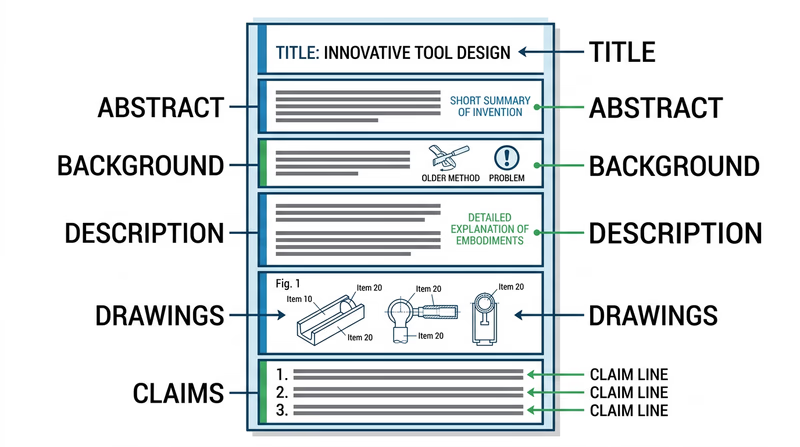
The claims matter most because they define the boundaries of the patent. Two products may look similar, but what counts legally is whether one product falls inside the claims of the patent.
Main patent types
- Utility patent: protects how something works, is used, or is made. This is the most common type.
- Design patent: protects the ornamental appearance of an item, not how it works.
- Plant patent: protects certain new and distinct plants that are reproduced asexually.
For this badge, you will mostly be dealing with utility and design patents because many camping and Scouting items use those forms of protection.
USPTO — Patents Basics An overview of what patents are, what they contain, and the main types recognized by the USPTO. Link: USPTO — Patents Basics — https://www.uspto.gov/patents/basicsRequirement 3c
This is where the topic becomes hands-on. Look at real gear you have used, such as a stove, lantern, cooler latch, water bottle cap, folding chair, trekking pole lock, or tent hardware. Many products have a patent number molded, stamped, printed, or labeled somewhere on the item or packaging.
Once you find a patent number, search for it online with your parent or guardian’s permission. Then compare the product in your hand with the patent drawings and claims.
What to compare
Patent comparison checklist
Notice how the real product matches the patent document- Shape and parts: Do the main parts look like the drawings?
- Function: Does the product solve the same problem described in the patent?
- Special feature: What seems to be the protected improvement?
- Claims: Which claim sounds most closely connected to the version you used?
- Differences: Has the finished product changed in any visible way from the patent drawings?
Patent drawings are often simpler than the real product because they focus on what needs to be protected. The real item may include branding, color choices, textures, or extra features that do not appear in the patent.
This requirement connects directly to Req 5. When you evaluate a camping product later, you will start seeing how much thought goes into even small design choices.
Google Patents A searchable patent database that makes it easier to read patent drawings, claims, and background information for real products. Link: Google Patents — https://patents.google.com/Requirement 3d
Patent infringement happens when a person or company makes, uses, sells, offers to sell, or imports something covered by another person’s valid patent claims without permission.
A helpful way to think about it is this: having a similar idea is not the main question. The real question is whether the copied product or process falls within the legal claims of the patent.
That is why claims matter so much. If the claims describe a certain combination of parts or steps, and another product uses that same protected combination without authorization, that may be infringement.
What infringement is not
- It is not just “being inspired by” a product.
- It is not automatically copying every feature exactly.
- It is not decided by appearance alone.
Instead, it is a legal question about whether protected claimed features were used without permission.
Now you understand the basic rules that protect inventions. Next, you will look at another important question: when should inventions be shared openly, and when should they be kept private or protected more carefully?
Req 4 — Inventions That Should Be Shared
Some inventions should be shared widely because they improve safety, health, learning, or everyday problem-solving. Other ideas may need careful limits, either because they could be dangerous if misused or because the inventor is still deciding how to protect and release them. This requirement asks you to think not just like a builder, but like a responsible citizen.
What kinds of inventions are appropriate to share?
In general, inventions are good to share when they:
- solve a real problem without creating major new risks
- can be explained clearly so people can use them safely
- improve access, safety, efficiency, health, or quality of life
- help communities rather than exploit them
Examples might include safer tools, better accessibility devices, cleaner water systems, improved medical tools, or smarter ways to reduce waste.
Why some inventions should be shared carefully
Not every invention belongs in full public circulation right away. Some ideas involve chemicals, electricity, medical use, or other hazards. Others may be easy to misuse. A responsible inventor thinks beyond “Can I make this?” and also asks, “What happens if the wrong person uses it the wrong way?”
Unpatented inventions still matter
An invention does not have to be patented to change society. Some useful ideas spread through open sharing, workplace improvements, community innovation, or small businesses that never pursued formal patents. Sometimes the inventor chose not to patent the idea. Sometimes the idea was too local, too simple, too expensive to patent, or better shared freely.
When you pick an unpatented invention to discuss, focus on its impact. Maybe it improved camp organization, made a classroom more efficient, helped a family member with daily tasks, or created a safer way to do a job.
How to talk about an unpatented invention
Organize your discussion around impact- What was the invention or improvement?
- What problem did it solve?
- Who benefited from it?
- Why might it have remained unpatented?
- How did it still make a difference?
Good discussion questions for your counselor
You can deepen this requirement by thinking through questions like these:
- Should life-saving inventions be shared as broadly as possible?
- When is it fair for inventors to protect their work for profit?
- How do you balance openness with safety?
- Can a small improvement still count as an invention worth sharing?
There may not be one perfect answer to every question. What matters is that you think carefully and explain your reasoning.
This requirement connects to Req 9, where you will think about the character traits inventors need. Responsibility is one of them. Good inventors do not just make new things. They think about the effect those things will have on real people.
Smithsonian Lemelson Center for the Study of Invention and Innovation Stories and resources about inventors, innovation, and how inventions influence society in both large and small ways. Link: Smithsonian Lemelson Center for the Study of Invention and Innovation — https://invention.si.edu/Next, you will stop talking in general and start thinking like a product improver by analyzing real camping gear you have used.
Req 5 — Rethink a Camping Product
This requirement turns you from observer to improver. Instead of inventing from scratch, you start with a real camping product and ask a powerful inventor question: What is the weak point? The answer might be comfort, weight, durability, ease of use, weather resistance, setup time, storage, or safety.
Pick the right product
Choose something you have actually used on an overnight trip. That matters because you need firsthand experience with the product’s strengths and frustrations.
Good choices might include:
- a tent stake, mallet, or rainfly clip
- a lantern or flashlight
- a camp chair or cot part
- a mess kit, spork, or mug
- a cooler, dry bag, or food container
- a stove windscreen or pot gripper
- a gear organizer, patrol box feature, or tote system
Avoid choosing something only because it looks easy to improve. Choose something you really noticed in use.
Look for real problems
The best improvements come from specific moments. Maybe a buckle was hard to open with cold hands. Maybe a cup tipped over easily on uneven ground. Maybe a stuff sack was too slippery when wet. Maybe a stake bent in rocky soil.
Product evaluation questions
Use these to spot what needs improving- When did the product work well?
- When did it fail or become annoying?
- Was it too heavy, fragile, awkward, or confusing?
- Did weather make it harder to use?
- Would a younger Scout or tired camper struggle with it more?
- Could a redesign make it safer or faster to use?
Make recommendations, not complaints
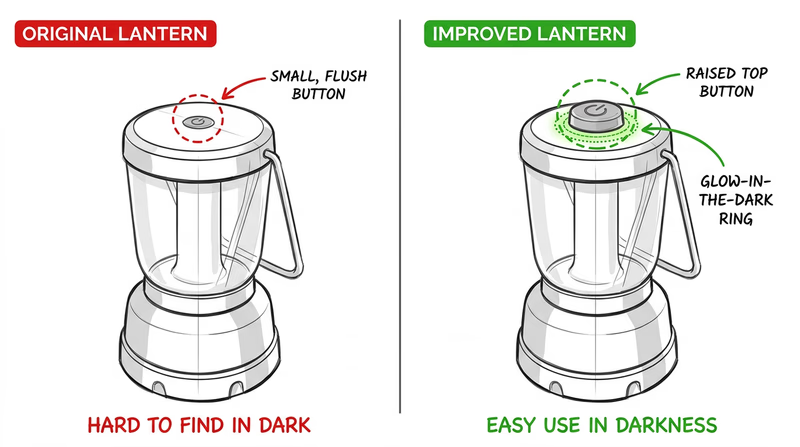
A weak response sounds like: “This lantern is bad.” A strong response sounds like: “The lantern’s power button is too small to find in the dark, so I would redesign the top with a larger raised button and a glow-in-the-dark ring around it.”
That kind of answer identifies:
- the problem
- the user situation
- the change you recommend
- the reason the change helps
What to include in your sketch
Your sketch does not have to look like professional engineering art. It does need to communicate your idea clearly.
Include:
- the product’s main shape
- the part you want to change
- labels showing the new feature
- notes explaining what the improved part does
You can draw the original and improved versions side by side if that helps. A comparison sketch often makes your thinking easier to explain to your counselor.
This requirement is excellent practice for Req 6, where you will invent something of your own. Here, you are training your eyes to notice user needs and design weaknesses.
Consumer Product Safety Commission — Recalls Examples of real consumer product problems and safety failures that show why product design details matter. Link: Consumer Product Safety Commission — Recalls — https://www.cpsc.gov/RecallsNext, you will move from improving an existing product to inventing a new solution for a real need.
Req 6 — Plan Your Invention
This requirement covers the full planning stage of inventing. You will identify a real problem, talk with people who would use your invention, sketch and describe your idea, build a model, and gather feedback before creating a working prototype in the next requirement.
- Req 6a: learn what users actually need and define the invention clearly
- Req 6b: build a simple model and plan materials for a prototype
- Req 6c: show the idea to others and record their feedback
A notebook matters here because inventing is a process, not a single moment. Your notes show how the idea changed and why.
Requirement 6a
Do not start by falling in love with your first idea. Start with the people who have the problem.
If your invention is for your troop, ask troop members what slows them down or frustrates them. If it is for your family, ask who deals with the problem most often. If it is for a community group, ask what makes the task difficult now.
Questions for potential users
User interview starter questions
Ask these before you finalize your design- What problem happens most often?
- When does it happen?
- What makes it annoying, slow, unsafe, or expensive?
- What have people already tried?
- What would a better solution need to do?
- What would make the solution easy to use?
After those conversations, write a clear problem statement and invention statement.
A useful pattern is:
- Problem statement: “Our troop needs a better way to ___.”
- Invention statement: “I want to invent a ___ that will help by ___.”
Then make a detailed sketch. Labels help a lot. Show moving parts, connection points, important dimensions if needed, and the main feature that solves the problem.
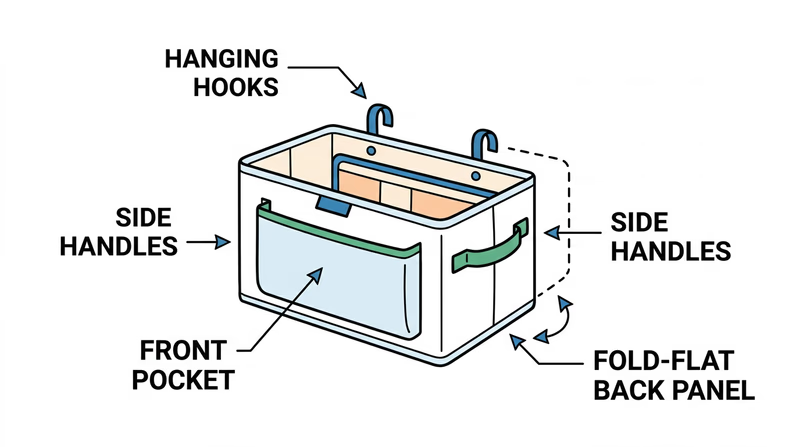
🎬 Video: Little Inventors: How to think up invention ideas! — Little Inventors — https://www.youtube.com/watch?v=ERFgorcRCJY
Requirement 6b
A model is not the same thing as a fully working prototype. A model helps you test size, layout, shape, and how parts fit together. Cardboard, paper, foam board, tape, string, clay, and recycled materials are all fine for this step.
Your model should answer basic design questions like:
- Is the invention too large or too small?
- Can a user reach the important parts?
- Does the shape make sense for the job?
- Are there weak points you can already spot?
Then make a materials list for the working prototype you hope to build next.
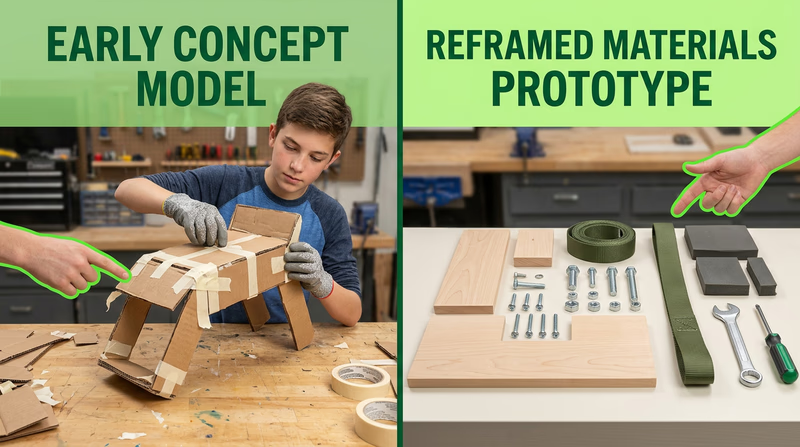
Think ahead to prototype materials
Your list might include:
- wood, plastic sheet, or metal parts
- fasteners like screws, bolts, nuts, or rivets
- adhesives
- fabric, webbing, foam, or rubber
- electronics such as batteries, switches, LEDs, or sensors
- tools needed for cutting, drilling, measuring, or assembly
Requirement 6c
This step can be hard because it asks you to let other people criticize your idea. But that is exactly what good inventors do. Feedback is not a sign that your idea failed. It is how your idea gets better.
When you show the model, ask people to react honestly.
Useful feedback prompts
Ask for comments that help you improve the invention- What part seems most useful?
- What part seems confusing?
- What could break, wear out, or cause frustration?
- What would make this easier to carry, store, or clean?
- Would you actually use this? Why or why not?
- What change would help the most?
Record feedback in a notebook as clearly as you can. Separate comments into categories such as function, comfort, safety, durability, and appearance. That will help you later in Req 7 when you build and evaluate the prototype.
MIT Lemelson — Inventing Resources Resources and stories focused on the real process of invention, including user needs, prototypes, and iteration. Link: MIT Lemelson — Inventing Resources — https://lemelson.mit.edu/You now have the foundation for your own invention: a real problem, user input, a sketch, a model, and feedback. Next comes the exciting part — building a working prototype and seeing how close your idea comes to the real world.
Req 7 — Prototype, Test, Improve
This is the moment when your invention stops being mostly an idea and starts becoming real. A working prototype does not have to be perfect, pretty, or ready for store shelves. It does need to perform the main job you designed it to do.
What a working prototype should prove
Your prototype should answer this question: Does the invention actually solve the problem in a real test?
That means the test should match the real use case as closely as you can manage. If you designed a troop gear organizer, test it with real gear. If you designed a camping accessory, test it in a realistic setup. If you designed something for your family, let family members try it.
Five evaluation areas to cover
The requirement already gives you a useful scorecard.
Prototype evaluation
Look at each of these areas when you test- Cost: How expensive would it be to build again? Are the materials reasonable?
- Usefulness: Does it actually help the user solve the original problem?
- Marketability: Would other people want it, buy it, or choose it over something else?
- Appearance: Does it look organized, sturdy, and understandable to use?
- Function: Does it work reliably, or only sometimes?
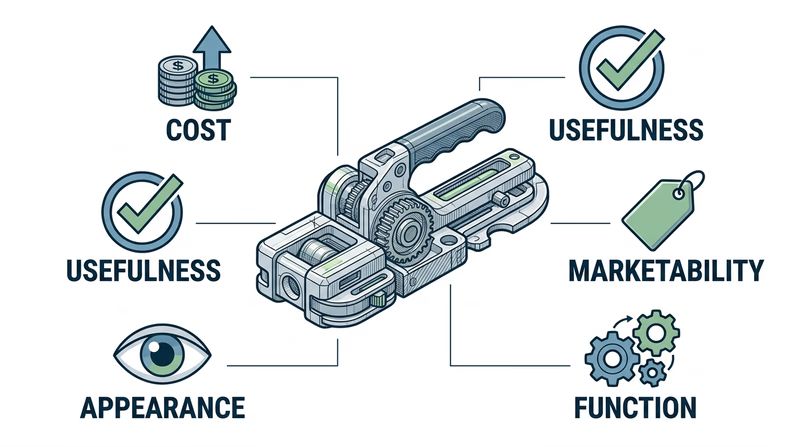
You do not need every category to be amazing. But you do need to think honestly about each one.
Compare your original vision with reality
This is one of the most valuable parts of inventing. Maybe your idea looked simple on paper but became awkward in real life. Maybe the invention worked better than expected but cost more to build. Maybe users liked the function but disliked the shape or size.
That is normal. Real inventing almost always reveals a gap between the original vision and the first real build.
How to test the prototype well
A useful test is repeatable and clear. Try to answer:
- what exact task the invention should perform
- how many times it should perform it
- what counts as success
- what failure or weakness you are watching for
For example, if your invention is meant to save setup time, compare setup time before and after. If it is meant to improve storage, test how much it holds and how easy it is to access items. If it is meant to improve comfort, let multiple users try it and compare reactions.
Counselor critique matters
Your counselor’s evaluation is not just a final checkmark. It is another round of feedback from someone who can look at your invention with fresh eyes. Listen for comments about:
- safety
- practicality
- simplicity
- durability
- whether the invention really solves the stated problem
Bring your notebook, sketches, and earlier feedback with you. That way, your counselor can see how the project developed from idea to prototype.
This requirement pulls together almost everything from Req 5 and Req 6: spotting problems, planning carefully, listening to users, and improving after critique.
National Institute of Standards and Technology — STEM Resources Resources about testing, measurement, and practical engineering thinking that can strengthen the way you evaluate a prototype. Link: National Institute of Standards and Technology — STEM Resources — https://www.nist.gov/education/stem-resourcesAfter building and testing your own invention, you will zoom back out and look at inventing in clubs, teams, and museums.
Req 8 — Choose an Inventing Experience
You must choose exactly one option for this requirement. Both choices take inventing out of your own notebook and place it in a wider world. One shows how teams build useful things together. The other shows how museums and exhibits preserve the stories behind inventions.
Your Options
- Req 8a — Build with a Team: Participate with a robotics, science, or engineering club that builds something useful. You will experience collaborative problem-solving, shared roles, and the way team projects improve through discussion and testing.
- Req 8b — Visit an Inventing Exhibit: Visit a museum or exhibit focused on an inventor or invention, then create a presentation to share with others. You will learn how inventions are explained, displayed, and connected to history and society.
How to Choose
Which option fits you best?
Compare the real-life demands and benefits of each path- Time commitment: Req 8a may require multiple meetings or practice sessions. Req 8b may fit better if you can complete a museum visit in one outing.
- Access: Choose Req 8a if you already know about a local club or team. Choose Req 8b if you live near a museum, science center, or traveling exhibit.
- What you will gain: Req 8a teaches teamwork, iteration, and build culture. Req 8b teaches observation, historical interpretation, and public presentation.
- Equipment needs: Req 8a may involve tools, kits, or team materials. Req 8b usually needs note-taking and presentation prep.
- Best fit for your style: If you love building with others, Req 8a may feel more natural. If you like research, displays, and storytelling, Req 8b may be stronger.
Both options can help you see that inventing is bigger than one person working alone. Even famous inventors depended on teams, communities, workshops, museums, and public sharing to spread ideas.
Smithsonian Spark!Lab Hands-on invention resources from the Smithsonian that connect teamwork, creativity, and invention history. Link: Smithsonian Spark!Lab — https://invention.si.edu/sparklabNext, you will start with the club-and-team option page so you can see what that experience involves before deciding.
Req 8a — Build with a Team
Inventing is often pictured as one person alone at a workbench, but many real inventions come from teams. A robotics club, science club, engineering team, or maker group can show you how ideas improve when several people bring different skills to the same problem.
What to notice during the experience
Do not just show up and say you attended. Pay attention to how the group works.
Look for:
- how the team defines the problem
- who takes on different roles
- how ideas are tested and improved
- how disagreements are handled
- how the group decides what is “good enough” to build
A useful item does not have to be huge or fancy. It just needs to solve a real problem or do a real job.
Things to record during your team experience
These notes will help you report clearly to your counselor- What was the team building?
- What problem was it trying to solve?
- What role did you play?
- What tool, skill, or idea did you contribute?
- What challenge came up?
- How did the team adjust or improve the design?
Team inventing teaches different lessons
When you invent alone, you make most decisions yourself. In a team, you have to explain your ideas, listen to other people, compromise, and sometimes accept that another person’s idea is better for the project. That is not a weakness. It is a real engineering and design skill.
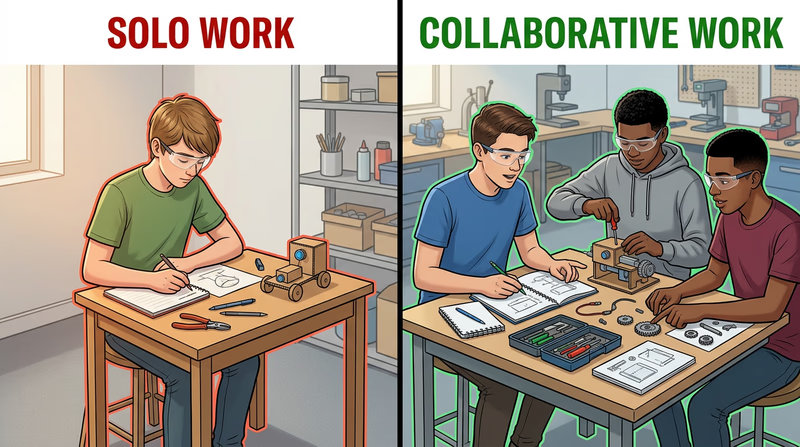
What to share with your counselor
Your counselor will probably want more than a simple summary like “we built a robot.” Explain:
- what the team was trying to accomplish
- what you observed about the inventing process
- what role teamwork played in improving the build
- what you personally learned from the experience
This connects well with Req 6 and Req 7. You already planned and built something yourself. Now you can compare solo inventing with group inventing.
FIRST Robotics A major youth robotics organization that shows how teams design, build, test, and improve useful systems together. Link: FIRST Robotics — https://www.firstinspires.org/The other option in Requirement 8 looks at inventing from a different angle: museums, exhibits, and public storytelling.
Req 8b — Visit an Inventing Exhibit
A great museum visit can make inventing feel real. You get to see the object, the time period, the problem it solved, and the story behind the people who built it. Good exhibits do more than display old things behind glass. They show how ideas changed lives.
What to look for at the exhibit
Do not try to remember every fact in the room. Focus on the invention story.
Ask yourself:
- What problem was the inventor trying to solve?
- What made this invention new or important?
- How did the invention affect daily life, work, health, travel, or communication?
- What details in the exhibit show how the design changed over time?
- What part of the invention story would be most interesting to your troop or patrol?
Notes to gather during your visit
These details will help you build a stronger presentation- Name of the inventor or invention
- Time period
- The problem it solved
- Important design features
- A challenge, failure, or revision in its history
- Why the invention still matters today
Make the presentation about ideas, not just facts
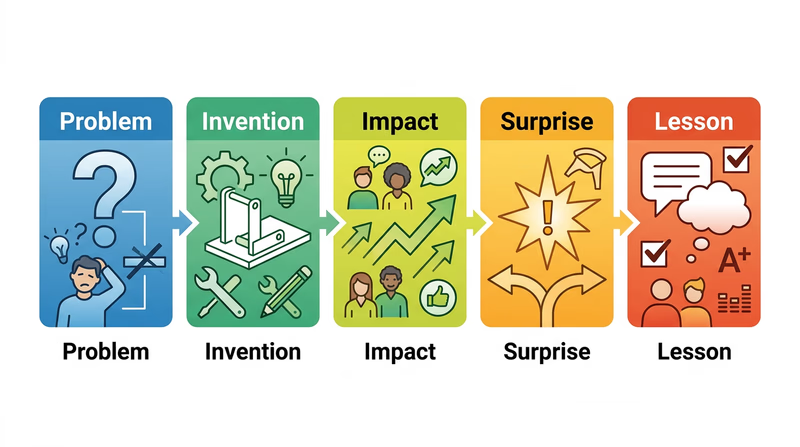
Your presentation should not feel like a long list of dates. Build it around a story:
- What problem existed?
- What was invented?
- Why did it matter?
- What surprised you most?
- What can your audience learn from it about inventing?
That structure will keep your talk clear and interesting.
Ways to make your presentation stronger
- compare an early version of the invention with a modern version
- include one surprising fact or moment of failure
- explain how the invention connects to a problem people still have today
- ask your troop or patrol a question such as, “What would you improve about this invention now?”
That last step turns your audience from listeners into inventors.
This option connects back to Req 1, where you looked at how inventions help humankind. A museum visit gives you concrete examples of that impact.
Smithsonian Lemelson Center for the Study of Invention and Innovation Exhibits and resources focused on the history of inventors, inventions, and the people affected by them. Link: Smithsonian Lemelson Center for the Study of Invention and Innovation — https://invention.si.edu/Next, you will look ahead to the future by thinking about the skills, preparation, and careers connected to inventing.
Req 9 — Skills and Careers of Inventors
Inventors are not all the same kind of person. Some are engineers. Some are designers. Some are mechanics, coders, medical researchers, teachers, or entrepreneurs. What connects them is not one job title. It is a set of habits: curiosity, observation, persistence, problem-solving, and the willingness to improve an idea instead of quitting when the first version fails.
Skills inventors use
Strong inventors often build a mix of technical and personal skills.
Core inventor skills
These skills matter in many inventing careers- Observation: noticing problems other people ignore
- Creativity: imagining new ways to solve those problems
- Communication: explaining ideas clearly to teammates, users, and customers
- Research: learning what already exists and what users really need
- Building and testing: turning ideas into models and prototypes
- Persistence: improving after failure instead of giving up
You have already practiced many of these in this badge. In Req 2, you learned from inventors. In Req 6 and Req 7, you went through the real inventing cycle yourself.
Education, training, and experience
There is no single school path that creates inventors. Some inventors study engineering, science, industrial design, computer science, or business. Others learn through trades, apprenticeships, military service, maker projects, or years of work in a field where they notice problems firsthand.
That is why the requirement says diverse skills, education, training, and experience. Inventors can come from many backgrounds.
How you can prepare now
You do not have to wait until adulthood to become more inventive. You can train that mindset right now.
- ask why things are designed the way they are
- fix or improve everyday problems at home
- learn to sketch your ideas clearly
- join clubs that build, test, or compete
- practice explaining your ideas out loud
- keep a notebook of frustrations, design ideas, and improvements
🎬 Video: What to do FIRST With Your Invention Idea — Patents Demystified — https://www.youtube.com/watch?v=9F-GXB-XAIs
Three career fields that use inventor skills
Here are three examples you could discuss with your counselor:
Product Design and Industrial Design
These professionals create physical products people use every day. They think about shape, comfort, materials, safety, cost, and appearance. Inventor skills matter because they must turn user needs into real objects.
Engineering
Engineers solve practical problems in fields like mechanical, electrical, civil, biomedical, aerospace, and environmental engineering. They design systems, test solutions, and improve how things work. Inventor skills matter because engineers often create new tools, devices, and processes.
Entrepreneurship and Startup Development
Entrepreneurs often identify a need, build a solution, and bring it to market. They may invent a product themselves or lead a team that does. Inventor skills matter because startups depend on spotting unmet needs and improving rapidly.
Other strong career examples include medical technology, robotics, software development, manufacturing, accessibility design, and outdoor gear design.
Bureau of Labor Statistics — Occupational Outlook Handbook Reliable career information you can use to explore jobs that depend on design, engineering, creativity, and problem-solving. Link: Bureau of Labor Statistics — Occupational Outlook Handbook — https://www.bls.gov/ooh/You have now finished the main badge requirements. The next page goes beyond the badge with deeper ideas, places to explore, and organizations connected to inventing.
Extended Learning
A. Congratulations
You finished a badge that asks you to do more than memorize facts. You noticed problems, studied inventors, protected ideas, improved gear, and built a prototype of your own. That is real creative work.
Inventing does not end with this badge. If anything, this is where it gets interesting. Once you start seeing the world through an inventor’s eyes, ordinary annoyances start looking like opportunities.
B. Deep Dive — What Makes an Invention Stick?
Some inventions are clever but disappear quickly. Others become part of everyday life. Why? Usually because they solve a real problem simply enough that people actually want to use them. A strong invention does not just work in theory. It fits into real routines, budgets, spaces, and habits.
That is one reason user needs matter so much. A product that is brilliant but confusing may fail. A design that looks impressive but costs too much may never spread. A tool that saves time but is hard to repair may frustrate users in the long run. Inventors who succeed learn to balance function, cost, durability, appearance, and ease of use.
Another reason inventions stick is timing. Sometimes an idea is good, but the materials, power sources, technology, or market are not ready yet. Other times, a simple improvement arrives at exactly the moment people need it. That is why inventing is partly about design and partly about understanding the world around you.
If you want to study invention more deeply, start comparing successful products with failed ones. Ask what made one design spread and another vanish. That question can teach you as much as building something yourself.
C. Deep Dive — Iteration Is the Real Superpower
Movies often show inventing as a single flash of genius. Real inventing usually looks more like revision. Sketch, test, adjust, repeat. The first version teaches you what the second version needs. The second version shows what the third version must fix.
That pattern is called iteration, and it is one of the most important habits in creative work. Engineers use it. Product designers use it. Software teams use it. Scientists use it. Scouts use it whenever they change a plan after a first attempt goes wrong.
If you want to grow as an inventor, learn to love small test versions. Make rough sketches. Build ugly models. Try ideas before you are emotionally attached to them. The faster you can test, the faster you can improve.
Iteration also makes failure less scary. A failed test is not proof that you are bad at inventing. It is information about what needs to change next. Inventors who improve steadily often beat inventors who wait too long for a perfect first try.
D. Deep Dive — Inventing for Inclusion and Access
One of the most powerful directions for invention is accessibility. These inventions help people move, communicate, learn, work, and participate more fully in daily life. That could mean a device for grip support, a better carry system, clearer visual cues, easier controls, or a process that removes a barrier.
Accessibility-focused inventing begins with humility. You do not start by assuming you already know the answer. You start by listening closely to the person or group facing the barrier. What is difficult? What is tiring? What is unsafe? What solution would actually help instead of just sounding helpful?
This kind of inventing can improve life for more people than you expect. A design created for accessibility often ends up being easier for everyone to use. Curb cuts are a famous example. They help wheelchair users, but they also help parents with strollers, travelers with luggage, and workers with carts.
If you want your future inventions to matter, train yourself to notice barriers. Inventors can make the world more fair as well as more efficient.
E. Real-World Experiences
Visit a maker space
Many communities have maker spaces with tools, mentors, and workshops for design, fabrication, and electronics. Seeing people prototype in real time is a great way to expand your own ideas.
Attend a robotics or engineering competition
Competitions show how teams solve problems under pressure. Watch how designs differ, how teams explain choices, and how they improve after setbacks.
Explore a patent search session
Spend an hour searching patents on gear, tools, or household items you use often. You will start noticing how many everyday objects contain inventive details you normally overlook.
Try a one-problem challenge
Pick one irritating problem at home, school, or camp and spend a week developing three different solution ideas. This is a great way to practice inventive thinking without waiting for a big project.
Interview another problem-solver
Even after the badge, keep talking to designers, engineers, mechanics, nurses, teachers, coders, and builders. Many of them invent improvements as part of their jobs even if they do not call themselves inventors.