Req 3 — Intellectual Property & Patents
This requirement introduces one of the biggest questions in inventing: if you create something useful, how do you protect it? You will learn what intellectual property is, how patents work, how to look up a real patent on gear you use, and what happens when someone copies protected work without permission.
- Req 3a: what intellectual property is and why it matters
- Req 3b: what a patent contains and the main patent types
- Req 3c: how to find and read a real patent on camping gear
- Req 3d: what patent infringement means
Requirement 3a
Intellectual property means creations of the mind that the law can protect. That includes inventions, written and artistic works, brand names, logos, and certain confidential business information.
In the United States, the two main federal agencies connected to this requirement are:
- United States Patent and Trademark Office (USPTO): handles patents and trademarks
- U.S. Copyright Office: handles copyright registration
Main types of intellectual property
- Patent: protects an invention or process for a limited time
- Trademark: protects brand names, logos, and symbols that identify goods or services
- Copyright: protects original creative works such as books, music, videos, software code, and art
- Trade secret: protects confidential business information, such as a secret formula or method, as long as it is kept secret
Why protection matters
Protection gives inventors and creators a reason to share and develop ideas. If anyone could instantly copy a new invention and sell it, the original inventor might never recover the time, money, and effort spent creating it. Protection can encourage investment, support new businesses, and reward creativity.
But protection also has limits. The goal is not to lock up ideas forever. It is to give creators a fair period of control and then, in many cases, allow knowledge to become part of the public record.
USPTO — What Is Intellectual Property? A clear introduction to patents, trademarks, and the purpose of intellectual property protection in the United States.Requirement 3b
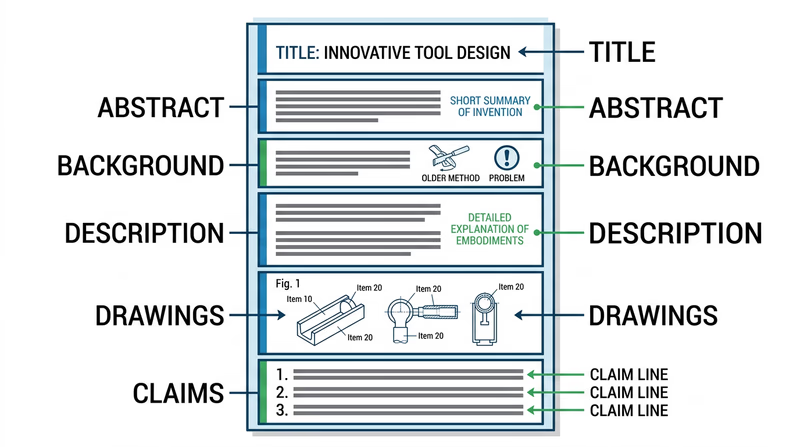
A patent is more than a certificate. It is a detailed legal and technical document. When you look at a patent, you will usually find these parts:
- Title: a short name for the invention
- Abstract: a brief summary of what the invention does
- Background: what problem existed before this invention
- Description or specification: a detailed explanation of how the invention works
- Drawings: labeled images showing parts, structure, or steps
- Claims: the most important legal section, stating exactly what the inventor says is protected
The claims matter most because they define the boundaries of the patent. Two products may look similar, but what counts legally is whether one product falls inside the claims of the patent.
Main patent types
- Utility patent: protects how something works, is used, or is made. This is the most common type.
- Design patent: protects the ornamental appearance of an item, not how it works.
- Plant patent: protects certain new and distinct plants that are reproduced asexually.
For this badge, you will mostly be dealing with utility and design patents because many camping and Scouting items use those forms of protection.
USPTO — Patents Basics An overview of what patents are, what they contain, and the main types recognized by the USPTO.Requirement 3c
This is where the topic becomes hands-on. Look at real gear you have used, such as a stove, lantern, cooler latch, water bottle cap, folding chair, trekking pole lock, or tent hardware. Many products have a patent number molded, stamped, printed, or labeled somewhere on the item or packaging.
Once you find a patent number, search for it online with your parent or guardian’s permission. Then compare the product in your hand with the patent drawings and claims.
What to compare
Patent comparison checklist
Notice how the real product matches the patent document
- Shape and parts: Do the main parts look like the drawings?
- Function: Does the product solve the same problem described in the patent?
- Special feature: What seems to be the protected improvement?
- Claims: Which claim sounds most closely connected to the version you used?
- Differences: Has the finished product changed in any visible way from the patent drawings?
Patent drawings are often simpler than the real product because they focus on what needs to be protected. The real item may include branding, color choices, textures, or extra features that do not appear in the patent.
This requirement connects directly to Req 5. When you evaluate a camping product later, you will start seeing how much thought goes into even small design choices.
Google Patents A searchable patent database that makes it easier to read patent drawings, claims, and background information for real products.Requirement 3d
Patent infringement happens when a person or company makes, uses, sells, offers to sell, or imports something covered by another person’s valid patent claims without permission.
A helpful way to think about it is this: having a similar idea is not the main question. The real question is whether the copied product or process falls within the legal claims of the patent.
That is why claims matter so much. If the claims describe a certain combination of parts or steps, and another product uses that same protected combination without authorization, that may be infringement.
What infringement is not
- It is not just “being inspired by” a product.
- It is not automatically copying every feature exactly.
- It is not decided by appearance alone.
Instead, it is a legal question about whether protected claimed features were used without permission.
Now you understand the basic rules that protect inventions. Next, you will look at another important question: when should inventions be shared openly, and when should they be kept private or protected more carefully?