Req 6 — Plan Your Invention
This requirement covers the full planning stage of inventing. You will identify a real problem, talk with people who would use your invention, sketch and describe your idea, build a model, and gather feedback before creating a working prototype in the next requirement.
- Req 6a: learn what users actually need and define the invention clearly
- Req 6b: build a simple model and plan materials for a prototype
- Req 6c: show the idea to others and record their feedback
A notebook matters here because inventing is a process, not a single moment. Your notes show how the idea changed and why.
Requirement 6a
Do not start by falling in love with your first idea. Start with the people who have the problem.
If your invention is for your troop, ask troop members what slows them down or frustrates them. If it is for your family, ask who deals with the problem most often. If it is for a community group, ask what makes the task difficult now.
Questions for potential users
User interview starter questions
Ask these before you finalize your design
- What problem happens most often?
- When does it happen?
- What makes it annoying, slow, unsafe, or expensive?
- What have people already tried?
- What would a better solution need to do?
- What would make the solution easy to use?
After those conversations, write a clear problem statement and invention statement.
A useful pattern is:
- Problem statement: “Our troop needs a better way to ___.”
- Invention statement: “I want to invent a ___ that will help by ___.”
Then make a detailed sketch. Labels help a lot. Show moving parts, connection points, important dimensions if needed, and the main feature that solves the problem.
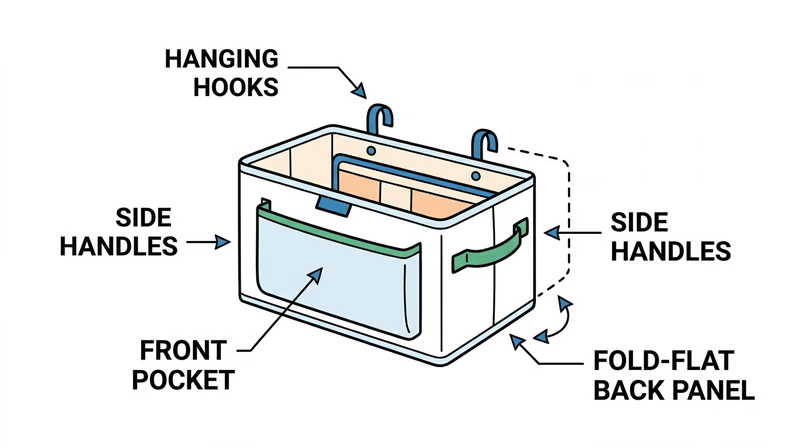
Requirement 6b
A model is not the same thing as a fully working prototype. A model helps you test size, layout, shape, and how parts fit together. Cardboard, paper, foam board, tape, string, clay, and recycled materials are all fine for this step.
Your model should answer basic design questions like:
- Is the invention too large or too small?
- Can a user reach the important parts?
- Does the shape make sense for the job?
- Are there weak points you can already spot?
Then make a materials list for the working prototype you hope to build next.
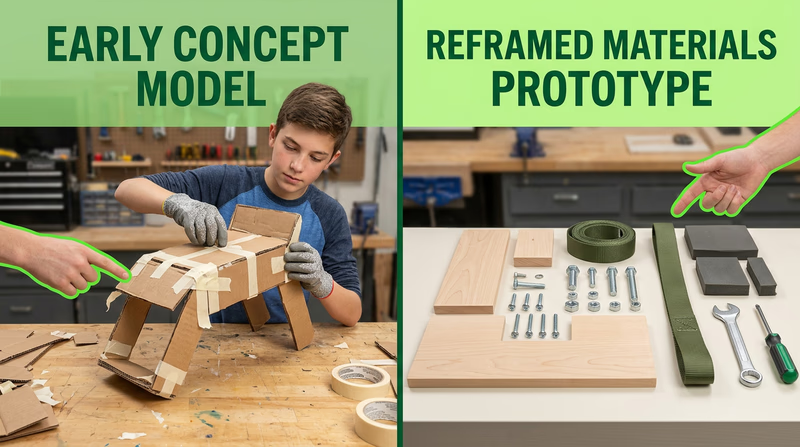
Think ahead to prototype materials
Your list might include:
- wood, plastic sheet, or metal parts
- fasteners like screws, bolts, nuts, or rivets
- adhesives
- fabric, webbing, foam, or rubber
- electronics such as batteries, switches, LEDs, or sensors
- tools needed for cutting, drilling, measuring, or assembly
Requirement 6c
This step can be hard because it asks you to let other people criticize your idea. But that is exactly what good inventors do. Feedback is not a sign that your idea failed. It is how your idea gets better.
When you show the model, ask people to react honestly.
Useful feedback prompts
Ask for comments that help you improve the invention
- What part seems most useful?
- What part seems confusing?
- What could break, wear out, or cause frustration?
- What would make this easier to carry, store, or clean?
- Would you actually use this? Why or why not?
- What change would help the most?
Record feedback in a notebook as clearly as you can. Separate comments into categories such as function, comfort, safety, durability, and appearance. That will help you later in Req 7 when you build and evaluate the prototype.
MIT Lemelson — Inventing Resources Resources and stories focused on the real process of invention, including user needs, prototypes, and iteration.You now have the foundation for your own invention: a real problem, user input, a sketch, a model, and feedback. Next comes the exciting part — building a working prototype and seeing how close your idea comes to the real world.