Req 7 — Prototype, Test, Improve
This is the moment when your invention stops being mostly an idea and starts becoming real. A working prototype does not have to be perfect, pretty, or ready for store shelves. It does need to perform the main job you designed it to do.
What a working prototype should prove
Your prototype should answer this question: Does the invention actually solve the problem in a real test?
That means the test should match the real use case as closely as you can manage. If you designed a troop gear organizer, test it with real gear. If you designed a camping accessory, test it in a realistic setup. If you designed something for your family, let family members try it.
Five evaluation areas to cover
The requirement already gives you a useful scorecard.
Prototype evaluation
Look at each of these areas when you test
- Cost: How expensive would it be to build again? Are the materials reasonable?
- Usefulness: Does it actually help the user solve the original problem?
- Marketability: Would other people want it, buy it, or choose it over something else?
- Appearance: Does it look organized, sturdy, and understandable to use?
- Function: Does it work reliably, or only sometimes?
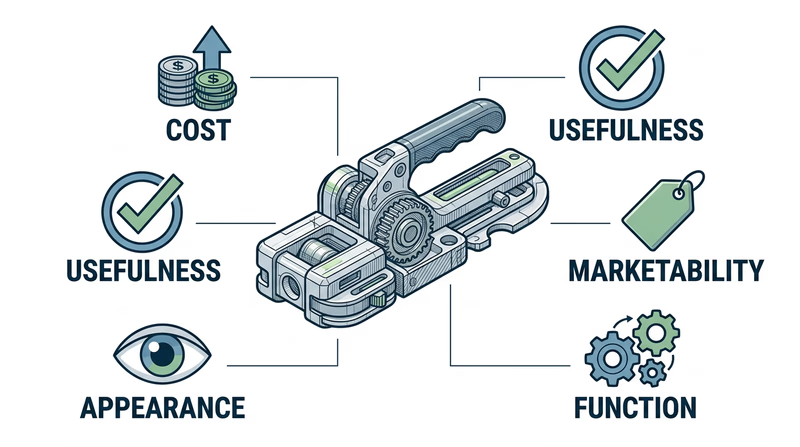
You do not need every category to be amazing. But you do need to think honestly about each one.
Compare your original vision with reality
This is one of the most valuable parts of inventing. Maybe your idea looked simple on paper but became awkward in real life. Maybe the invention worked better than expected but cost more to build. Maybe users liked the function but disliked the shape or size.
That is normal. Real inventing almost always reveals a gap between the original vision and the first real build.
How to test the prototype well
A useful test is repeatable and clear. Try to answer:
- what exact task the invention should perform
- how many times it should perform it
- what counts as success
- what failure or weakness you are watching for
For example, if your invention is meant to save setup time, compare setup time before and after. If it is meant to improve storage, test how much it holds and how easy it is to access items. If it is meant to improve comfort, let multiple users try it and compare reactions.
Counselor critique matters
Your counselor’s evaluation is not just a final checkmark. It is another round of feedback from someone who can look at your invention with fresh eyes. Listen for comments about:
- safety
- practicality
- simplicity
- durability
- whether the invention really solves the stated problem
Bring your notebook, sketches, and earlier feedback with you. That way, your counselor can see how the project developed from idea to prototype.
This requirement pulls together almost everything from Req 5 and Req 6: spotting problems, planning carefully, listening to users, and improving after critique.
National Institute of Standards and Technology — STEM Resources Resources about testing, measurement, and practical engineering thinking that can strengthen the way you evaluate a prototype.After building and testing your own invention, you will zoom back out and look at inventing in clubs, teams, and museums.