 Getting Started
Introduction & Overview
A breaking story can begin almost anywhere: a city council vote, a storm rolling through town, a championship game, or a Scout event where something unexpected happens. Journalism is the work of noticing what matters, checking the facts, and helping other people understand what happened and why it matters.
The Journalism merit badge teaches you how news is gathered, shaped, and shared across print, online, audio, video, and photography. It also asks you to think about something bigger than writing style: how a free press protects the public by asking questions, verifying claims, and telling the truth as accurately and fairly as possible.
Then and Now
Then — Broadsheets, Printers, and Penny Papers
Early American journalism moved slowly by modern standards. Printers published broadsheets, pamphlets, and newspapers that carried speeches, political arguments, shipping news, and reports from faraway places. Editors often had strong opinions, and many papers openly supported one political side or another.
Even so, the press became one of the main ways ordinary people learned what leaders were doing. By the 1800s, cheaper printing and rising literacy helped create the “penny press” — newspapers sold for a penny that reached a much larger audience. Reporters covered crime, politics, business, and daily life, and journalism started becoming a profession instead of just a sideline for printers and politicians.
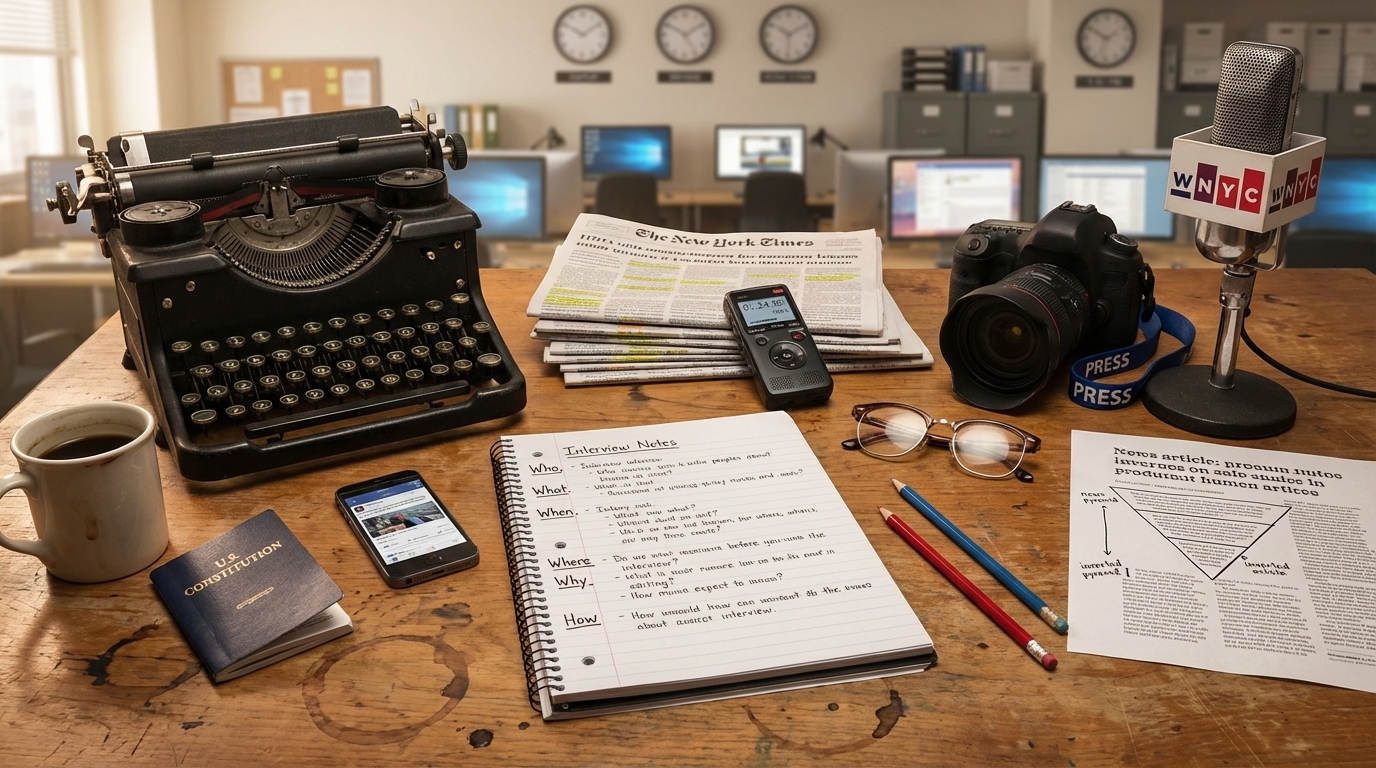
- Main tools: Printing presses, telegraph wires, notebooks, and deadlines tied to delivery wagons and train schedules
- Big challenge: Getting verified information quickly enough to print before the next edition
Now — Digital Publishing and 24/7 News
Today, a journalist might write a text story, record audio for a podcast, shoot video on a phone, post verified updates online, and answer questions on social media — all in the same day. News moves fast, but the core job has not changed: gather facts, confirm them, give context, and explain them clearly.
Modern journalism also includes many specialties. Local reporters cover school boards and public safety. Investigative teams dig through records for months. Photojournalists tell stories with images. Data journalists use spreadsheets and charts to reveal patterns. Audience editors think about how stories reach readers on phones and social platforms.
- Main tools: Laptops, smartphones, editing software, public records databases, live video, and analytics dashboards
- Big challenge: Working quickly without spreading rumors, half-truths, or manipulated content
Get Ready!
You do not need to sound like a famous anchor or write like a seasoned columnist to begin this badge. You just need curiosity, careful observation, and the willingness to ask one more question when something does not quite add up.
Kinds of Journalism
Local News Reporting
Local journalism focuses on the meetings, decisions, events, and people that shape everyday life in a community. That might mean covering a school board vote, interviewing the fire chief after a storm, or writing about a new park project. Local reporters often know their communities well, which helps them notice what is changing and what questions still need answers.
Investigative Journalism
Investigative reporters do not just describe events. They follow documents, interviews, data, and public records to uncover patterns, waste, corruption, or hidden problems. This kind of work can take weeks or months, and it depends on patience, accuracy, and fairness.
Broadcast Journalism
Broadcast journalists work in radio, television, streaming, and podcasts. They think about sound, timing, pacing, and visuals as much as word choice. A story for radio must make sense through sound alone. A story for television or video must pair facts with useful images.
Photojournalism
Photojournalism tells the story with images. A strong photo can capture emotion, action, setting, and detail in a single moment. Good photojournalists still follow the same ethical rules as writers and broadcasters: do not mislead, do not stage reality, and make sure captions are accurate.
Opinion and Review Writing
Not every piece of journalism is straight news. Editorials, columns, criticism, and reviews can include judgment and opinion. The important part is honesty: readers should be able to tell when they are reading verified reporting and when they are reading analysis or commentary.
Now that you know how journalism developed and the many forms it takes today, you are ready to start with the rights and responsibilities that shape every good story.