Req 5 — Paddle Skills & Paddle Care
This requirement focuses on the paddle itself and the habits that make it work well. You will cover:
- How to use a kayak paddle efficiently
- What each major part of the paddle is called
- How to care for a paddle so it stays reliable
Requirement 5a
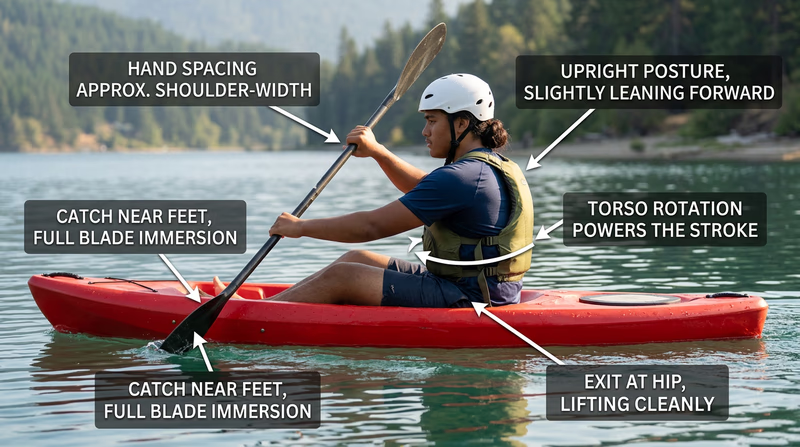
Many beginners try to move a kayak with their arms alone. That works for a few minutes, then the shoulders get tired and the strokes get sloppy. Good paddling uses your torso, posture, and rhythm. The paddle is not just something you pull with. It is a tool you plant in the water so your body can move the boat past it.
A correct grip starts with hands spaced comfortably on the shaft and blades oriented the right way. Keep a tall posture, relax your shoulders, and rotate from your torso instead of curling forward. Catch the water near your feet, move through the power phase smoothly, and finish before the stroke drifts too far behind your hip.
Good Technique Habits
- Hold the paddle with a firm but not crushing grip.
- Sit tall so your core can help.
- Rotate your chest toward the stroke instead of pulling with bent arms only.
- Keep strokes smooth and repeatable.
- Match the stroke to the result you want: forward travel, turning, sideways movement, or stopping.
Efficient Paddle Use
What counselors usually want to see
- Balanced hand position on the shaft.
- Correct blade orientation before each stroke.
- Torso rotation instead of arm-only paddling.
- Good posture and balance in the seat.
- Controlled finish so the stroke stays useful and does not waste effort.
Requirement 5b
Most kayak paddles have two blades connected by a shaft. The outer ends of the blades are the tips. The area where the blade meets the shaft is often called the shoulder or throat area, depending on design. Some paddles have adjustable ferrules that let you separate the paddle into sections and sometimes change feather angle.
Knowing paddle parts matters for setup, instruction, and care. If someone tells you to inspect the shaft for cracks or says the blade edge is chipped, you should understand what they mean.
Common Paddle Terms
- Blade: The flat part that goes in the water.
- Shaft: The section you hold with your hands.
- Tip: The far end of the blade.
- Shoulder / throat area: Transition between shaft and blade.
- Ferrule: Joint where a two-piece paddle comes apart and reconnects.
- Feather angle: The offset between the two blades on some paddles.
Requirement 5c
A paddle looks simple, but it deserves the same attention as the kayak. Small cracks, loose ferrules, or damaged blade edges can get worse under stress. A paddle also gets dropped on parking lots, trapped under gear, and scraped on rocky launches.
After paddling, rinse off dirt, sand, and saltwater. Check the shaft for cracks or dents, especially on lightweight materials. Inspect the blades for chips and loose edges. If the paddle is adjustable or separates into pieces, make sure the ferrule still locks securely and is free of grit.
Avoid using a paddle as a pry bar, push pole, or drag handle for the boat. That kind of misuse is a fast way to damage it.
Basic Paddle Care
Quick checks that keep a paddle dependable
- Rinse after use if exposed to sand, mud, or salt.
- Inspect blades for cracks or severe chips.
- Inspect shaft for wear, bends, or damage.
- Check ferrule and buttons on two-piece paddles.
- Store out of harsh sun and heavy pressure when possible.
These paddle basics lead directly into the next major skill set: what to do when you capsize, exit, rescue, and recover without panic.