Req 7 — Essential Kayak Strokes
This requirement covers the core strokes that make a kayak respond on purpose instead of by accident. You will demonstrate:
- Forward stroke
- Backstroke
- Forward sweep
- Reverse sweep
- Draw stroke
- Stern draw
Think of these as the paddler’s vocabulary. In Req 5, you learned how the paddle works. Now you are learning what to say with it.
Requirement 7a
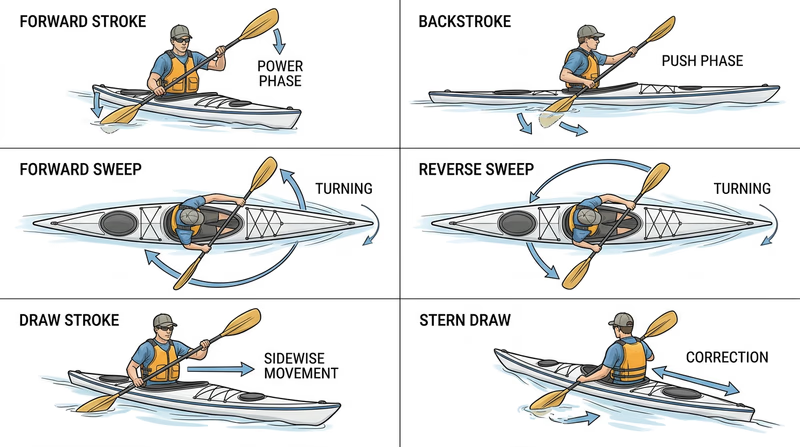
The forward stroke is your main engine. A good one moves the kayak ahead efficiently while helping you stay balanced and in rhythm. The stroke begins with a clean catch near your feet, uses torso rotation through the power phase, and finishes around your hip.
Requirement 7b
The backstroke moves the boat backward and helps with stopping or repositioning. It is especially useful in tight spaces, near docks, or when correcting position before another maneuver. Keep it controlled so the blade does not dive too deep or throw off your balance.
Requirement 7c
A forward sweep turns the kayak by making a wide arcing stroke from front to back. It is larger than a standard forward stroke and is meant to pivot the bow away from the paddling side.
Requirement 7d
The reverse sweep works in the opposite direction, helping turn the kayak by using an arc from back toward front. Together, the forward and reverse sweeps give you strong turning tools without having to stop completely.
Requirement 7e
The draw stroke moves the kayak sideways. You place the blade out from the boat and draw water toward the hull. This is useful for moving toward a dock, lining up next to another kayak, or making small positioning changes.
Requirement 7f
The stern draw is a steering stroke used near the rear of the kayak while the boat is moving. It helps the kayak keep tracking where you want or make small heading changes without a full sweep stroke.
How These Strokes Work Together
No stroke lives alone. You often use one to set up another. A forward stroke builds movement. A sweep changes direction. A stern draw fine-tunes the turn. A backstroke slows or resets position. Skilled paddlers blend strokes smoothly instead of treating each one like a separate trick.
What Strong Stroke Demonstrations Show
Things a counselor will notice
- Balanced posture in the seat.
- Torso rotation instead of arm-only paddling.
- Clean blade placement in the water.
- Purposeful finish rather than random splashing.
- Control of the boat’s response after each stroke.
These six strokes are your toolkit. Next you will apply them to real boat-handling tasks such as paddling straight, pivoting, moving sideways, stopping, reversing, and completing a figure 8 course.