Req 4 — Mapping Water, Access, and Comfort
This requirement turns you into a field investigator and a beginner designer. You will measure an arrival area, map what is already there, study how water moves, and then propose changes that make the place safer and more comfortable.
This page covers three connected tasks:
- 4a: make a measured site plan of the main entry area
- 4b: map how water drains across that plan
- 4c: redesign the area to improve comfort and safety
Requirement 4a
A site plan is a top-down view of a place. It does not need to look fancy, but it must be clear and accurate enough that someone else could understand the layout.
Start by choosing a study area that is large enough to show how people arrive and move toward the building, but small enough that you can measure it carefully. Include the drop-off or parking edge, the main walk, and the immediate area near the entrance.
A Good Measuring Process
- Pick one baseline, such as the edge of a sidewalk or building wall.
- Measure major lengths first: the walk, driveway width, planting bed edges, and distance to the door.
- Add fixed objects next: poles, drains, benches, signs, trees, utility boxes, and lights.
- Label features as you go so nothing gets forgotten later.
- Write the drawing scale clearly, such as 1 inch = 5 feet.
🎬 Video: Create Your Own Landscape Design | Site Survey (video) — https://youtu.be/6fLp1fWKzjQ?si=9c4WHFrHoS30ltSk
What Your Original Site Plan Should Show
These are the features your counselor will expect to see
- Arrival areas: bus drop-off, parking edge, or driveway approach
- Main pedestrian route: sidewalk or path to the front entry
- Structures: building edge, walls, canopies, signs, fences, or railings
- Planting: trees, shrubs, lawn panels, beds, or ground covers
- Site furnishings: benches, lights, trash cans, bike racks, or planters
- Water features: drains, ditches, low points, or visible slopes
- Utilities and obstacles: hydrants, utility boxes, poles, or grates
Requirement 4b
This step is about seeing a site the way water sees it. Rain does not care where you hoped people would walk. It follows gravity. If the grading is poor, water can make entries muddy, icy, slippery, or inaccessible.
Look for clues even if it is not raining during your visit:
- staining on pavement or walls
- eroded mulch or exposed roots
- sediment near curbs or drains
- low spots in turf
- cracked edges where runoff cuts across soil
- moss or damp areas that stay wet longer than the rest of the site
Draw arrows to show likely flow direction. Mark any ditch, swale, drain, or basin. If you know where puddles form after storms, label those too.
Requirement 4c
Now you get to think like a problem solver. Your redesign should respond to the issues you observed, not just add random features. If people stand in the rain near the curb, a covered waiting area may make sense. If runoff crosses the main path, you may need grading changes, a drain, or a rain garden. If the entrance is hard to find, a wider walk, better planting frame, or clearer lighting might help.
A strong redesign usually improves several things at once:
- safety by reducing conflicts between cars and people
- comfort through shade, shelter, seating, and smoother circulation
- clarity by making the arrival sequence easier to understand
- drainage by moving or capturing runoff more effectively
- appearance by organizing plants and site elements into a more unified whole
Ideas You Might Consider
| Problem you observed | Possible redesign move |
|---|---|
| People crowd near the curb with no shelter | Add a covered waiting area and bench seating |
| Walkway is too narrow or indirect | Widen or realign the path |
| Parking dominates the arrival view | Add trees, planting islands, or screening shrubs |
| Water crosses the path | Add grading improvements, drains, or a bioswale |
| Entrance is hard to read | Use paving emphasis, entry trees, lighting, or signage |
| No place to pause | Add benches in shade near but not blocking circulation |
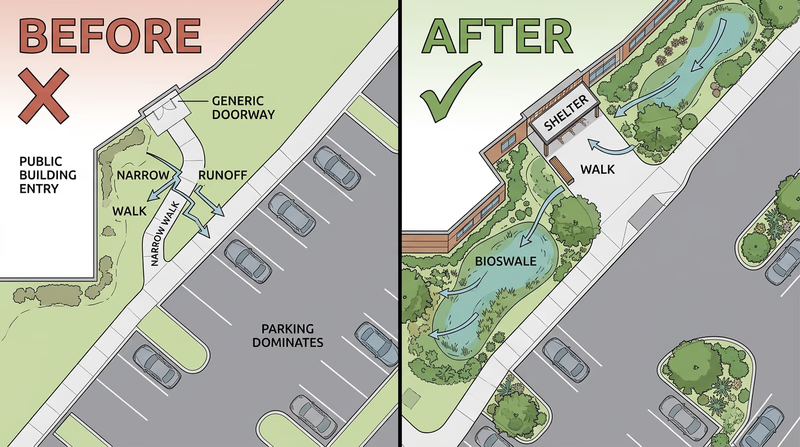
How to Explain Your Redesign
Your counselor will want to hear why you changed what you changed. Use a sentence pattern like this:
- “I moved this walkway because…”
- “I added shade trees here because…”
- “I marked runoff arrows to show that water currently…”
- “I placed a bench here because users need a place to wait without blocking the entrance…”
That kind of explanation shows design thinking, not just drawing skill.
This requirement also connects strongly to Req 2. The same ideas are here again: entry sequence, paths, comfort, planting function, and drainage. The difference is that now you are the one proposing improvements.
EPA Green Infrastructure at Schools Introduces practical drainage and stormwater ideas such as rain gardens, permeable surfaces, and planted areas that can improve school and civic sites. Link: EPA Green Infrastructure at Schools — https://www.epa.gov/green-infrastructure/what-green-infrastructureIf you can explain the existing site clearly and defend your redesign decisions, you are doing real introductory landscape architecture work. The final requirement asks you to explore where those skills could lead as a career.