Extended Learning
A. Introduction
Congratulations on completing the Law merit badge requirements! You now have a solid understanding of what law is, where it comes from, and how it shapes our daily lives. But the legal world is vast, and there is so much more to explore. Whether you are considering a career in law or simply want to be a more informed citizen, the resources and experiences below will help you keep learning.
B. Deep Dive: How a Bill Becomes a Law
You have learned about the sources of law and the different types of legal systems. But how does a new law actually get created? The process is longer and more complex than most people realize.
It begins with an idea. Anyone can suggest a new law — a citizen, an interest group, a government agency — but only a member of Congress (a senator or representative) can formally introduce a bill. The member who introduces it becomes the bill’s sponsor.
Once introduced, the bill is assigned to a committee that specializes in the subject matter. For example, a bill about environmental protection would go to the Environment and Public Works Committee. The committee studies the bill, holds hearings where experts and citizens testify, and may rewrite parts of it. Most bills die in committee — they never make it to a vote.
If the committee approves the bill, it goes to the full chamber (the Senate or House of Representatives) for debate and a vote. If it passes one chamber, it must then pass the other chamber in the same form. If the two chambers pass different versions, a conference committee works out a compromise.
Once both chambers pass the same version, the bill goes to the President, who can either sign it into law or veto it. Congress can override a presidential veto, but it takes a two-thirds vote in both chambers — a very high bar.
The entire process can take weeks, months, or even years. Of the thousands of bills introduced each session of Congress, only a small fraction become law. This is by design — the Founders wanted lawmaking to be deliberate and difficult, so that only well-considered laws would pass.
C. Deep Dive: The U.S. Court System
Understanding how courts are organized helps you see how the legal system fits together. The United States actually has two parallel court systems — federal and state — and each has multiple levels.
Federal Courts handle cases involving federal law, the Constitution, disputes between states, and cases involving the U.S. government. The federal system has three levels:
- U.S. District Courts — The trial courts where federal cases begin. There are 94 district courts across the country.
- U.S. Courts of Appeals — Also called circuit courts, these handle appeals from district courts. There are 13 circuits, each covering a group of states.
- The U.S. Supreme Court — The highest court in the land. It has nine justices and is the final word on what the Constitution means. The Supreme Court hears only about 70–80 cases per year out of the thousands of petitions it receives.
State Courts handle the vast majority of legal cases — over 95% of all cases in the United States are decided in state courts. Each state organizes its courts differently, but most have a similar three-tier structure: trial courts, appellate courts, and a state supreme court.
A case typically starts in a trial court, where evidence is presented and a judge or jury makes a decision. If the losing side believes a legal error was made, they can appeal to a higher court. Appellate courts do not hold new trials — they review the trial court’s record to decide whether the law was applied correctly.
D. Deep Dive: Your Rights If You Are Stopped by Police
As a young person, it is important to know your constitutional rights during interactions with law enforcement. This knowledge protects you and helps you handle these situations calmly and safely.
The Fourth Amendment protects you from unreasonable searches and seizures. Police generally need a warrant to search your home or belongings, though there are important exceptions (like searches during a lawful arrest or when evidence is in plain view).
The Fifth Amendment gives you the right to remain silent. You do not have to answer questions that might incriminate you. If you are arrested, police must read you your Miranda rights before questioning you.
The Sixth Amendment guarantees your right to an attorney. If you are arrested and cannot afford a lawyer, one will be appointed for you.
Understanding your rights is not about being confrontational — it is about being informed. Knowing what the law says helps you stay safe and make good decisions.
E. Real-World Experiences
These experiences bring the law to life beyond the merit badge requirements.
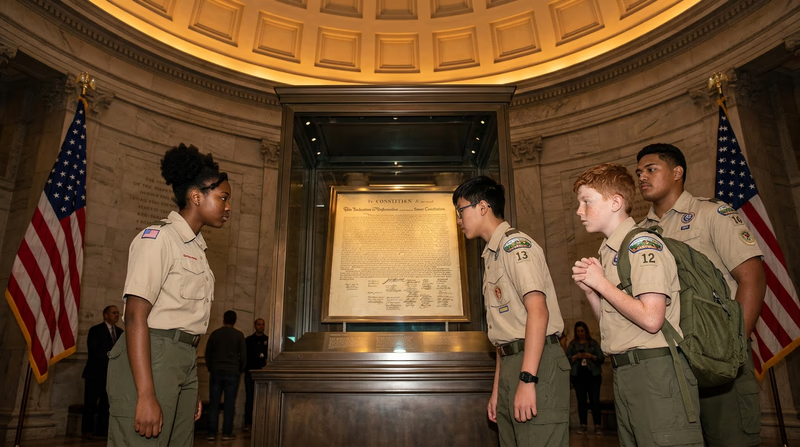
Visit the National Archives
Attend a City Council or School Board Meeting
Tour Your County Courthouse
Participate in a Youth Court Program
Join a Mock Trial or Debate Team
F. Organizations
These organizations offer resources, programs, and opportunities for young people interested in law and justice.
The largest professional organization for lawyers in the United States. Their Division for Public Education offers programs and resources specifically for students.
Founded by retired Supreme Court Justice Sandra Day O’Connor, iCivics provides free educational games and resources that teach students about government, law, and civic participation.
A nonprofit that creates programs and materials to educate young people about law, democracy, and human rights. Their classroom curriculum is used in schools nationwide.
An interactive museum in Philadelphia dedicated to the U.S. Constitution. Offers online exhibits, podcasts, and educational resources for students of all ages.
The nation’s largest funder of civil legal aid for low-income Americans. Their website connects people to free legal help across all 50 states.