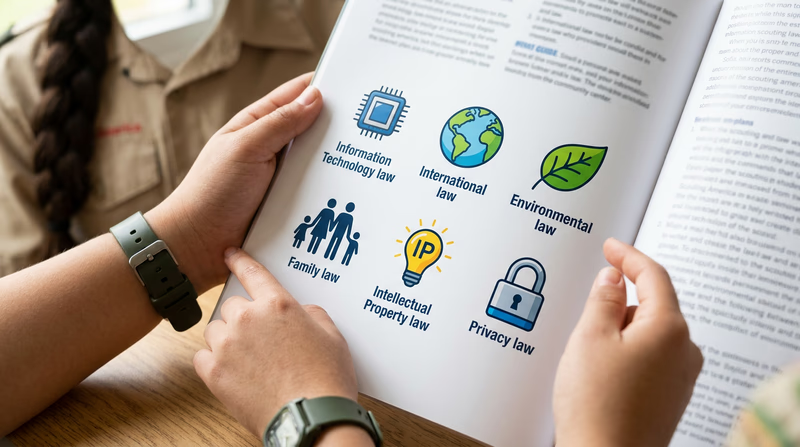
Req 11 — Areas of Law
(a) Administrative Law
Administrative law governs how government agencies make and enforce rules. Congress and state legislatures pass broad laws, but agencies like the Environmental Protection Agency (EPA), the Federal Communications Commission (FCC), and the Food and Drug Administration (FDA) write the detailed regulations that carry out those laws.
Why it matters: Administrative law affects nearly every part of daily life — the safety of your food, the quality of your drinking water, the radio frequencies your phone uses, and the standards your school must meet. When an agency proposes a new rule, citizens and businesses have the right to comment on it, ensuring public participation in government decisions.
(b) Alternative Dispute Resolution
Not every disagreement needs to go to court. Alternative Dispute Resolution (ADR) refers to methods of resolving conflicts outside the traditional courtroom setting. The two most common forms are:
- Mediation — A neutral third party (the mediator) helps both sides communicate and reach a voluntary agreement. The mediator does not decide who is right or wrong.
- Arbitration — A neutral third party (the arbitrator) hears both sides and makes a binding decision, similar to a judge. It is faster and usually cheaper than going to court.
Why it matters: Courts are expensive and slow. ADR gives people a faster, less costly way to resolve disputes. Many contracts — including the ones you agree to when signing up for apps and services — include clauses requiring disputes to be settled through arbitration rather than in court.
(c) Bankruptcy
Bankruptcy is a legal process that helps people or businesses who cannot pay their debts get a fresh start. Under federal bankruptcy law, a person can ask a court to either reorganize their debts (create a payment plan) or discharge them (wipe them out and start over).
The two most common types for individuals are:
- Chapter 7 — Most debts are eliminated, but you may have to give up some property
- Chapter 13 — You keep your property but follow a court-approved plan to repay debts over 3–5 years
Why it matters: Without bankruptcy protection, people crushed by medical bills, job loss, or other financial disasters would have no legal path to recovery. Bankruptcy gives them a second chance while still protecting creditors’ rights. It also helps businesses restructure and save jobs rather than shutting down completely.
(d) Biotechnology Law
Biotechnology law deals with the legal and ethical issues around biological research and technology — genetic engineering, gene therapy, cloning, stem cell research, genetically modified organisms (GMOs), and DNA testing.
Why it matters: Science is advancing faster than the law can keep up. Can a company patent a human gene? Should genetically modified crops be labeled? How should DNA evidence be used in criminal cases? Biotechnology law grapples with some of the most complex and controversial questions of our time, balancing scientific progress with ethical boundaries and public safety.
(e) Environmental Law
Environmental law protects the natural world — air, water, land, and wildlife — from pollution and destruction. Major federal environmental laws include the Clean Air Act, the Clean Water Act, and the Endangered Species Act.
Why it matters: Without environmental laws, companies could dump waste into rivers, pollute the air without limits, and destroy wildlife habitats without consequence. These laws set standards for pollution control, require environmental impact assessments before major projects, and hold polluters accountable. Environmental law connects directly to the Scout Outdoor Code: “I will be clean in my outdoor manners” and “I will be conservation-minded.”
(f) Family Law
Family law covers legal matters involving family relationships — marriage, divorce, child custody, adoption, child support, and domestic violence protection. Family courts handle some of the most emotionally charged cases in the legal system.
Why it matters: Family law directly affects millions of people. When parents divorce, family law determines where children live, who makes decisions about their education and healthcare, and how financial support is handled. Adoption laws ensure children are placed in safe, loving homes. Domestic violence laws protect victims and hold abusers accountable.
(g) Immigration Law
Immigration law governs who can enter, live, and work in the United States. It covers visas, green cards, citizenship, asylum, deportation, and border security. Immigration law is primarily federal — meaning the national government, not individual states, makes the rules.
Why it matters: The United States has always been a nation of immigrants, and immigration law shapes who gets the opportunity to become part of American society. It balances national security with humanitarian responsibilities, economic needs, and family reunification. Immigration cases can be life-changing for the people involved, affecting where they live, whether families stay together, and whether someone fleeing danger can find safety.
(h) Information Technology Law
IT law (also called cyber law) addresses legal issues created by computers, the internet, and digital technology — cybercrime, data breaches, online fraud, digital contracts, social media regulation, and the legal responsibilities of tech companies.
Why it matters: Technology evolves far faster than the law. Who is responsible when a company’s data breach exposes your personal information? Is it legal for a website to track your every click? Can you be held responsible for what you post online? IT law is one of the fastest-growing and most dynamic areas of legal practice, and it affects anyone who uses a phone, computer, or the internet — which means virtually everyone.
(i) Intellectual Property Law
Intellectual Property (IP) law protects creations of the mind. The three main types of IP protection are:
- Copyright — Protects original creative works like books, music, movies, software, and artwork. Copyright protection is automatic the moment you create something.
- Patents — Protect inventions and new processes. You must apply for a patent, and it gives you exclusive rights to your invention for a limited time (usually 20 years).
- Trademarks — Protect brand names, logos, and slogans that identify a business. Think of the Nike swoosh or the McDonald’s golden arches.
Why it matters: Without IP law, anyone could copy your song, steal your invention, or use your company’s name to sell inferior products. IP law encourages innovation and creativity by ensuring that creators and inventors benefit from their work. It also protects consumers by preventing confusion about who makes a product.
(j) International Law
International law governs relationships between countries. It includes treaties, trade agreements, human rights conventions, laws of war, and the rules of international organizations like the United Nations.
Why it matters: No single country can solve global problems alone. International law provides a framework for cooperation on issues like climate change, terrorism, trade, and human rights. It establishes rules for how countries treat each other — and how they treat their own citizens. While enforcement can be challenging (there is no “world police”), international law represents humanity’s best effort at creating a peaceful global order.
(k) Privacy Law
Privacy law protects your right to control your personal information — who collects it, how it is used, and who can see it. Key U.S. privacy laws include HIPAA (health records), FERPA (school records), COPPA (children’s online data), and various state-level data privacy laws.
Why it matters: In the digital age, your personal data is collected constantly — by apps, websites, stores, schools, and government agencies. Privacy law sets limits on what organizations can do with your information. It protects your medical records from being shared without permission, your school grades from being made public, and your online activity from being sold to advertisers without your knowledge. As technology advances, privacy law is becoming one of the most important areas of legal practice.
Preparing for Your Discussion
Areas of Practice — American Bar Association The ABA organizes its work by legal specialty — browse their sections to learn more about any area of law.