Req 2 — Landmarks in Legal History
Option A: Three Foundational Legal Documents
These three documents span nearly 3,500 years of history. Each one changed the way people thought about law, justice, and the rights of individuals.
The Code of Hammurabi (c. 1754 BCE)
King Hammurabi ruled Babylon (in present-day Iraq) and created one of the oldest known written legal codes. He had 282 laws carved into a tall stone pillar called a stele and placed it in a public area so everyone could read the rules. The laws covered everything from property disputes to marriage to wages for workers.
Hammurabi’s Code is famous for the principle of “an eye for an eye” — the idea that punishment should match the severity of the crime. While that sounds harsh by modern standards, it was actually a step forward. Before written laws, powerful people could punish others however they wanted. Hammurabi’s Code set limits on punishment and made the rules the same for everyone (though penalties did vary by social class).
Justinian’s Code (529–534 CE)
Nearly 2,300 years after Hammurabi, Roman Emperor Justinian I ordered scholars to collect and organize the entire body of Roman law. The result was the Corpus Juris Civilis (Body of Civil Law), a massive work that brought together centuries of Roman legal thought into one organized system.
Justinian’s Code is one of the most influential legal works in history. It became the foundation for the legal systems of most European countries, and its ideas about contracts, property, and civil rights still echo in modern law. If you have ever heard the legal phrase “innocent until proven guilty,” you can thank the Romans.
The Magna Carta (1215 CE)
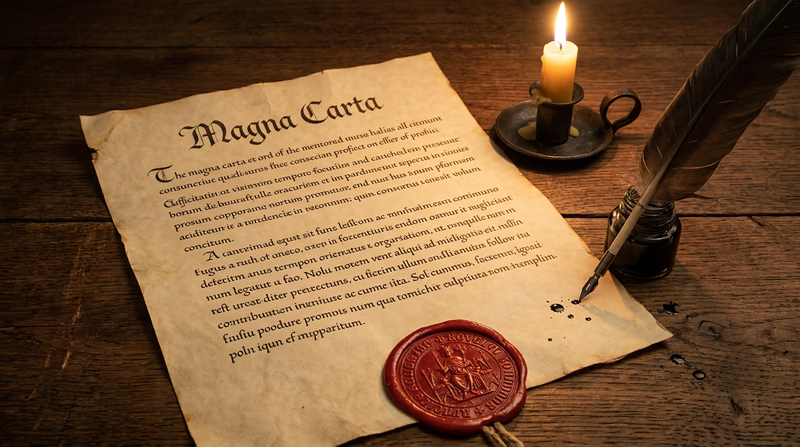
In England, King John was taxing his nobles heavily and punishing anyone who challenged him. In 1215, a group of rebellious barons forced the king to sign a document called the Magna Carta (Latin for “Great Charter”). It established a groundbreaking idea: the king is not above the law.
Key principles from the Magna Carta include:
- No one can be imprisoned without a legal process (the seed of habeas corpus)
- Taxes cannot be imposed without the consent of a council (taxation with representation)
- Justice cannot be sold, delayed, or denied
The Magna Carta directly influenced the U.S. Constitution and the Bill of Rights. When the Founders wrote about “due process of law,” they were building on ideas that English barons fought for over 800 years ago.
Option B: The Development of the Jury System
The right to a trial by jury is one of the cornerstones of American justice. But where did the idea come from?
Ancient Roots
The concept of having ordinary citizens decide guilt or innocence dates back to ancient Athens (around 500 BCE). Athenian juries could have hundreds or even thousands of members. They would listen to arguments and vote using bronze disks — one with a solid center for “not guilty” and one with a hollow center for “guilty.”
The English Jury
The modern jury system traces most directly to medieval England. In 1166, King Henry II created a system where a group of local citizens — called a jury of presentment — would report crimes to the king’s judges. Over time, this evolved into the trial jury, where citizens would hear evidence and decide the outcome of a case.
The Magna Carta (1215) reinforced the right to trial by jury by declaring that no free person could be punished “except by the lawful judgment of his peers.” This principle became a bedrock of English common law.
The American Jury
The Founders considered the right to a jury trial so important that they protected it in three places in the Constitution:
- Article III guarantees jury trials in federal criminal cases
- The Sixth Amendment guarantees the right to a speedy and public trial by an impartial jury in criminal cases
- The Seventh Amendment preserves the right to a jury trial in civil cases involving more than $20
Today, juries in criminal cases typically have 12 members, though some states allow smaller juries for certain cases. Jurors must be selected fairly and must reach their verdict based only on the evidence presented in court.
Option C: Two Famous Trials in History
History is full of trials that changed the course of law, politics, and human rights. Here are several famous trials you could research and discuss with your counselor. Pick the two that interest you most.
The Trial of Socrates (399 BCE)
The ancient Greek philosopher Socrates was put on trial in Athens for “corrupting the youth” and “impiety” (disrespecting the gods). A jury of 501 citizens found him guilty, and Socrates was sentenced to death by drinking poison hemlock. His trial raises lasting questions about freedom of thought, the power of the state, and the courage to stand by your beliefs.
The Salem Witch Trials (1692)
In Salem, Massachusetts, a wave of hysteria led to the accusation, trial, and execution of 20 people — mostly women — on charges of witchcraft. The trials are a powerful example of what can go wrong when fear overrides evidence and due process. They led to reforms in how evidence is evaluated in American courts.
The Scopes “Monkey” Trial (1925)
High school teacher John Scopes was charged with violating a Tennessee law that banned the teaching of evolution. The trial became a national sensation, pitting famous lawyers William Jennings Bryan and Clarence Darrow against each other. It sparked a national conversation about science, education, and the limits of government power.
Brown v. Board of Education (1954)
In this landmark U.S. Supreme Court case, the Court ruled unanimously that racial segregation in public schools was unconstitutional. The decision overturned the “separate but equal” doctrine and became a catalyst for the Civil Rights Movement. Thurgood Marshall, who argued the case, later became the first African American Supreme Court Justice.
Miranda v. Arizona (1966)
Ernesto Miranda was arrested and confessed to a crime without being told he had the right to remain silent or to have a lawyer. The Supreme Court ruled that police must inform suspects of their constitutional rights before questioning them. Those warnings — “You have the right to remain silent…” — are now known as Miranda rights and are a fixture of the American justice system.
Magna Carta — National Archives Explore the history and text of the Magna Carta at the U.S. National Archives. Landmark Supreme Court Cases — United States Courts Read about the most important Supreme Court decisions in U.S. history.