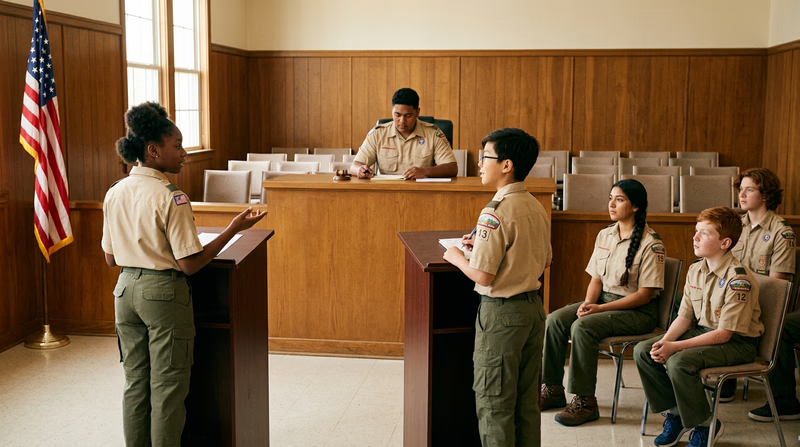
Req 6 — Courtroom Experience
Option A: Attend a Court Session
Watching a real court proceeding is one of the most eye-opening parts of this merit badge. Courtrooms are open to the public, and you do not need a reservation or invitation — just walk in, sit quietly, and observe.
How to Find a Court Session
- Check your local courthouse website for a schedule of hearings and trials. Most county courts post daily calendars online.
- Call the clerk of court and ask when public hearings are scheduled. Tell them you are a Scout working on the Law merit badge — they are usually very helpful.
- Ask your merit badge counselor if they know of any upcoming cases that would be good to observe.
What to Look For
As you watch, pay attention to these elements:
Courtroom Observation Guide
Things to notice during a court session
- The judge: How do they manage the courtroom? What decisions do they make?
- The attorneys: How do the lawyers for each side present their arguments? What is their style?
- The defendant: Are they present? Do they speak?
- The jury (if present): How many jurors are there? What do they seem to pay attention to?
- Courtroom procedures: Does the judge explain any rules? Are objections raised?
- The courtroom layout: Where does everyone sit? Who is present besides the main participants?
- The outcome: Is a verdict reached, or is the case continued to another date?
Writing Your 250 Words
After your visit, write about what you observed. Focus on:
- What type of case it was (civil or criminal)
- What happened during the session
- What surprised you or stood out
- How the experience changed your understanding of the legal system
Option B: Plan and Conduct a Mock Trial
A mock trial is a simulated court case where you and your group play the roles of judge, lawyers, witnesses, jurors, and defendant. It is a fantastic way to learn how the legal system works by doing it yourself.
Planning Your Mock Trial
Step 1: Choose a Case
You can make up a scenario or use a pre-written case. Good mock trial scenarios are simple enough to understand but have enough evidence on both sides to make the outcome uncertain. Examples:
- A student is accused of plagiarizing a school paper
- A neighbor is accused of letting their dog damage someone’s garden
- A store owner claims a customer shoplifted
Step 2: Assign Roles
Mock Trial Roles
Every mock trial needs these participants
- Judge: Runs the trial, rules on objections, and instructs the jury.
- Prosecutor/Plaintiff’s attorney: Presents the case against the defendant.
- Defense attorney: Represents the defendant and argues their innocence.
- Defendant: The person accused of the wrongdoing.
- Witnesses (2–4): Testify about what they saw, heard, or know.
- Jury (6–12): Listens to all evidence and decides the verdict.
- Bailiff: Calls the court to order and swears in witnesses.
Step 3: Follow Courtroom Procedure
A simplified trial follows this order:
- Bailiff calls the court to order
- Opening statements — prosecution/plaintiff goes first, then defense
- Prosecution/plaintiff presents witnesses — direct examination, then cross-examination by defense
- Defense presents witnesses — direct examination, then cross-examination by prosecution
- Closing arguments — prosecution/plaintiff goes first, then defense
- Judge instructs the jury on how to evaluate the evidence
- Jury deliberates and reaches a verdict
- Verdict is announced
Step 4: Discuss the Experience
After the verdict, discuss these questions with your group:
- Was the verdict fair? Why or why not?
- What was the strongest evidence on each side?
- What was it like to play your role?
- What did you learn about how the justice system works?