Req 12 — Escape Techniques
This is the requirement that could save your life as a rescuer. No matter how careful you are — no matter how well you use lead-and-wait and buoyant aids — there may come a moment when a panicking victim grabs you. If that happens, you need to know how to break free immediately, before they push you underwater.
The Principle Behind Every Escape
Every escape technique is built on one simple fact: a panicking victim wants to stay at the surface. If you submerge, they will let go. Their survival instinct forces them to push away from anything that is going down and reach for anything that is going up.
This means your escape strategy always starts the same way:
- Take a deep breath. You are about to go underwater.
- Tuck your chin. Protect your airway.
- Submerge. Push yourself down.
- Break the grip using the specific technique for that hold.
- Swim away underwater and resurface at a safe distance.
- Reassess and try again — this time with a buoyant aid and better positioning.
Wrist Grab Escape
A victim grabs your wrist as you extend your arm toward them.
Technique:
- Take a breath and submerge. Go down.
- Rotate your wrist toward the victim’s thumb. The thumb is the weakest point in any grip.
- Pull sharply in the direction of their thumb gap. Your wrist will slide free.
- Swim away underwater — at least 6 feet — and resurface.
Key detail: Always turn toward the thumb. Even if a person has a crushing grip, the opening between their thumb and fingers is a natural weak point that you can exploit.
Front Head Hold Escape
A victim facing you wraps both arms around your head and shoulders, pressing you against their chest.
Technique:
- Take a breath and tuck your chin against the victim’s chest. This protects your airway.
- Submerge. Push yourself downward by bending at the waist and driving your hips under the victim.
- Place both hands on the victim’s hips and push them away from you as you go deeper.
- Turn the victim as you push — spin them so their back is toward you.
- Swim away underwater behind them and resurface at a safe distance.
- If possible, transition to a rear approach position for a safer rescue attempt.
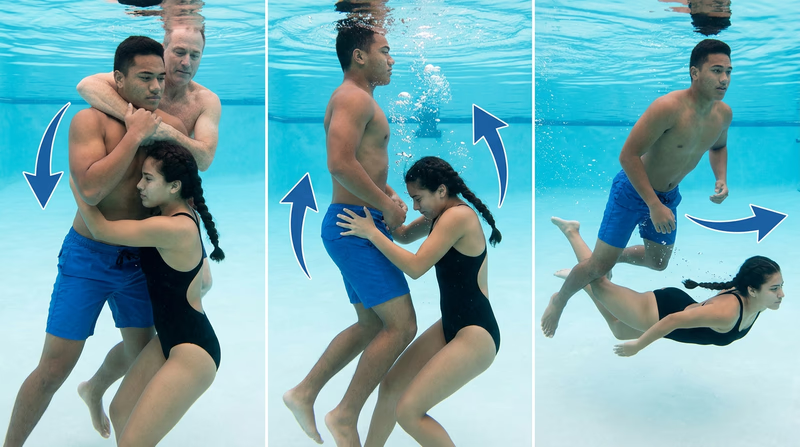
Rear Head Hold Escape
A victim behind you wraps both arms around your head and shoulders from the rear.
Technique:
- Take a breath and tuck your chin. The victim’s arms are around your neck from behind — tucking your chin protects your airway and creates space.
- Submerge. Drive yourself downward.
- Grab the victim’s elbow (the arm that is highest or most constraining) with both hands.
- Push the arm up and over your head while you duck under it.
- Spin to face the victim as you come free. Keep hold of their arm.
- Push them away and swim to a safe distance.
- Resurface behind or to the side of the victim.
After the Escape
Breaking free is only half the job. Once you have escaped:
- Catch your breath. You just performed an intense maneuver underwater. Take a moment.
- Reassess the situation. Is the victim still active? Have they tired out? Are they unconscious now?
- Get a buoyant aid if one is available. Do not approach again without one.
- Use lead-and-wait if the victim is still actively panicking.
- Approach from the rear if you must make contact again. The rear approach gives you the most control and the least chance of being grabbed.
Common Mistakes
Escape Pitfalls
Errors that can get you trapped
- Trying to break free at the surface — you must submerge first
- Forgetting to take a breath before going under
- Not tucking your chin — leaving your throat exposed to compression
- Surfacing too close to the victim — they will grab you again
- Panicking yourself — stay calm, trust your training, and execute the technique
- Giving up after one failed attempt — try again, go deeper