Req 14 — Submerged Victim Recovery
When a victim goes under before you reach them, the rescue becomes a recovery — and the stakes could not be higher. The window between submersion and irreversible brain damage is only 4–6 minutes. Your ability to pinpoint where they went down, dive to the bottom, and bring them back to the surface can determine whether they survive.
When a Victim Submerges
If you are swimming toward a victim and they go under before you arrive, here is what you should do:
- Mark the spot. Pick a landmark on shore — a tree, a sign, a dock post — and line it up with the spot where the victim was last seen. If possible, pick two landmarks (one on each side) to create a cross-reference.
- Swim to the last-seen location as fast as possible. Use a strong crawl stroke.
- Upon arrival, perform a surface dive to search the bottom.
- Search systematically. Start at the last-known position and expand outward in a circle.
- If you do not find them on the first dive, surface, breathe, and dive again. Repeat.
- Call for help. Make sure 911 has been called. Professional divers and equipment may be needed.
Surface Dives: Two Types
A surface dive is how you transition from swimming at the surface to swimming toward the bottom. Both types get you to the same place — the difference is how you enter the dive.
14a — Feetfirst Surface Dive
The feetfirst surface dive is the safer of the two methods. You enter vertically, feetfirst, which means you can see what is below you on the way down and you will not hit your head on an unseen obstacle.
Step by step:
- Tread water at the surface over the target area.
- Press both arms downward powerfully against the water — this pushes your body upward.
- As your body rises, squeeze your legs together and straighten them below you.
- Let your body sink feetfirst. Keep your arms at your sides to reduce drag.
- Once submerged, use a sweeping arm motion (like a breaststroke pull) to push yourself deeper.
- When you reach the desired depth, tuck your body and roll forward to swim horizontally along the bottom.
- Search with your hands if visibility is low. Feel along the bottom.
- Grab the weight (or victim) and push off the bottom toward the surface.
14b — Headfirst Surface Dive (Pike Dive)
The headfirst surface dive (also called a pike dive) gets you to the bottom faster because you are streamlined — head pointed down, body straight. However, it requires clear visibility to avoid hitting your head on the bottom or an obstacle.
Step by step:
- Swim forward with a breaststroke or crawl stroke at the surface.
- At the dive point, bend sharply at the waist — pike your body so your head points straight down.
- Lift your legs out of the water — the weight of your legs above the surface drives you downward.
- Extend your arms in front of you (toward the bottom) in a streamlined position.
- Once fully submerged, use a breaststroke pull to propel yourself deeper.
- Level off at the bottom and search.
- Grab the weight (or victim) and swim toward the surface.
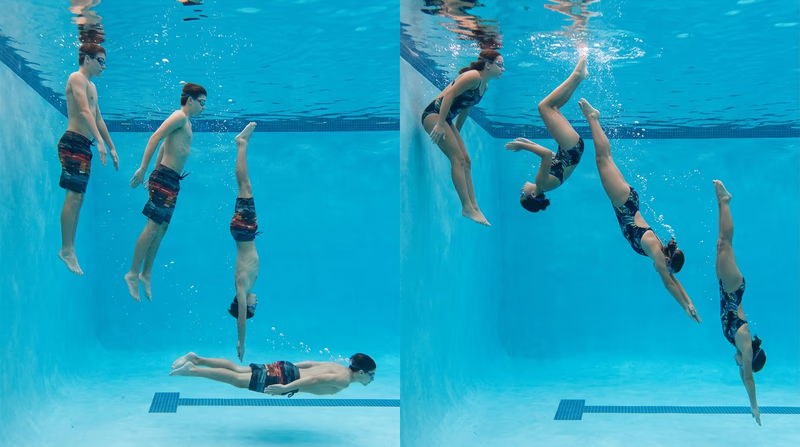
Comparing the Two Dives
| Element | Feetfirst | Headfirst (Pike) |
|---|---|---|
| Entry position | Vertical, feet down | Bent at waist, head down |
| Speed to depth | Slower | Faster |
| Visibility on descent | Good — you can see below | Limited — head is pointed down |
| Risk of head injury | Low | Higher in shallow or unclear water |
| Best for | Unknown depth, murky water | Clear water, known depth |
| Starting position | Treading water | Swimming forward |
Tips for the 10-Pound Weight Recovery
The requirement asks you to recover a 10-pound weight from 8–10 feet of water. Here is how to succeed:
Weight Recovery Tips
Set yourself up for success
- Equalize the pressure in your ears on the way down by pinching your nose and gently blowing (Valsalva maneuver). Ear pain will stop your dive short.
- Exhale slowly on the way up — never hold your breath tightly during ascent.
- Grab the weight securely with both hands before pushing off the bottom.
- Push off the bottom with your feet for an extra boost toward the surface.
- Kick hard on the way up — 10 pounds feels much heavier underwater than on land.
- Practice your dives multiple times at shallower depths before attempting the full 8–10 feet.