Req 15 — Spinal Injury Management
A spinal injury in the water is one of the most dangerous situations you can encounter — not because of the water, but because of what happens next. Moving a person with a spinal injury incorrectly can cause permanent paralysis or death. Your job as a rescuer is to stabilize the victim’s head and spine, keep them breathing, and wait for professional medical help.
15a — Causes, Signs, and Symptoms
Common Causes of Spinal Injury in Aquatic Settings:
- Diving into shallow water — the most common cause. A person dives headfirst and strikes the bottom, a sandbar, or a submerged object.
- Diving off elevated surfaces — diving boards, rocks, docks, or cliffs into water of unknown depth.
- Falls — slipping on a wet pool deck, falling off a boat, or falling from a waterside cliff.
- Being struck — hit by a boat, surfboard, watercraft, or another swimmer.
- Being tumbled by waves — large surf can slam a person headfirst into the sand.
Signs and Symptoms to Watch For:
Spinal Injury Indicators
If you see any of these, suspect a spinal injury
- Pain in the neck or back
- Numbness, tingling, or loss of sensation in the arms, legs, or fingers
- Inability to move arms or legs (“I can’t feel my legs”)
- Deformity — the neck or back looks misaligned
- Bruising or swelling on the head, neck, or upper back
- Loss of bladder or bowel control
- Altered consciousness or confusion after a head impact
- Victim found unconscious in the water after a diving or falling incident
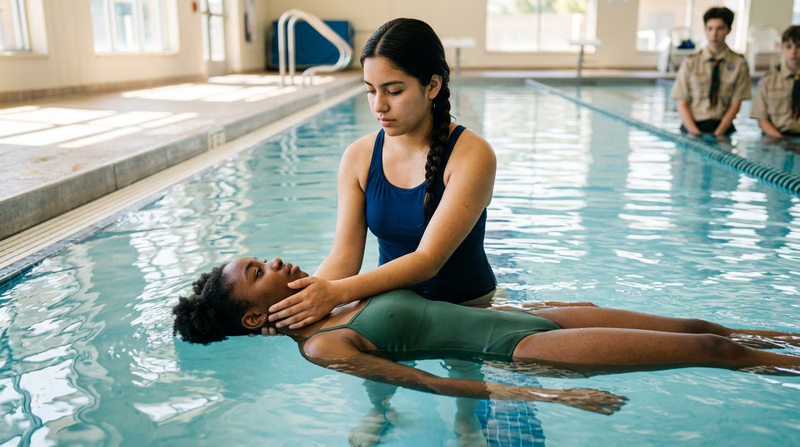
15b — Supporting a Faceup Subject
This technique is called in-line stabilization. You keep the victim’s head, neck, and spine in a straight line while supporting them at the surface in standing-depth water.
Step by step:
- Approach the victim carefully — do not create waves or disturbance that could move them.
- Position yourself at the victim’s head. Stand behind them (at the top of their head).
- Place your hands on either side of the victim’s head — one hand on each side, fingers supporting the back of the skull, palms against the ears.
- Gently squeeze your forearms against the victim’s upper arms/shoulders. This traps the head between your forearms and creates a “splint” effect.
- Keep the head, neck, and body in a straight line. Do not tilt, bend, or rotate.
- Lower yourself so that the victim’s head and body float at the surface. The water provides buoyancy — you provide stability.
- Hold this position and wait for help. Do not move the victim unless they are in immediate danger (e.g., the water is rising).
15c — Turning a Facedown Subject Faceup
A facedown victim with a potential spinal injury cannot breathe. You must turn them faceup — but you must do it without bending or twisting their spine. This technique is called a log roll or vice grip turn.
Step by step:
- Approach the victim at their side, near their head.
- Place one arm along the victim’s spine — your forearm along their back, your hand supporting the base of their skull.
- Place your other arm along the victim’s chest — your forearm across their breastbone, your hand supporting their chin.
- Clamp your arms together, trapping the victim’s head between your forearms. This is the “vice grip.”
- Slowly roll the victim toward you, rotating their entire body as a single unit. Do not let the head move independently of the body.
- Continue the rotation until the victim is faceup.
- Transition to the faceup support position — both hands supporting the head, forearms bracing the shoulders.
- Ensure the victim’s face is clear of the water and check for breathing.
Critical Rules for Spinal Management
Do's and Don'ts
Absolute rules when managing a suspected spinal injury
- DO call 911 immediately — this is a medical emergency beyond your training to fully manage
- DO keep the victim still — movement is the enemy
- DO support the head and neck at all times
- DO keep the victim in the water until professional help arrives (the water supports the body and reduces movement)
- DO NOT bend, twist, or rotate the victim’s neck
- DO NOT pull the victim out of the water unless they are in immediate danger or not breathing (and you must perform CPR)
- DO NOT remove a helmet (cycling, skiing) if the victim is wearing one — it provides stabilization
- DO NOT let bystanders move the victim