Req 2 — Swimming Prerequisites
Lifesaving is built on top of strong swimming. You cannot rescue someone in the water if you are struggling yourself. That is why these two prerequisites must be completed before you begin any of the rescue requirements (3–15).
Why Swimming Comes First
Imagine trying to tow an exhausted swimmer to shore while fighting to keep your own head above water. It would not work — and it would put both of you in danger. A rescuer must be a confident, capable swimmer who can cover distance efficiently and still have energy left when they arrive.
The 400-yard continuous swim is not just a test — it is a benchmark that proves you have the endurance and technique to handle real rescue situations.
The Four Strokes You Need
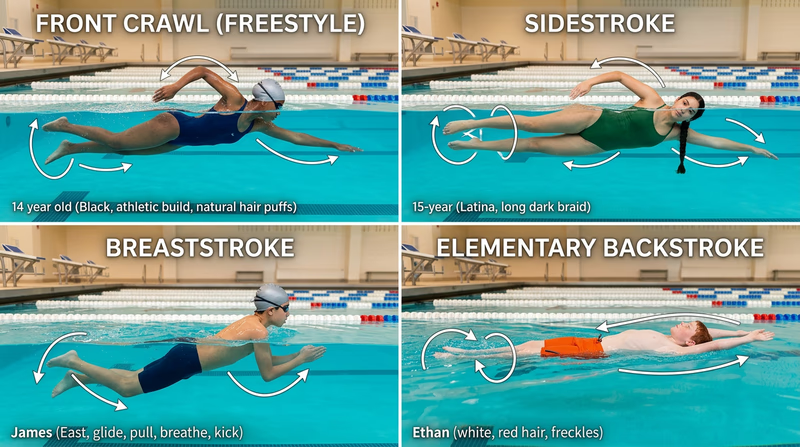
Each of the four required strokes has a specific role in lifesaving. Understanding why each stroke matters will help you appreciate the 400-yard swim as more than just a fitness test.
Front Crawl (Freestyle) — This is your fastest stroke and the one you will use for the approach — getting to a victim as quickly as possible. Speed matters when someone is struggling. Your head-up front crawl variation lets you keep eyes on the victim while swimming toward them.
Sidestroke — This is the workhorse of water rescue. The sidestroke lets you swim on your side with one arm free — perfect for towing a victim or carrying a rescue device. You will use this stroke more than any other during actual rescues.
Breaststroke — A slower, energy-efficient stroke that keeps your head above water naturally. This is valuable for approaching a victim when you need to maintain visual contact and assess the situation. It is also useful in choppy water where breathing with a crawl stroke is difficult.
Elementary Backstroke — This is your rest stroke. When you are tired from a rescue, you can roll onto your back and use this stroke to recover while still making progress toward shore. It is also used in some towing techniques where you pull a victim while swimming on your back.
What “Strong Manner” and “Good Form” Mean
Your counselor is looking for more than just getting from one end of the pool to the other. Here is what strong, good-form swimming looks like:
Stroke Quality Checklist
What your counselor will evaluate
- Rhythmic breathing: Consistent breathing pattern that does not interrupt your stroke
- Smooth transitions: No stopping or standing between stroke changes
- Efficient kick: Kick generates propulsion without wasted energy
- Proper arm mechanics: Full extension and pull-through on each stroke
- Body position: Streamlined in the water, not dragging legs or lifting head too high
- Endurance: 400 yards without stopping, resting, or touching the bottom
Building Your Endurance
If you are not yet able to swim 400 continuous yards, do not worry — that is exactly what training is for. Here are some ways to build up:
- Start with distance, not speed. Swim at a comfortable pace and add 50 yards to your total each week.
- Practice stroke transitions. Switch between strokes smoothly — you will need to do this during the test and during rescues.
- Train the sidestroke. Many Scouts are less familiar with the sidestroke, but it is the most important stroke for lifesaving. Give it extra practice time.
- Swim with a buddy. Training is safer and more motivating with a partner.