Req 3a — Drowning Situations
Drowning does not look like what you see in the movies. There is usually no screaming, no dramatic splashing, no waving arms. It happens quietly, quickly, and in places that seem perfectly safe. Understanding where and how drowning happens is your first step toward preventing it.
Unfenced Residential Pools
Home swimming pools are the number one location for drowning among children under age five. A backyard pool without a fence is an open invitation for unsupervised children to wander in. Even for older kids and adults, residential pools often lack lifeguards, rescue equipment, and clear safety rules.
How to avoid it:
- Pools should be surrounded by a four-sided fence at least four feet high with a self-closing, self-latching gate.
- Never swim alone in a residential pool — the buddy system applies everywhere.
- Keep rescue equipment (a reaching pole and a ring buoy) beside the pool at all times.
Drop-Offs
A drop-off is a sudden change in water depth. You might be wading in knee-deep water and take one more step into water over your head. Drop-offs are common at lakes, rivers, and ocean beaches where sandbars shift. They catch people off guard — especially non-swimmers who thought they were in safe, shallow water.
How to avoid it:
- Never assume water stays shallow. Test the depth ahead of you before wading further.
- Swim only in areas where the bottom has been checked and boundaries are marked.
- Watch for changes in water color — darker water usually means deeper water.
River Currents
Rivers flow, and that flow creates currents that can overpower even strong swimmers. Foot entrapment — getting a foot stuck between rocks on a river bottom — is one of the most dangerous situations in moving water. The current pushes against your body while your foot holds you in place, forcing you underwater.
How to avoid it:
- Never try to stand or walk in river water above your knees if there is any current.
- If you fall into a river, float on your back with your feet downstream to fend off obstacles. Do not try to stand until the water is very shallow and slow.
- Stay away from strainers (fallen trees, fences, or debris that let water pass through but trap objects — and people).
Rip Currents
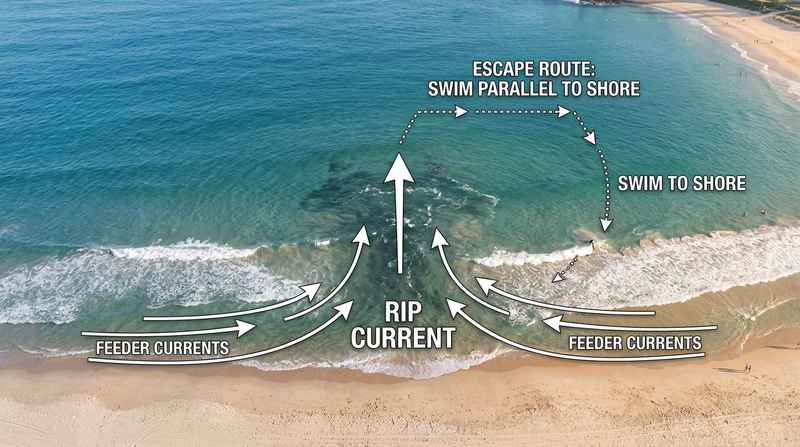
A rip current is a narrow, powerful channel of water flowing away from shore at a beach. Rip currents form when waves push water onto the beach and it needs a path back out to sea. They can pull swimmers hundreds of yards from shore in less than a minute.
How to avoid it:
- Learn to spot rip currents: look for a channel of choppy, discolored water flowing seaward, a break in the wave pattern, or a line of foam or debris moving out.
- Swim at beaches with lifeguards and ask about conditions before entering the water.
- If caught in a rip current, do NOT swim directly back to shore. Swim parallel to the beach until you are out of the current, then swim in at an angle.
Medical Emergencies
Sometimes drowning is caused by a medical event that happens in or near the water. A seizure, a heart attack, a severe allergic reaction, or a diabetic emergency can all cause a person to lose consciousness and slip underwater. Alcohol and drugs are also major factors — they impair judgment, coordination, and reaction time.
How to avoid it:
- Complete the personal health review before swimming activities.
- Never swim under the influence of alcohol, drugs, or any medication that causes drowsiness.
- People with seizure disorders or heart conditions should always have a buddy who knows their condition and what to do.
- Keep a first-aid kit and an AED (if available) near every swimming area.
Other Common Scenarios
Beyond the situations listed in the requirement, be aware of:
- Unsupervised children: A child near any body of water without a watchful adult is at risk. Supervision means dedicated, undistracted attention — not glancing up from a phone.
- Hyperventilation before diving: Some swimmers deliberately hyperventilate to hold their breath longer. This can cause shallow-water blackout — unconsciousness underwater with no warning.
- Cold-water shock: Jumping into cold water triggers an involuntary gasp reflex that can fill your lungs with water in seconds.