Req 3d — Adapting Rescue Techniques
You have learned the Reach-Throw-Row-Go sequence, but rescue is not a one-size-fits-all operation. The method you use depends on two key factors: where the emergency is happening and what condition the victim is in. A tired swimmer at the edge of a pool requires a very different response than an unconscious person in the middle of a lake.
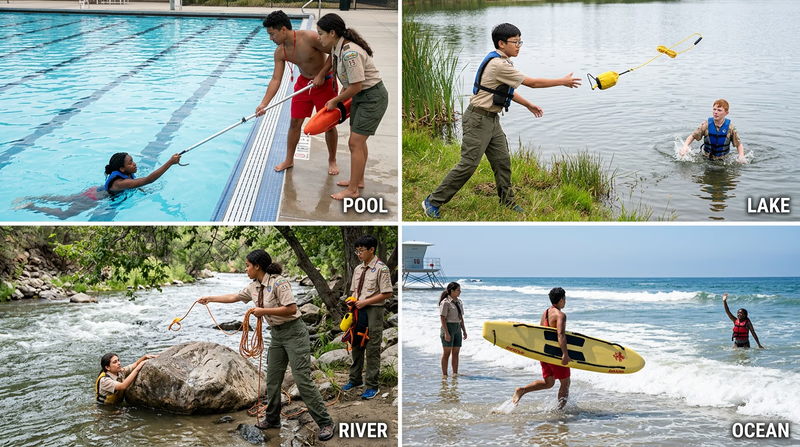
How Setting Changes Your Approach
Swimming Pools:
- Clear water, known depth, rescue equipment nearby
- Reaching rescues are almost always possible — the edge is never far
- Ring buoys, reaching poles, and backboards are typically available
- Getting the victim out of the water is relatively easy (ladders, gutters, deck)
Lakes and Ponds:
- Murky water — you may not be able to see the victim if they submerge
- Soft, uneven bottoms with potential drop-offs
- Shoreline may be muddy, rocky, or overgrown — harder to perform reaching rescues
- Greater distances to cover; throwing rescues require more accuracy
- Water temperature may be significantly colder than air temperature
Rivers and Streams:
- Current adds a time-critical element — the victim is moving downstream
- Foot entrapment risk makes wading dangerous
- Position yourself downstream of the victim if possible when throwing a line
- Eddies (calm spots behind rocks) can be used as rescue zones
- Never attempt a swimming rescue in moving water without specialized training
Ocean Beaches:
- Rip currents can carry both victim and rescuer away from shore
- Breaking waves can disorient and exhaust a rescuer
- Sand bars create false bottoms that disappear suddenly
- Rescue boards and fins significantly improve a rescuer’s capability in surf
How the Victim’s Condition Changes Your Approach
The same body of water can require completely different rescue techniques depending on whether the victim is conscious, unconscious, calm, or panicking.
Distressed Swimmer (Conscious, Still Responsive):
- Can hear and follow directions
- May be able to grab a thrown device or swim toward a reaching aid
- Talk to them! Calm, clear instructions make a huge difference: “I see you — grab the ring — kick your feet!”
- A reaching or throwing rescue is usually sufficient
Active Drowning (Conscious, Instinctive Response):
- Cannot follow instructions
- Will instinctively grab anything — including you
- Keep a buoyant object between you and the victim at all times
- If you must swim to them, approach from behind to avoid being grabbed
- Time is extremely limited — act fast but smart
Passive Drowning / Unconscious:
- No response to voice or splash
- May be facedown or just below the surface
- You will likely need to enter the water — reaching and throwing will not work if they cannot grab anything
- Speed is critical — get them out and begin resuscitation
- Support the head and neck in case of spinal injury (especially in shallow-water incidents)
Submerged Victim:
- Victim has already gone under
- Mark the last known location — use a landmark on shore as a reference
- Surface dives may be necessary
- Call 911 immediately — professional rescue teams are needed
- Do not risk your own life searching in deep or murky water
Matching Method to Situation
Here is a quick reference for how setting and condition combine to shape your rescue:
| Situation | Best Method | Key Concern |
|---|---|---|
| Conscious victim near pool edge | Reach | Quick, easy, keep them calm |
| Conscious victim far from shore | Throw | Accuracy of throw, clear instructions |
| Active drowning, 30 ft from shore | Go with buoyant aid | Keep aid between you and victim |
| Unconscious victim in open water | Go with rescue approach | Speed, spinal precaution |
| Victim in river current | Throw from downstream | Current speed, rope management |
| Victim caught in rip current | Direct them to swim parallel | Communicate if possible |