Req 4 — Reaching Rescues
4.
Demonstrate “reaching” rescues using various items such as arm, leg, towels, shirts, paddles, poles.
Reaching rescues are the first method in the Reach-Throw-Row-Go sequence — and for good reason. They are the safest type of rescue because you never leave solid ground. Your feet stay planted on the pool deck, dock, or shoreline while you extend something for the victim to grab.
The Golden Rule of Reaching
Get low, stay anchored, and extend. Every reaching rescue follows this pattern:
- Get low. Lie flat on your stomach or drop to one knee. This lowers your center of gravity so you cannot be pulled in.
- Anchor yourself. Grab something solid with your free hand — a dock post, a pool ladder, a tree root. If nothing is available, have a bystander hold your belt or ankles.
- Extend the reach. Stretch your arm, leg, or object toward the victim.
- Pull slowly and steadily. Once the victim has a grip, pull them in smoothly. Do not yank — you could lose your grip or pull the object away from them.
Reaching Tools — From Your Body to Your Environment
The beauty of a reaching rescue is that you can use almost anything. Here are the most common reaching aids, roughly in order from simplest to most effective:
Your Arm or Leg:
- Lie flat on the deck or dock and extend your arm toward the victim.
- If the victim is slightly farther, extend your leg — your reach is longer.
- Only use your body as a reaching tool when the victim is very close (within about 3 feet) and you are firmly anchored.
A Towel or Shirt:
- Roll or twist a towel or shirt into a rope-like shape.
- Hold one end firmly and extend or toss the other end to the victim.
- The victim grabs one end while you pull from the other.
- A wet towel is easier to throw accurately because the added weight keeps it straighter.
A Paddle or Oar:
- Extend the flat blade end toward the victim — it provides a larger surface to grab.
- Hold the handle end with both hands for a strong grip.
- Be careful not to hit the victim — extend slowly and let them grab on.
A Pole or Branch:
- Shepherd’s crooks (the long poles with a hook at the end found at many pools) are ideal.
- A long tree branch works in natural settings.
- The longer the pole, the farther you can reach — but the harder it is to control.
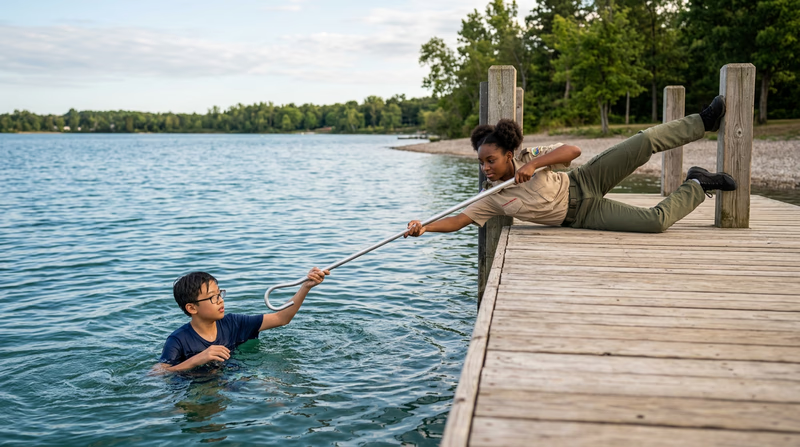
Step-by-Step: Reaching Rescue with a Pole
Here is a detailed walkthrough of the most common reaching rescue:
- Spot the victim and shout reassurance: “I see you — I’m going to help!”
- Get low — lie flat on your stomach near the water’s edge.
- Anchor — grab a solid object with your non-dominant hand, or have someone hold your legs.
- Extend the pole slowly toward the victim, keeping it just above the water surface.
- Guide the victim’s hand to the pole with your voice: “Grab the pole with both hands!”
- Wait for a firm grip before you start pulling.
- Pull steadily toward shore, keeping your body flat and your grip firm.
- Help them out of the water once they reach the edge.
Common Mistakes to Avoid
Reaching Rescue Pitfalls
What NOT to do
- Standing upright or kneeling at the very edge without bracing
- Extending your reach so far that you lose your balance
- Letting go of your anchor to get a few extra inches of reach
- Pulling too fast and ripping the aid out of the victim’s hands
- Hitting the victim with the reaching aid — extend gently
- Forgetting to communicate — always talk to the victim