Req 5 — Throwing Rescues
5.
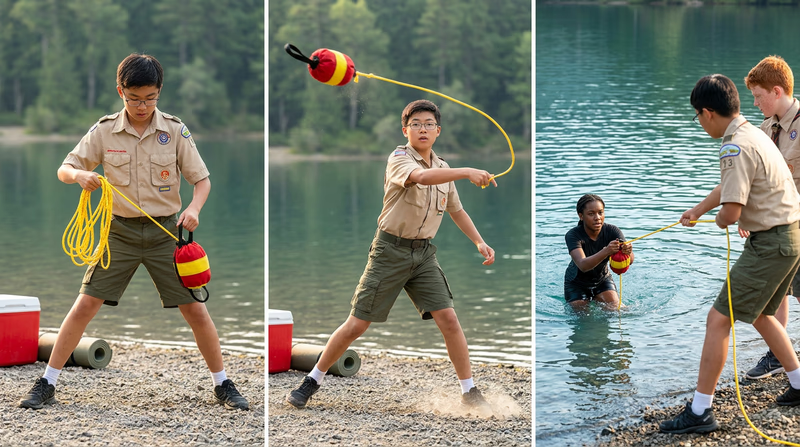
Demonstrate “throwing” rescues using various items such as a line, ring buoy, rescue bag, and free-floating support. Successfully place at least one such aid within reach of a practice victim 25 feet from shore.
When a victim is beyond your reach, the next safest option is to throw them something that floats. Throwing rescues keep you on solid ground while extending your effective rescue range to 50 feet or more. The key is accuracy — a flotation device that lands 10 feet away from a drowning person might as well be on the moon.
The Throwing Technique
Good throwing technique is surprisingly similar across different devices. Here is the universal approach:
- Plant your feet in a stable stance, one foot slightly ahead of the other.
- Coil the line (if applicable) in your non-throwing hand so it feeds out freely.
- Aim past the victim — throw beyond them so you can pull the device back to them. An overthrow is better than an underthrow.
- Use an underhand swing for ring buoys and throw bags. Overhand throws are less accurate.
- Shout instructions as you throw: “Grab the ring! Hold on!”
- Pull gently once the victim has a grip, drawing them toward shore.
Throwing Devices
Ring Buoy:
- A hard, buoyant ring (usually white or orange) with a line attached.
- Throw it underhand with a slight arc.
- Aim to land it just past the victim — then drag the line across them so they can grab it.
- Ring buoys provide excellent flotation and are easy for a victim to hold.
Rescue Bag (Throw Bag):
- A small bag filled with coiled rope that feeds out as the bag flies through the air.
- Hold the free end of the rope in your non-throwing hand.
- Throw the bag with an underhand motion — the rope uncoils behind it.
- Very accurate because the bag’s weight gives it a predictable arc.
- After use, you must re-stuff the rope back into the bag before a second throw.
Line (Rope):
- A simple coil of rope — no bag, no ring.
- Coil it neatly in your non-throwing hand and throw the coiled portion with your other hand.
- Less accurate than a throw bag, but available in almost any setting.
- The rope itself does not float (unless it is polypropylene), so the victim must grab it before it sinks.
Free-Floating Support:
- Any buoyant object: a life jacket, a cooler, a sealed empty jug, a pool noodle, a kickboard.
- Throw it as close to the victim as you can.
- No line attached — the victim must swim to it or you must direct them to it.
- Use this when you have no rope or ring buoy available.
What If You Miss?
Missing the first throw is normal, especially under pressure. Here is what to do:
- Re-coil quickly. Pull the line back, coil it, and throw again. Speed matters.
- With a throw bag: For the second throw, pull the rope out of the bag, coil it by hand, and throw the loose coil. Re-stuffing the bag takes too long in an emergency.
- Adjust your aim. If you overthrew, shorten up. If you underthrew, put more into the swing. If the wind pushed it sideways, compensate.
- Switch devices. If one device is not working, try something else.
Improvised Throwing Aids
You will not always have professional rescue equipment nearby. Here are common items you can throw in an emergency:
Improvised Flotation
Everyday items that can save a life
- Empty plastic water jug with the cap on — floats well and is easy to throw
- Sealed cooler — significant buoyancy, visible in the water
- Plastic storage bin with the lid on — floats and provides a large surface to grab
- Basketball or soccer ball — good buoyancy, easy to throw accurately
- Empty milk gallon jug — lightweight and very buoyant
- Pool noodle — does not throw far, but excellent flotation if victim is close