Req 6 — Rowing Rescue
6.
With your counselor’s approval, view in-person or on video a rowing rescue performed using a rowboat, canoe, kayak, or stand up paddleboard. Discuss with your counselor how effectively and efficiently the rescue was performed.
The “Row” step in Reach-Throw-Row-Go uses a watercraft to bring the rescuer close to the victim without entering the water. A boat, canoe, kayak, or stand up paddleboard gives you speed, stability, and a large buoyant platform — advantages that swimming simply cannot match.
Why Rowing Rescues Work
A rowing rescue bridges the gap between shore-based methods (reach and throw) and the most dangerous option (swimming). Here is why watercraft are so effective:
- Speed: A rowboat or kayak can cover 50–100 feet of water in seconds — far faster than swimming.
- Stability: The watercraft provides a platform the victim can hold onto without climbing on top of the rescuer.
- Equipment transport: You can bring rescue devices, first-aid supplies, and even a backboard with you.
- Reduced contact danger: The hull of the boat stays between you and a panicking victim.
How a Rowing Rescue Works
While you are observing (in person or on video), watch for these key elements:
Approach:
- The rescuer approaches from downwind or downcurrent so the boat drifts toward the victim, not away.
- The approach is controlled — coming in too fast risks hitting the victim with the bow.
- The rescuer keeps eyes on the victim at all times.
Contact:
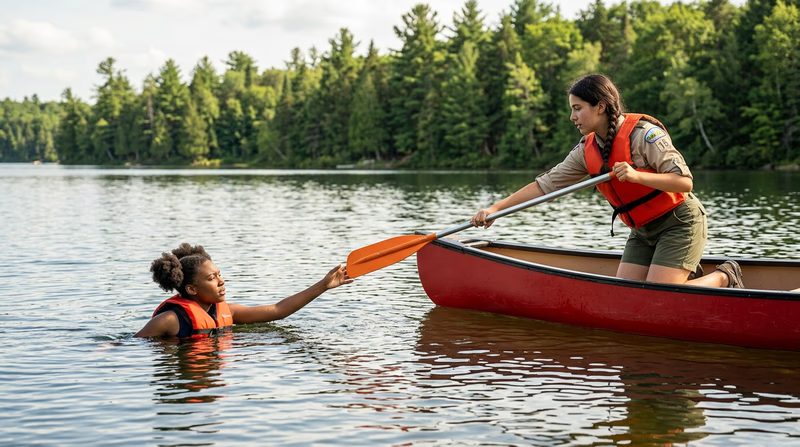
- The rescuer extends an oar, paddle, or rescue device from the boat — never reaches over the side with bare hands toward an active victim.
- The rescuer positions the boat so the victim can grab the stern (back) or gunwale (side) without capsizing the craft.
- Communication is constant: “Grab the end of the paddle. Hold on. I’m going to pull you in.”
Recovery:
- For a canoe or kayak, the victim holds onto the side while the rescuer paddles to shore. Pulling the victim into a small boat risks capsizing.
- For a rowboat, the victim may be pulled over the stern (the flattest, most stable point).
- For a stand up paddleboard, the victim holds the tail while the rescuer paddles prone (lying down) to shore.
What to Look For in the Video or Demonstration
When you observe the rowing rescue, pay attention to these details — your counselor will want to discuss them:
Observation Checklist
Key elements to evaluate
- Did the rescuer approach from the correct direction (downwind/downcurrent)?
- Was the approach speed appropriate — controlled, not too fast?
- Did the rescuer maintain visual contact with the victim throughout?
- Did the rescuer use equipment (paddle, oar) to make initial contact, or did they reach with bare hands?
- Was the boat positioned to avoid capsizing when the victim made contact?
- Did the rescuer communicate clearly with the victim?
- Was the victim brought to shore safely without being pulled into the craft (for small boats)?
- How long did the rescue take from start to finish?
- What would you have done differently?
Watercraft Strengths and Limitations
| Watercraft | Strengths | Limitations |
|---|---|---|
| Rowboat | Most stable, can carry equipment and multiple people | Slowest to maneuver, rower faces away from victim |
| Canoe | Good capacity, can be paddled solo or tandem | Less stable, risk of capsizing with an active victim |
| Kayak | Fast, maneuverable, one-person operation | Very limited space, easy to capsize, hard to assist victim aboard |
| Stand Up Paddleboard | Extremely fast when paddled prone, low profile in surf | No sides for victim to grab, unstable in rough water |