Req 7 — Go Rescue Aids
When you must enter the water to rescue someone — the “Go” in Reach-Throw-Row-Go — never go empty-handed. Bringing a rescue aid with you dramatically increases the safety of the rescue for both you and the victim. The type of aid you bring can mean the difference between a controlled rescue and a dangerous struggle.
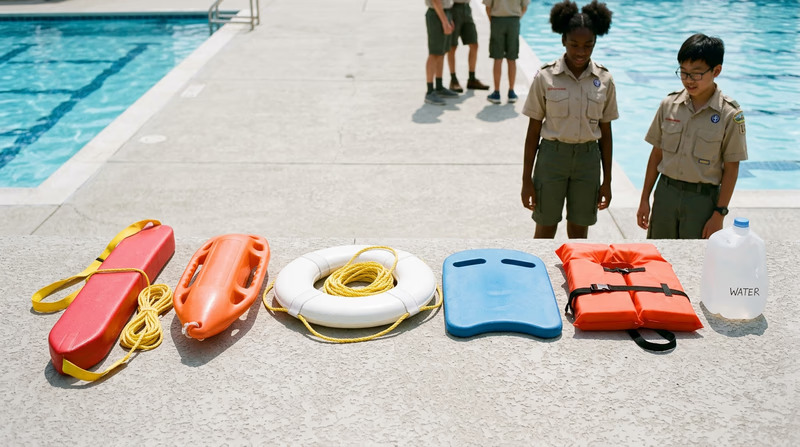
Buoyant Aids
Buoyant aids float. They provide additional support for both the rescuer and the victim, and they create a physical barrier between you and a panicking person.
Rescue Tube:
- A long, flexible foam tube (usually red or orange) with a strap and tow line.
- The standard tool for professional lifeguards.
- Can be wrapped around a victim’s chest or held between rescuer and victim.
- Provides enough buoyancy to support two people.
Rescue Buoy (Torpedo Buoy):
- A hard, torpedo-shaped plastic float with handles and a tow line.
- The victim grabs the handles while the rescuer tows with the shoulder strap.
- Extremely buoyant and easy to present to a victim.
Ring Buoy:
- Can be thrown from shore or carried into the water.
- The victim holds onto the ring while the rescuer tows or swims alongside.
Kickboard:
- A pool training tool, but it floats and can be held between you and the victim.
- Not as buoyant as a rescue tube, but widely available at any pool.
Life Jacket / PFD:
- A spare life jacket can be handed to the victim for instant flotation.
- Requires the victim to be calm enough to put it on or at least hold it.
Improvised Buoyant Aids:
- Empty plastic jugs with caps sealed
- Sealed cooler
- Pool noodles (limited buoyancy but better than nothing)
- An inflated beach ball or inner tube
- Any air-filled, sealed container
Nonbuoyant Aids
Nonbuoyant aids do not float, but they still serve an important purpose: they extend your reach in the water and provide something the victim can grab that is not your body.
Towel or Shirt:
- Extend one end to the victim while you hold the other.
- Useful for towing a calm, cooperative victim.
- Sinks eventually, so must be used quickly.
Belt or Strap:
- Similar to a towel — extend one end to the victim.
- Stronger and less likely to rip than a wet shirt.
Rope or Line:
- Can be used to tow a victim while you swim.
- Must be careful not to entangle yourself or the victim.
Why Buoyant Aids Are Preferred
This is the core of the requirement, and there are several clear reasons:
1. Flotation for the victim. A panicking victim’s primary need is to keep their head above water. A buoyant aid meets that need instantly. The moment the victim grabs a rescue tube or buoy, they can breathe — and a victim who can breathe can start to calm down.
2. Separation from the victim. A buoyant aid placed between you and the victim acts as a barrier. The victim grabs the aid instead of grabbing you. This is critical because a panicking person will instinctively climb on top of anything — including their rescuer — pushing them underwater.
3. Energy conservation. Swimming while towing a person is exhausting. A buoyant aid supports the victim’s weight, meaning you are only towing the drag of the aid through the water — not carrying a person.
4. Support for the rescuer. If you become fatigued during the rescue, a buoyant aid keeps both of you afloat while you rest and recover.
5. Works with unconscious victims. An unconscious victim cannot grab a towel or hold a rope. But a rescue tube can be wrapped around their chest to keep them at the surface while you tow them in.
American Red Cross — Lifeguarding Resources Information about lifeguard training, including the equipment used in professional water rescue.