Req 8 — Buoyant Aid Rescues
This is where your training shifts from knowledge to action. You are entering the water, swimming 30 feet to a conscious person, and performing a real rescue using buoyant aids. These two rescues teach two fundamentally different strategies — one where you let the victim save themselves, and one where you actively tow them in.
The Entry
Every swimming rescue starts with a proper water entry. You are not diving into unknown water — you are entering quickly and safely.
Stride Jump (Compact Entry):
- Step forward off the edge with one foot leading.
- Keep your head up and eyes on the victim.
- Squeeze your legs together and press your arms down as you enter to prevent going too deep.
- This entry keeps you at the surface so you can start swimming immediately.
Do not dive headfirst. You need to maintain visual contact with the victim, and a dive takes your eyes off them.
The Approach Stroke
Use the head-up front crawl (also called the lifeguard approach) to swim to the victim. This is a modified freestyle stroke where you keep your head above water and your eyes locked on the victim. It is slightly slower than a regular crawl stroke, but you never lose sight of the person you are rescuing.
Switch to a head-up breaststroke if conditions make it difficult to breathe with the crawl (choppy water, for example).
Communicating with the Victim
Before you present any aid, talk to the victim. Communication serves three purposes:
- Assessment: “Can you hear me? Are you okay? Can you float?” — determine how much help they need.
- Instructions: “I’m going to give you a float. Grab it and hold on.” — tell them what to do.
- Encouragement: “You’re going to be fine. I’m right here.” — calm them down.
A conscious, responsive victim who hears a calm, confident voice will often stop panicking. That makes the entire rescue safer.
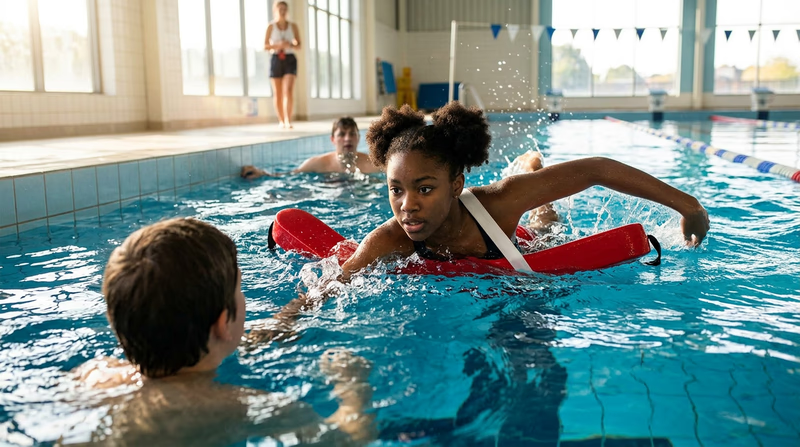
Rescue 8a — Present and Release
In this rescue, you give the buoyant aid to the victim and let them make their own way to safety. This is the safest type of swimming rescue because you maintain distance from the victim.
Step by step:
- Enter the water with the stride jump, buoyant aid in hand.
- Swim to the victim using a strong approach stroke, keeping eyes on them.
- Stop about 6 feet away. Do not swim directly to the victim — maintain a safe distance.
- Speak to the victim: “I have a float for you. I’m going to push it to you. Grab it with both hands.”
- Extend or push the aid toward the victim. Let it float to them.
- Release the aid completely. Back away to a safe distance (at least 6 feet).
- Coach them in: “Kick your feet toward shore. You’re doing great.”
- Swim alongside at a safe distance, ready to assist if needed, but not in contact.
Rescue 8b — Present and Tow
In this rescue, you keep hold of the aid and actively tow the victim to shore. This is necessary when the victim cannot swim to safety on their own — they are too tired, too scared, or the distance is too far.
Step by step:
- Enter the water with the stride jump, buoyant aid in hand (with tow line if it has one).
- Swim to the victim using a strong approach stroke.
- Stop about 6 feet away and speak to them: “Grab this and hold on tight. I’m going to pull you to shore.”
- Extend the aid to the victim. Wait for them to grab it securely.
- Begin towing using the sidestroke. If the aid has a tow line, clip the strap over your shoulder and swim. If not, hold one end while the victim holds the other.
- Swim steadily — do not sprint. Pace yourself so you can make it all the way to shore.
- Keep communicating: “Hold on. We’re almost there. Keep your chin up.”
- Assist them out of the water when you reach the edge or shallows.
Key Differences Between 8a and 8b
| Element | 8a — Release | 8b — Tow |
|---|---|---|
| Your contact with the aid | You release it | You keep holding it |
| Distance from victim | Stay 6+ feet away | Connected through the aid |
| Victim’s role | Kicks to shore independently | Holds on while you swim |
| Towing stroke | None — you swim alongside | Sidestroke with tow |
| Best for | Alert victim, close to shore | Exhausted or distant victim |